“Two steadfast commitments” - the firm political and ideological foundation for building a revolutionary, regular, elite, modern Vietnam People’s Army
At the 12th Military Party Congress for the 2025 - 2030 tenure, General Secretary (now General Secretary, State President) To Lam stressed the requirement to implement the principle of “two steadfast commitments, two accelerations, and two preventions” in order to realise the goal of building a revolutionary, regular, elite, modern Vietnam People’s Army (VPA). In this regard, the “two steadfast commitments” serve as the core political - ideological foundation enabling the VPA to preserve its revolutionary nature and remain absolutely loyal to the Fatherland, Party, State, and people in the new situation.
Theoretical and practical basis of the “two steadfast commitments”
The “two steadfast commitments” are established upon the Party’s ideological foundation and strategic thinking on military and defence affairs. In essence, they represent loyalty to and creative application of Marxism - Leninism and Ho Chi Minh Thought on military affairs, national defence, and socialist Fatherland protection. At the same time, these commitments affirm the Party’s absolute, direct leadership over the VPA in all aspects as a consistent principle, together with the thought on all-people national defence. This constitutes a system of strategic guiding principles that keeps all activities relating to VPA building on the right trajectory: national independence associated with socialism. However, “steadfast commitment” does not mean rigidity or immutability; rather, it reflects the persistent pursuit of strategic objectives in combination with flexible thinking in the implementation process. On that basis, the “two steadfast commitments” are concretised into a system of strategic contents which both deeply demonstrate the Party’s lines and effectively address the VPA internal development requirements in the new revolutionary stage.
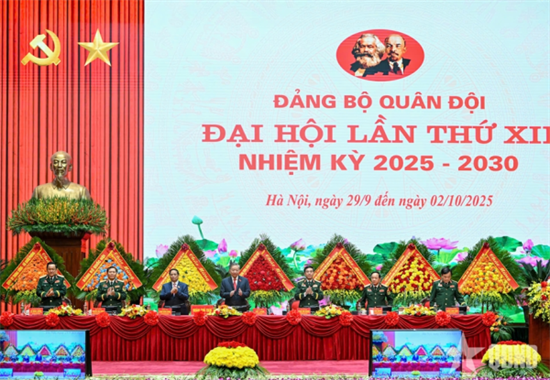 |
| 12th Military Party Congress for 2025 - 2030 tenure (photo: qdnd.vn) |
The new context and the requirement to consolidate the VPA’s political - ideological foundation in the new period. Today, “the world is undergoing rapid, complex, unprecedented changes characterised by multipolarity, multicentrality, multilayeredness, fragmentation, and sharp alignment”. International relations are increasingly intertwined and complicated, with the boundaries between partners and adversaries changing flexibly according to strategic interests, thereby posing unpredictable challenges. Alongside traditional security threats, the VPA is also facing increasingly serious non-traditional security challenges arising from cyberspace, information warfare, and psychological warfare. This rapidly evolving environment has put the vitality of the “two steadfast commitments” to the test and necessitated the VPA not only modernising its combat capability but also strengthening its political resolve. The unity between technical strength and ideological firmness constitutes the basis for the VPA to bring into full play its overall strength and successfully accomplish all assigned tasks.
Strategic connotations of the “two steadfast commitments”
Adhering to the Party’s military and defence lines. This serves as a guiding pillar that ensures unity in both thought and action across all defence and security activities. Its core content is to uphold the viewpoint of peaceful and self-defensive national defence and consistently pursuit the “four nos” defence policy: no partaking in military alliances, no siding with one country to act against another, no foreign military bases in the Vietnamese territory or using Vietnam as leverage to counteract other countries, and no using force or threatening to use force in international relations. These principles define the distinctive identity of Vietnam’s defence diplomacy. On that basis, the Party’s lines are realised through the promotion of overall strength and the close combination of national defence and socio-economic development. In this process, the “posture of people’s hearts and minds” plays a foundational role, affirming that the people are both the subject and the source of invincible strength in the cause of Fatherland protection.
Remaining steadfast in building a politically strong VPA. This is the pillar that guarantees the VPA’s revolutionary nature, people-orientated character, and national identity in all periods, serving as the basis for raising the Military’s overall quality and combat strength. The foremost requirement is to uphold the principle of the Party’s absolute, direct leadership over the VPA in all aspects - the decisive factor throughout the entire process of construction and development of the Military. In the context of modern warfare, as cyberspace, information warfare, and psychological warfare have become critical fronts, building a politically strong VPA means consolidating its internal resilience. This allows the VPA to proactively respond to the impacts of non-traditional security factors and maintain and enhance its combat readiness. On that foundation, fostering revolutionary moral qualities and the will to fight among cadres and soldiers becomes a prerequisite for successfully fulfilling all assigned tasks.
The dialectical relationship between the two steadfast commitments. The “two steadfast commitments” do not exist separately; rather, they form a unified whole characterised by dialectical interaction. The Party’s military lines provide strategic orientation, define objectives, and set the trajectory of development. Meanwhile, building a politically strong VPA creates internal strength, including political steadfastness, organisational capacity, and spiritual strength for realising those lines. This two-way interaction forms an integrated mechanism between orientation and execution, between spiritual strength and material potential. That enables the VPA to maintain high overall quality and combat strength to meet its task requirements in the new situation.
The foundational role of the “two steadfast commitments”
Guiding the building of a modern VPA. The “two steadfast commitments” ensure that the process of building a modern VPA is always carried out in the correct political direction, with a close combination between human and organisational development and the improvement of weapons, equipment, and military art. Building a modern VPA is not merely a matter of upgrading equipment, technology, or combat capability; rather, it requires the synchronous development of politics, organisation, personnel, and technology within a unified whole. If detached from the political foundation, this process may lose its strategic direction, leading to an imbalance between material capabilities and socio-political objectives. Conversely, political and ideological steadfastness acts as an “anchor” that maintains strategic stability, keeping the process of building a modern VPA on the right track, under control, and with flexible adaptability to constant changes in the new security environment.
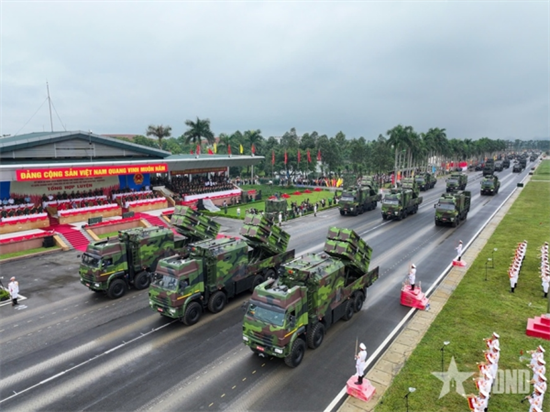 |
| Truong Son missile system researched and developed by Viettel Military Industry and Telecoms Group (photo: qdnd.vn) |
Generating political and spiritual motivation for building a modern VPA. Fundamentally, building a modern VPA begins with the modernisation of personnel, as human beings are the subjects who receive, master, and operate weaponry, equipment, and technical means. In the context of high-tech warfare, information warfare, and cyberspace operations, firm political resolve not only helps cadres and soldiers approach technology proactively, confidently, and in the right direction, but also transforms it into practical combat power. When the political foundation is solidified and scientific-technological capabilities are harmoniously combined with combat capability, it will prevent a situation of “modern equipment but limited operational capacity”. The political factor does not stand in opposition to technology; rather, it is the condition for converting technological potential into real combat power. Political steadfastness does not hinder the VPA’s modernisation process. On the contrary, it optimises the decision-making speed, minimises systemic delays, improves the forecasting quality, and enables the accurate selection of operational options in modern warfare.
Ensuring the effective execution of the “two accelerations” and “two preventions”. Successfully realising the “two steadfast commitments” will lay the groundwork for the synchronous and effective implementation of the Party’s two major orientations for developing the VPA. First, it is the acceleration of the building of a revolutionary, regular, elite, modern VPA, ensuring that this process is unified and achieves the set objectives. In the acceleration of international integration and defence diplomacy, the “two steadfast commitments” help firmly maintain independence, self-reliance, and the distinctive identity of Vietnam’s national defence. The more intensive and extensive international integration becomes, the more necessary it is to remain steadfast in strategic principles in order to minimise the risk of dependence on, or domination by foreign military doctrines and interests. Therefore, the “two steadfast commitments” both provide the foundation for expanding international cooperation and firmly sustain independence and self-reliance in building and developing the VPA. In addition, they contribute to preventing the risk of conflict early and from afar via the effective implementation of the Party’s sound defence diplomacy policy, and combating manifestations of degradation in political ideology, morality, and lifestyle, as well as “self-evolution” and “self-transformation” within the VPA.
Major solutions for realising the “two steadfast commitments”
First, improving the quality of political - ideological education to meet the requirements of VPA building in the new context. This work must be continuously renewed in a substantive and modern manner, with the building of political resolve being placed at the centre and theoretical education being closely linked with military practice and Fatherland protection. Educational content should go beyond mere knowledge dissemination; it should aim to foster critical thinking, skills for identifying, analysing, and filtering information, and the capacity to counter wrong, hostile viewpoints within a multi-dimensional information environment. As cyberspace has become a crucial front in ideological struggle, political education must take one step ahead, proactively orientate awareness and build political and ideological “resistance” among cadres and soldiers against harmful impacts and sabotage schemes by hostile forces.
Second, raising the leadership capacity and combativeness of party committees and party organisations within the Military Party Organisation. It is necessary to synchronously adopt solutions to build clean, strong, and highly capable party committees and party organisations. This requires the strict, substantive implementation of the principles of democratic centralism, self-criticism, and criticism, with priority given to inspection, supervision, and Party discipline work. Assessment of party organisations and party members must be linked to the results of fulfilling political tasks and building units. At the same time, the principle of the Party’s absolute, direct leadership over the VPA in all aspects must be further concretised and deeply grasped, as it is the vital factor ensuring consistent political orientation in all military activities.
Third, proactively preventing and fighting against degradation in political ideology, morality, and lifestyle within the Military Party Organisation and the entire VPA. This work should be conducted regularly and continuously according to the motto of taking proactive action early and from afar to prevent the emergence of systemic “weaknesses”. In the new conditions, this is not merely a matter of inspection and supervision but must become an internal defensive mechanism in which military culture serves as the foundation. Military culture may be likened to the “operating software” of the military system, while weapons and equipment constitute the “hardware”. Therefore, it is essential to build a modern military culture based on a harmonious combination of traditional values, such as patriotism and loyalty to the Fatherland and the Party, with new requirements, including technological discipline and digital thinking. This will help form a robust “immune system” for cadres and soldiers against the impacts of malicious information flows and the infiltration of foreign cultures.
Fourth, developing high-quality human resources to meet the requirements of building a revolutionary, regular, elite, modern VPA. Human beings are the decisive factor in transforming political and technological potential into actual combat power. Accordingly, it is required to thoroughly grasp and strictly execute the resolutions of the Party and the Central Military Commission, as well as the Project on “Policies to attract and utilise talents for the VPA towards 2030, with a vision to 2050”. Priority should be given to building a contingent of cadres capable of meeting their task requirements, with not only firm political willpower and sharp strategic thinking but also the ability to master modern technologies. At the same time, a favourable environment should be created to encourage the “seven dares” spirit among cadres, especially key leaders at all levels.
The “two steadfast commitments” constitute unity between the political - ideological foundation and the requirement of modernisation, serving as a mechanism to guarantee the VPA’s strategic stability and sustainable development orientation in all circumstances. Their core value does not lie merely in a system of principles but, more importantly, in the ability to translate these principles into practical operational effectiveness. This is the pathway for the VPA to both firmly preserve its revolutionary nature and make breakthroughs in modernisation.
In the new period, thoroughly grasping and creatively applying the “two steadfast commitments” is a prerequisite for building a revolutionary, regular, elite, modern VPA capable of firmly safeguarding the Fatherland early and from afar.
Associate Prof. PHAN TRONG HAO, PhD
Former Full-time Scientific Secretary of the Central Theoretical Council