Building a modern Army – A sound policy and strategic vision of the Party (Continued and Concluded)
III. Firmly grasping the opportunities, overcoming the challenges, and resolving to build a modern Military
Entering a new era of development, the nation confronts interwoven opportunities and advantages alongside difficulties and challenges. To realise the goal of building a modern Military and firmly defending the Fatherland in the new period, numerous solutions must be implemented resolutely, synchronously, and effectively, with a focus on the following principal solutions:
Firstly, strengthen the leadership of the Party and the management of the State, and raise the awareness and responsibility of all levels, sectors, forces, and the entire population in building a modern Military.
In implementing this solution, the entire Party, the entire People, the entire Military, and the whole political system continue to thoroughly grasp, and resolutely and effectively implement the Party’s resolutions and strategies on military and defence affairs and the protection of the Fatherland, above all, the 14th National Party Congress’s viewpoint on building a revolutionary, regular, elite, and modern Military; and the Resolution of the 12th Military Party Congress. On this basis, these resolutions and strategies are concretised into synchronised mechanisms, policies, programmes, plans, and legal systems, ensuring harmony between building a modern Military and building a strong, modern all-people national defence; establishing proactive and firm defensive zones; and linking them with socio-economic development, defence and security enhancement, and the acceleration of national industrialisation and modernisation, etc. Concurrently, the work of State management over national defence is effectively promoted; decentralisation and delegation of authority are strengthened in conjunction with inspection, supervision, and the control of power, ensuring that all Military-building activities proceed rigorously, in accordance with law and principle, and achieve high effectiveness.
Along with this, the leadership capacity and combat strength of Party committees and organisations within the Military must be constantly enhanced; simultaneously, the role of Party committees, authorities, ministries, sectors, and localities is promoted in concretising the Party’s guidelines and policies into plans, programmes, mechanisms, policies, and resources serving Military modernisation, ensuring that every decision on building a modern Military is implemented effectively from the Central level down to the grassroots.
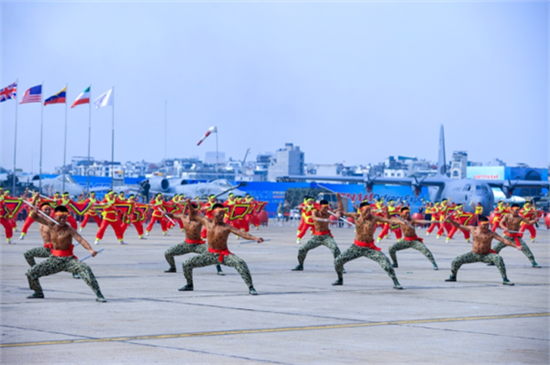 |
| VPA troops perform martial art at the opening ceremony of the Vietnam International Defence Expo 2024 (Photo:baochinhphu.vn) |
Building a modern Military is the responsibility of the entire Party, the entire People, the entire Military, and the entire political system. Therefore, it is necessary to vigorously promote propaganda and education to unify awareness regarding the position, role, objectives, content, and responsibilities of each organisation and force; thereby leveraging the comprehensive strength of socio-political organisations, enterprises, the corps of intellectuals and scientists, and the People in building defence potential, developing the defence industry, military science and technology, and the high-quality human resources required for building a modern Military.
Hand in hand with this, it is necessary to proactively identify and resolutely combat every view that “military modernisation is costly and unnecessary”, that “merely purchasing modern weapons and equipment will yield a modern Military”, or that regards this task as “the exclusive responsibility of the Military”, etc.
Secondly, concentrate on building a politically strong Military, create a firm foundation for building a modern Military and continuously raise its overall quality and combat strength.
In implementing this solution, Party committees and organisations at all levels within the Military Party Committee, together with the entire Military, continue to thoroughly grasp and strictly implement the guidelines and policies on Party building and rectification; concentrate on building a clean and strong Military Party Committee in terms of politics, ideology, ethics, organisation, and cadres; attach importance to enhancing the leadership capacity and combat strength of Party committees and organisations, particularly grassroots-level Party organisations, as well as the quality of the contingent of cadres and Party members; thoroughly grasp and effectively implement the viewpoint of “people first, weapons later” in building a modern Military; and constantly improve the quality, effectiveness, and efficiency of Party work and political work across all tasks.
Continue to innovate and further enhance the quality of political education and ideological management in a scientific and modern direction, suited to the characteristics of each group, each type of unit, and the new combat environment; closely combine traditional education with the teaching of political theory, law, discipline, revolutionary ethics, and military culture. Ensure that every cadre and soldier always possesses a deep understanding of Marxism-Leninism, Ho Chi Minh’s thought, the Party’s guidelines and viewpoints, and the Military’s ideals and fighting objectives, maintains a profound awareness of the situation, the tasks, the partners, and the adversaries; and strictly complies with State laws and Military discipline, and constantly strives to successfully accomplish all assigned missions.
Along with this, continue to vigorously promote the study and practice of Ho Chi Minh’s thought, morality, methodology, and style; promote the noble qualities and cultural values of “Uncle Ho’s Soldiers” in the new era, proactively protect the Party’s ideological foundation, and struggle to defeat all schemes and tactics of “peaceful evolution” and the “de-politicisation” of the Military. Focus on nurturing a healthy military cultural environment, strengthening discipline and order, internal unity, and the flesh-and-blood relationship with the People, making the “people’s hearts posture” ever more solid.
Building a politically strong Military must be carried out synchronously with building an elite, compact, strong, and modern Military; developing the people must go hand in hand with building organisations; and the enhancement of political-spiritual strength must align with the development of scientific-technological potential, military art, and the capacity to master modern weapons and equipment. Only on a firm political foundation can the Military effectively harness the power of its weapons and equipment, master new methods of combat, and raise its overall quality and combat strength, thereby meeting the requirements of firmly defending the Fatherland in the new situation.
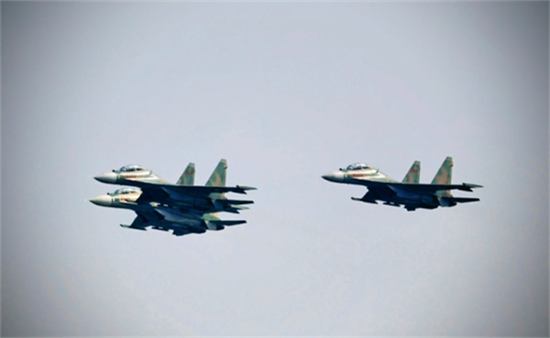 |
| Vietnam Air Force showcases its strength at the opening ceremony of the Vietnam International Defence Expo 2024 (Photo: baochinhphu.vn) |
Thirdly, continue to adjust force organisation toward being “elite, compact, and strong”, and achieve breakthroughs in developing high-quality human resources to meet the requirements of building a modern Military.
Accordingly, based on the results of force structure adjustments in recent years, following the spirit of Resolution No. 05-NQ/TW, issued by the Political Bureau on 17 January 2022, and Resolution No. 230-NQ/QUTW, issued by the Central Military Party Committee on 2 April 2022, the entire Military continues to review and adjust force organisation toward an elite, compact, strong, modern, mobile, and flexible structure; reduce intermediate phases, overcome overlapping, and ensure balance and synchronisation among force components, services and arms, and strategic areas, while rigorously deploying the plan for adjusting local military organisation to ensure synchronised, stable, and effective operations.
Emphasis is placed on building operational- and strategic-level mobile forces with high levels of qualification, combat capabilities, and mobility; priority is given to developing combat forces in new domains, such as unmanned systems forces, airborne assault forces, space warfare, and cyber warfare, etc. The process of reorganisation and adjustment must be scientific and synchronous, aligning with Vietnamese military art and the requirements for national protection in the new situation, while enhancing mobility, coordination, rapid response, and combat capabilities in all environments.
Along with organisational adjustment, it is necessary to build scientific, strict, flexible, and unified operational mechanisms, ensuring seamless commands from the strategic to the tactical levels, while enhancing the effectiveness of centralised and unified command and rapid response capabilities in all situations. Concurrently, vigorously renew the methods of leadership, command, and management in the direction of clear responsibility, shortened processes, and appropriate delegation of authority; strengthen the application of technology in information connectivity and sharing and in command support, raising the operational quality and effectiveness of organisations and apparatus.
In particular, it is critical to make breakthroughs in building high-quality military human resources. This is the pivotal step for streamlining the organisation and converting scientific-technological potential into actual combat strength. Accordingly, it is essential to focus on making breakthroughs in developing education and training toward standardisation, modernisation, and international integration; building a system of smart Military schools, linking training with battlefield realities, and mastering next-generation weapons, equipment, and modern combat methods under the principle that “the school’s training quality represents the unit’s combat readiness”. Emphasis is placed on training a contingent of cadres with strategic thinking, leadership, command, and management capabilities, alongside modern scientific-technological qualifications; and on developing contingents of leading experts in fields such as artificial intelligence, big data, cybersecurity, automation, aerospace, and the defence industry, etc.
Along with this, continue to effectively implement Resolution No. 1659-NQ/QUTW, issued by the Central Military Commission on 20 December 2022, on raising the quality of training for the 2023–2030 period and the following years. Emphasis is placed on training soldiers to be proficient in technique, tactics, and specialised skills, while enhancing the efficiency of exploiting, utilising, and mastering new, modern weapons and equipment; closely combining military training with political education; and combining training with physical conditioning, regular military building, and the transmission of combat experience. Step up the organisation of exercises at all levels, including exercises using simulation and real-time automated command methods under modern combat conditions across various types of terrain and operational environments (air, ground, surface, undersea, cyber, and aerospace). Consequently, this will elevate the qualifications, command capabilities, and combat coordination of commanders, agencies, units, and all cadres and soldiers.
Continue to effectively implement the Project on “Policies for attracting and employing talent in the Vietnam People’s Army to 2030, with a vision to 2050”. Renew the mechanisms for evaluating and employing cadres and experts based on competence, quality, and work efficiency; boldly assign difficult tasks and major responsibilities, granting commensurate autonomy to enable capable personnel to maximise their strengths. Furthermore, expand domestic and international training linkages and cooperation to acquire knowledge and enhance the quality of human resources.
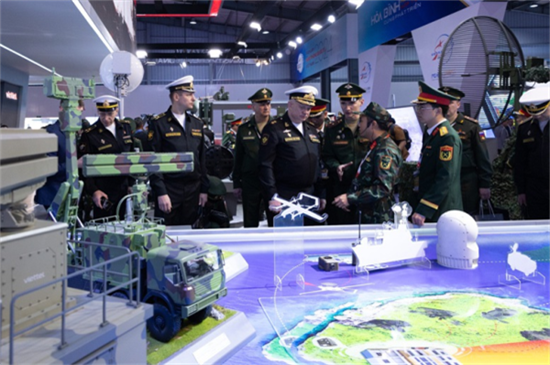 |
| Foreign visitors to the Vietnam International Defence Expo 2024 (Photo: baochinhphu.vn) |
Fourthly, enhance strategic autonomy in science, technology, and the production of modern weapons and equipment to meet the Military's building and combat requirements.
Accordingly, resources must be concentrated on accelerating the development of military science and technology. Priority is given to researching and mastering platform technologies, core technologies, and strategic technologies, laying the foundation for the design and manufacture of advanced, modern weapons and equipment suited to Vietnam’s combat methods and military art, with particular attention to crucial domains such as artificial intelligence, new materials, rocket propellants and engines, fighter aircraft, submarines, unmanned vehicles, and early-warning radars, etc. Along with this, continue to boldly renew research management mechanisms in the direction of closely linking basic and applied research with the needs of training and combat readiness; taking applicability, mastery, and practical effectiveness as the key criteria for evaluating research outcomes.
Continue to promote the development of an autonomous, self-reliant, self-strengthening, dual-use, and modern defence industry, gradually raising the capacity to design, manufacture, produce, repair, improve, upgrade, and modernise all types of weapons and equipment. The focus is on developing domains capable of generating breakthroughs in command, reconnaissance, communications, electronic warfare, cyber warfare, automation, unmanned vehicles, and technical support. For the Army, priority is given to developing mobile, multi-role weapons and equipment possessing great firepower and high precision, tanks, armoured vehicles, and self-propelled artillery, while progressively developing individual equipment supporting high-technology warfare, enhancing survivability, situational response, communications, reconnaissance, and target acquisition. For the Air Defence - Air Force, concentration is placed on researching and manufacturing unmanned vehicles (for reconnaissance, target designation, and suicide-attack missions, etc.), missiles, smart bombs and munitions, fighter aircraft, and command and early-warning systems, raising long-range combat capability. For the Navy, priority is given to developing surface vessels, submarines, naval aviation, coastal artillery and missiles - weapons for forces performing missions at sea and on islands. For cyber warfare, priority is given to developing the capabilities and tools serving reconnaissance and the defence of critical information systems, enhancing the capacity to detect, respond to, and effectively handle situations in cyberspace, etc.
Along with this, focus on researching, producing, and mastering modern technologies and equipment, such as automated command systems, military robots, dual-use satellites, unmanned vehicles, precision weapons, guided munitions, and integrated weapons systems. The defence industry is closely linked with the national industry; the promotion of internal strength is combined with proactive international integration and cooperation; advanced technologies are selectively acquired, thereby raising strategic autonomy in the research, production, and repair of advanced, modern weapons and equipment, meeting the building and combat requirements of the Military, and firmly defending the Fatherland in the new era.
Fifthly, strengthen the review of practical experience and the development of theory, science, and military art to meet the requirements of building a modern Military.
Building a modern Military demands not only a rational force organisation, high-quality human resources, and advanced weapons and equipment, but also guidance from a peak system of scientific theory and military art. Accordingly, it is necessary to renew the work of research and review of practical experience in the direction of staying close to the realities of the Military’s building, training, combat readiness, and the exploitation and utilisation of modern weapons and equipment; simultaneously, proactive studying the transformations of modern warfare and the world’s military development trends, promptly identifying newly arising issues and new requirements in order to supplement and perfect theoretical understanding. Along with this, continue to research, supplement, and perfect the modern Vietnamese military doctrine, creating the foundation for unifying awareness regarding the viewpoints, guiding thought, mottos, implementation principles, and major guidelines in the cause of Military building and Fatherland protection in the new era. At the same time, clarify the new issues concerning the building of an all-people national defence and the People’s Army; the construction of defensive zones; and force organication alongside methods of conducting warfare to protect the Fatherland under new conditions, etc.
In particular, it is vital to conduct in-depth research into the impact of artificial intelligence, automation, electronic warfare, cyberspace, precision weapons, unmanned systems, and the emerging forms of combat upon military art. Through this, Vietnamese military art will be gradually supplemented and developed, from the art of warfare at the strategic, operational, and tactical levels, ensuring that our signature combat methods are effectively leveraged, while utilising intellect, military art, and synergistic strength to neutralise the adversary’s technological advantages. Concurrently, vigorously promote research and development in military social sciences and humanities, military logistics and technical sciences, and military science and technology, etc.
Theoretical research is linked with the innovation of educational and training content and programmes; new research findings are promptly introduced into the realities of training, education, force building, and the organisation of command and combat. Emphasis is placed on building a contingent of research cadres and military experts with strategic thinking, forecasting capabilities, and the competence to approach emerging concepts; and on strengthening the linkages among research agencies, schools, and units, etc.
Consequently, this will foster a high level of unity between theory and practice, between research and application, and between the inheritance of tradition and bold innovation, forming the basis for the Military to remain consistently proactive in strategic thinking, flexible in combat methods, with an ever-higher level of modernisation, and capable of firmly protecting the Fatherland from early on and from afar.
CAO THANH - QUANG HOP - THANH TUNG - BA PHU - VIET VUONG - VAN VUONG