In response to the requirements of building and safeguarding the Fatherland in the new situation, the Municipal Military Party Committee (MMPC) and Municipal Military Command (MMC) of Can Tho have focused on leading and directing efforts to build “adept, compact, strong” armed forces, suited to the city’s organisational structure, geographical characteristics, and military and defence tasks, thereby contributing to building a solid defensive zone and creating a stable environment for the city’s rapid and sustainable development.
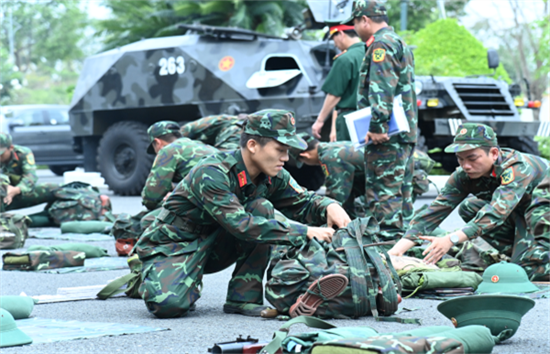 |
| Combat readiness practice |
Amid efforts to accelerate the restructuring of the political system’s apparatus, adjust administrative boundaries, and adopt a two-tier local government system, Can Tho city has gained new development opportunities, while facing new requirements for local military and defence tasks.
Against that backdrop, the MMPC and MMC have thoroughly grasped and strictly implemented resolutions, directives, conclusions, plans, and projects of the Party, the Central Military Commission, the Ministry of National Defence, and the Military Party Committee and Command of Military Region 9 on continuing to reorganise local military agencies and units towards being “adept, compact, strong”. Accordingly, the MMPC’s Standing Board and the MMC have worked closely with relevant agencies to study and assess the overall situation and advise Can Tho city’s Party Committee, People’s Council, and People’s Committee on issuing resolutions, directives, and legal normative documents within their respective authority. These measures have formed a legal basis for the implementation process of units and localities, promptly and effectively addressing defence and security issues. Emphasis has been placed on the reorganisation and operation of local military agencies and units in accordance with the two-tier local government system, while coordinated measures have been taken to build “adept, compact, strong” municipal armed forces.
With a proactive and determined approach, the MMPC and MMC have proactively released resolutions and action plans to ensure the orderly and effective restructuring. In the process of restructuring agencies and units, party committees, party organisations, and commands at all levels have educated officers and soldiers to render troops fully aware of the dissolution, transfer, merger, and reorganisation of units, as well as the establishment of new ones. They have regularly conducted inspection and supervision of agencies and units, enabling them to keep abreast of the situation, promptly resolve difficulties, and respond appropriately to the concerns and aspirations of officers and soldiers. At the same time, they have identified and corrected shortcomings, resolutely fighting against misguided perceptions and actions, unconstructive remarks, reluctance to changes, avoidance of responsibility, and manifestations of formalism, opportunism, and other negative practices. This has helped achieve a common understanding and high degree of consensus on decisions made by higher-level authorities, foster solidarity and determination to overcome difficulties and rapidly stabilise organisational structure, allowing agencies and units to resume operations in accordance with their assigned functions and initially fulfil their assigned tasks successfully.
To date, the reorganisation and adjustment of the organisational structure of the city’s units and local military agencies have largely been completed as planned, with a balanced and appropriate distribution of components and forces according to geographical areas. The operations of commune-level military agencies have been effectively maintained without interruption. Coordination, staff work, direction, and command in the performance of local military and defence tasks have proceeded smoothly. In particular, in implementing the policy of deploying Army officers to the commune level, the MMC has proactively reviewed personnel requirements and coordinated with the Military Region to promptly transfer and appoint personnel to positions within commune-level military commands. To date, all commune-level military commands have been fully staffed; 100% of commander positions have been filled; 100% of commune-level military party cells have built party committees; all communes and wards have established standing militia squads. The reserve force has been registered, managed, and organised in accordance with military occupational specialities, with personnel assigned to appropriate local areas; its staffing rate has exceeded 99.9%, and party members account for at least 15% of the force strength.
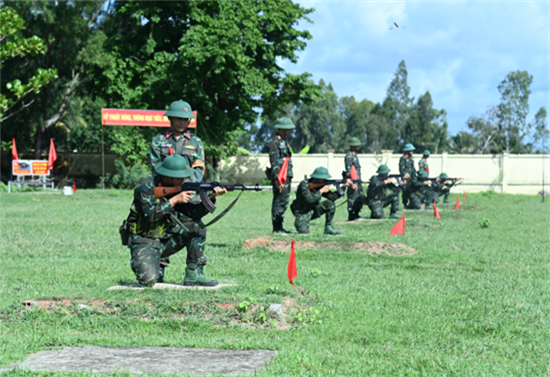 |
| Shooting training for new soldiers |
Additionally, the MMC has closely supervised the handover and receipt of responsibilities, functions, organisational structures, personnel, weapons, technical equipment, facilities, combat documents, and defence land in accordance with regulations. It has directed the review and revision of routine combat-readiness, search and rescue, defensive combat, and operational plans at all levels to reflect the new administrative boundaries. It has also urgently consolidated command and mass organisations, stabilised organisational structures, and organised exercises on combat-readiness, fire and explosion prevention, and the protection of key sites and vital targets, thereby ensuring the smooth, continuous performance of military and defence work. At the same time, it has reviewed and adjusted the military posture within the defensive zone to reflect actual situation, developing training plans and programmes and organising training in accordance with regulations, ensuring that training is appropriate to potential adversaries and new operational areas. Importance has been attached to improving training quality in conjunction with promoting digital transformation, administrative reform, regularity building, discipline management, and absolute safety assurance.
To continue accelerating the building of the city’s armed forces towards being “adept, compact, strong”, the MMPC’s Standing Board and the MMC are determined to lead and direct the successful implementation of the following key tasks and solutions.
First, continuing to thoroughly grasp and effectively implement higher-level resolutions, directives, conclusions, and guidance on local military and defence tasks in the new situation. Emphasis will be placed on effectively executing Resolution 866-NQ/QUTW, dated 14 June 2025, by the Central Military Commission, Plan 3433/KH-BQP, dated 14 June 2025, issued by the Ministry of National Defence, and the Project on reorganising local military agencies and units towards being “adept, compact, strong”. Relevant thematic resolutions of the Central Military Commission and the Party Committee of Military Region 9 on force organisation, training, combat readiness, regularity building, and discipline management will also be implemented effectively. Based on those documents, agencies and units will be directed to thoroughly grasp and translate the objectives, targets, tasks, and solutions into action plans and programmes in a rigorous, systematic, scientific manner, tailored to the characteristics of each unit and locality. Particular attention will be paid to identifying key tasks and breakthroughs under the prescribed road map and with clearly defined results.
In the process, agencies and units will be encouraged to demonstrate initiative, flexibility, and creativity and assign specific responsibilities to each section and force. Inspection and supervision will be strengthened to detect and resolve difficulties and obstacles promptly. Resolute action will be taken to deal with the avoidance and shifting of responsibility, fear of making mistakes, failure to “match words with action”, and poor task performance. Due regard will be paid to building a contingent of key cadres in commune-level military agencies who are capable of providing sound advice, performing tasks effectively, and genuinely serving as the centre of unity, showcasing the courage to think, act, and take responsibility.
Second, continuing to review and consolidate the organisational structure of agencies and units following mergers. New organisational arrangements will be executed in accordance with the improved establishment tables to ensure effective operation under the two-tier local government system. Reorganised and newly established commune-level military agencies will quickly grasp their functions, responsibilities, and working relationships, provide sound advice to local party committees and authorities on military and defence tasks, and promptly identify inadequacies and overlapping responsibilities. They will propose solutions to remove “bottlenecks” and raise the quality and effectiveness of the political system at grass-roots level.
On the basis of a comprehensive assessment of the capabilities of personnel in commune-level military agencies, great value will be attached to strengthening refresher training and professional support for personnel holding concurrent posts at grass-roots level. Plans will be proactively developed for personnel training, professional development, and deployment, with priority given to personnel who have received basic training and possess extensive practical experience, so that they can be reassigned and appointed to positions suited to their capabilities and professional expertise. Efforts will be made to fill all commander, assistant, and technical specialist positions at commune-level military commands in 2026. Consideration will be given to building a strong, extensive militia and self-defence force and a robust, high-quality reserve force, organising training and exercises tailored to local conditions, and providing sound advice to local party committees and authorities on military and defence tasks, thereby contributing to maintaining a firm posture of all-people national defence closely integrated with the posture of people’s security at grass-roots level.
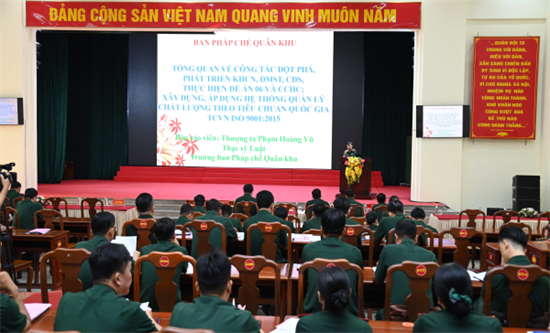 |
| Training course on science and technology development, innovation, and digital transformation |
Third, improving training quality and combat readiness. The MMPC and MMC will direct party committees and commands at all levels to strengthen education and dissemination and strictly implement higher-level resolutions and directives on training and exercises, thus achieving a high degree of unity in awareness and action. Thorough preparations for training will be made, with particular attention paid to improving the professional capabilities of personnel in commune-level military commands and providing training in local military and defence work for the Municipal Border Guard Command and in border guard work for personnel of the MMC. Training content and methods will be actively renewed towards greater synchronisation, specialisation, and relevance to assigned tasks, target groups, and local conditions. Emphasis will be placed on raising the quality of training for new recruits and in-service training for officers, professional military personnel, and technical specialists, as well as training and inspecting the mobilisation readiness of the reserve force. Due regard will be paid to training the militia and self-defence force to proficiently use weapons, equipment, supporting tools, and improvised weapons, and master and flexibly apply tactics. Importance will be attached to training troops in combat plans and exercises in coordination with forces in the defensive zone and participating in responses to non-traditional security challenges. Great weight will be added to constantly perfecting defensive zone combat plans and intensifying joint training and inter-sectoral, multiple-locality defensive exercises closely aligned with the city’s defensive combat plans.
Fourth, strengthening regularity building and discipline management. The quality and effectiveness of building “exemplarily, typically” comprehensively strong units will be improved. Education work will be effectively carried out to foster self-discipline among officers and soldiers. Agencies and units will closely monitor personnel’s ideological developments and social relationships and regularly review and assess the implementation of measures for regularity building and discipline management in order to take timely corrective action. They will resolutely prevent, repel, and strictly deal with manifestations of deterioration in political ideology, morality, and lifestyle, as well as “self-evolution” and “self-transformation”. Due attention will be paid to promoting the building of a military cultural environment, creating a democratic and healthy atmosphere in each agency and unit, and caring for troops’ material and mental lives.
These are the fundamental tasks and solutions for Can Tho city continue building “adept, compact, strong” armed forces, with increasingly high overall quality and combat power to successfully deal with any situations.
Sr. Col. HUYNH VAN HUNG
Commander of the MMC