National defence and security education for students at Hanoi University of Physical Education and Sports
Alongside specialised training, Hanoi University of Physical Education and Sports has consistently attached importance to national defence and security education for students, with the aim of developing well-rounded, high-quality human resources capable of meeting the requirements of national construction and defence in the new era.
In implementing the Party’s and the State’s policies on national defence and security education for students, the University’s Centre for National Defence and Security Education has, in recent years, has fulfilled its core role by proactively advising the University Party Committee and Board of Management on leadership and direction, while directly carrying out this important work through appropriate and innovative measures. These efforts have yielded positive results and gradually established the Centre as one of the country’s leading and most reputable institutions for national defence and security education.
Firstly, to strengthen education to raise the awareness and responsibility of administrators, lecturers and students regarding national defence and security education. Accordingly, the Centre regularly ensures that all groups thoroughly understand the Party’s and the State’s guidelines and policies and higher-level guidance, particularly Politburo’s Directive No.12-CT/TW dated 3 May 2007 on strengthening Party leadership over national defence and security education in the new situation, the Law on National Defence and Security Education, and its implementing documents. On this basis, it fosters a shared understanding, appropriate motivation and responsibility, and concrete implementation. For administrators and lecturers, alongside a thorough understanding of the subject’s position, role, objectives and requirements, the Centre requires Party committees and leaders of departments and faculties to coordinate planning, resource allocation, inspection, supervision and assessment. It emphasises initiative, responsibility and exemplary conduct, particularly among staff directly involved in teaching and student management, and firmly addresses the tendency to disregard the subject, together with superficiality, formalism and achievement-oriented practices. For students, education and guidance help them understand that the subject is not merely a compulsory requirement for graduation, but also an opportunity to develop political steadfastness, discipline, professional conduct, basic military skills and civic responsibility for national construction and defence. This encourages self-motivated learning and training and improves educational quality and effectiveness.
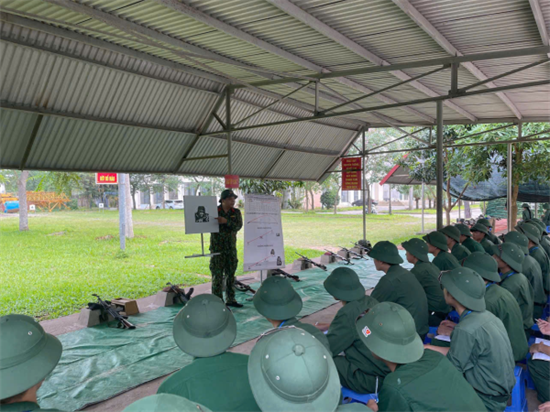 |
| Conducting shooting training for students |
To translate awareness into action, the Centre uses diverse communication and educational activities, closely combining briefings and collective meetings with discussions, cultural exchanges and artistic activities. Their content and formats are adapted to students’ age and psychology, creating a welcoming and engaging atmosphere while maintaining the educational value and discipline of a military environment. In particular, the Centre makes effective use of its website, Facebook fanpage and Zalo groups to broaden communication, share innovative practices and exemplary actions, and enable students to access information quickly and conveniently. Regular monitoring and inspections help identify and correct incomplete understanding, inattentive learning and reluctance to study or train. Outstanding individuals and groups are recognised and rewarded to motivate further progress.
Preparation for training is a key factor directly affecting the quality of the subject. The Centre therefore prioritises personnel, facilities, training grounds and practice areas. Despite limited infrastructure and a large intake of students from different disciplines and partner institutions, it works closely with affiliated universities to agree on student numbers and schedules and to plan admission, class organisation, accommodation and activities. It carefully selects capable, experienced and responsible personnel for student management teams and provides task briefings and training in organisation, management, command and the identification and resolution of students’ concerns. Lecturers receive regular professional development to standardise teaching content, requirements and methods, update knowledge and improve their use of information technology and artificial intelligence. Classroom observations, teaching competitions and reviews help identify and correct shortcomings. The Centre also encourages lecturers to be dedicated, creative and approachable mentors who inspire and accompany students throughout their studies and training.
Alongside personnel preparation, the Centre mobilises resources to construct, repair and upgrade targets, teaching models, training grounds and practice areas. It invests in information technology infrastructure and software for digital transformation, administration and scientific research, and develops its website and digital library to improve teaching, learning and research. Regular education reinforces responsibility and strict compliance with regulations governing weapons and equipment, especially equipment used by students, preventing damage and deterioration caused by negligence.
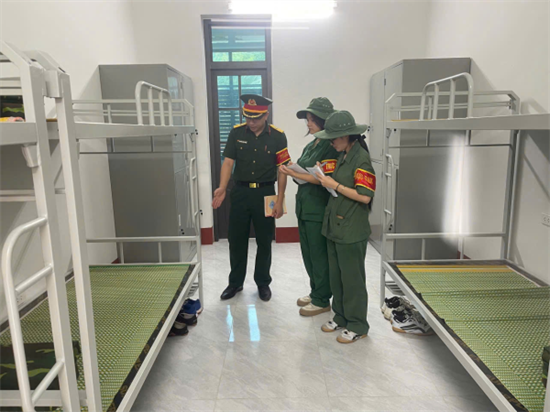 |
| Checking room order and neatness |
To realise its ambition of meeting national standards and strengthening its standing among national defence and security education centres nationwide, the Centre is comprehensively renewing its organisation and teaching methods to bring about substantive improvements in educational quality. In accordance with prescribed curricula and higher-level guidance, it regularly reviews and updates content on the Party’s policies, State law, socio-economic developments, national defence, security and protection of the Fatherland, with particular attention to non-traditional security, cybersecurity and the responsibilities of young people. Visits and experiential activities at historical sites, museums and military units are integrated into learning to broaden knowledge, foster patriotism and national pride, and develop appropriate learning motivation.
In terms of teaching methods, the Centre is making a decisive shift from knowledge transmission to learner competence development, encouraging student initiative, creativity and independent study. Lecturers are encouraged to use information technology, electronic lesson plans, images, documentary videos and three-dimensional visualisation to make lessons more accessible and engaging, while students are encouraged to study materials and prepare video presentations. Teachers guide and facilitate students’ independent research, discussion and conclusions. Practical training progresses from easy to difficult and from simple to complex, combining demonstrations, model teams and instructional clips with continuous guidance and corrective feedback. Students practise, review their own performance, learn from experience and correct mistakes, while developing military discipline, orderly conduct and teamwork. This enables them to understand theory, master practical movements and apply knowledge flexibly to specific situations.
The Centre also reforms testing and assessment to ensure objectivity and substantive evaluation of both knowledge and practical application. It regularly updates its question bank and increasingly uses information technology to prepare examinations, administer tests, mark work, compile statistics and analyse results. These measures provide lecturers with a stronger basis for evaluating quality and ensure that assessments accurately reflect students’ learning and training outcomes.
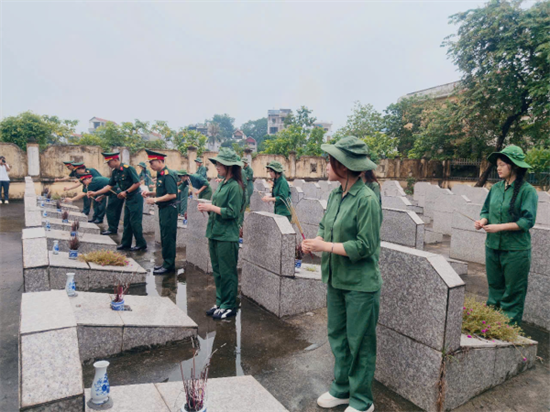 |
| Paying tribute to the martyrs |
Following the motto “Building an orderly, united unit that teaches well and learns well”, the Centre closely combines management and training with a healthy military cultural environment so that students gain genuine experience of military life. In each course, students are organised into companies, platoons and squads, while administrators and lecturers are assigned direct command and management responsibilities and practise the “three together” approach with students. Before courses begin, regulations on study, daily activities, entitlements, rights and obligations are fully explained and published on the Centre’s website. Daily and weekly routines are strictly maintained in accordance with military regulations, helping students develop discipline, military courtesy, orderly conduct, self-awareness and teamwork comparable to that of service personnel.
The Centre pays close attention to creating a friendly, healthy educational environment suited to students’ psychological and developmental characteristics. Administrators and lecturers are expected to demonstrate professionalism, responsibility and dedication, educating students through their own exemplary conduct. Persuasion and education are combined with strict discipline so that students gradually develop self-discipline and a sense of collective responsibility. Extracurricular activities, including the “Student-Soldier” programme, “Green Sunday”, incense-offering ceremonies commemorating fallen heroes and martyrs, and volunteer work, strengthen solidarity, mutual support and responsibility while fostering a lively spirit of emulation and enriching students’ practical experiences.
Through strong political determination and systematic, scientific approaches, national defence and security education at Hanoi University of Physical Education and Sports has achieved substantial positive progress and received high evaluations from partner institutions. In the 2025-2026 academic year alone, the Centre organised 12 courses for more than 22,000 students; over 99% met the required standard, including more than 52% achieving good or excellent results. These achievements provide an important foundation for further improving the quality of national defence and security education and meeting the requirements of national construction and defence in the new era.
Senior Colonel PHAN TU LANG, Deputy Director of the Centre for National Defence and Security Education