Da Nang city builds economic potential for strong, modern all-people national defence
In pursuit of its strategic development objectives in the new context, Da Nang city has focused on building economic potential for strong, modern all-people national defence immediately following the merger. The city regards this as a regular strategic task of decisive importance to its sustainable development and that of the Central Region.
The new Da Nang city was established through the merger of the former Da Nang city and Quang Nam province, covering a total natural area of 11,859.59 square kilometres, having a population of more than three million. Its diverse terrain encompasses plains, midlands, mountainous areas, coastal areas, and islands. This has expanded the city's strategic development space and deepened its defence posture from the border and mainland to the sea and islands.
As the political, economic, and social hub of the Central and Central Highlands region, as well as a key link in the East - West Economic Corridor, Da Nang city occupies a strategic position in the defence posture of Military Region 5. Its diverse transport infrastructure, comprising deep-water seaports, an international airport, the North - South railway, and National Highway 1A, is not only a major driver of economic growth but also serves as a vital lifeline for the manoeuvre of forces, vehicles, and equipment when the city transitions to different defence and security postures in response to contingencies. Emerging economic models with a leading role, such as the free trade zone and the international financial centre currently under development, are generating substantial resources to enhance the economic, scientific, and technological potential of the defensive zone. On the maritime front, the Son Tra Peninsula forms a natural protective barrier and occupies a strategic position in firmly safeguarding national sovereignty over the sea and islands.
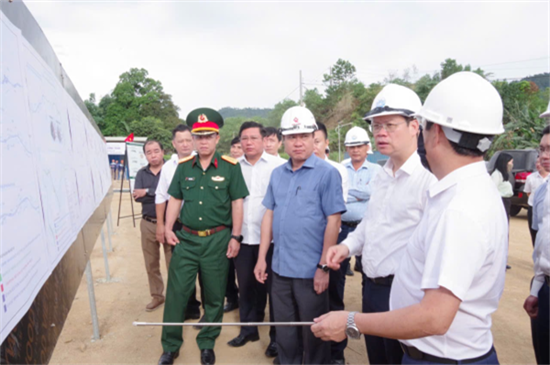 |
| Leaders of the city inspect the construction of National Highway 14D |
Fully aware of its new position, the city has determined that economic development must always go hand in hand with defence and security consolidation. It has attached importance to building the defensive zone and strengthening all-people national defence and the postures of all-people national defence and people's security. This is an objective demand arising from the fundamental laws governing the cause of Fatherland construction and protection, and is consistent with the requirements for building defensive zones in the new situation. Accordingly, for Da Nang today, building economic potential for all-people national defence does not simply mean increasing GRDP, budget revenue, or mobilising investment capital. More importantly, it means developing an economy with a rational structure, high resilience, and a high level of self-reliance, a synchronised infrastructure system, high-quality human resources, advanced science and technology, and competitive enterprises capable of rapidly converting economic resources into resources serving national defence when necessary.
Following the merger, although the city had to undertake numerous major tasks simultaneously, including reorganising its apparatus, operating the two-tier local government model, addressing transitional issues relating to planning, investment, finance, land, and infrastructure, and overcoming the consequences of natural disasters, it still maintained its growth momentum. In 2025, Da Nang's GRDP grew by 9.18%, the highest rate recorded during the 2021 - 2025 period, with its GRDP at current prices estimated at VND 316.1 trillion. Total development investment in the city reached approximately VND 85,824 billion, up 16.7% compared with 2024. Tourism, trade, exports, and industrial activities continued to maintain a positive recovery momentum.
In 2026, Da Nang's economy continued to record positive developments and outstanding achievements. Its GRDP in the first nine months of the year was estimated to have grown by 10.31%, placing the city among the localities with relatively high growth rates nationwide. It ranked seventh out of 34 localities in the third quarter and ninth out of 34 localities over the first nine months. Total investment at current prices during the first nine months was estimated at VND 88 trillion, up 42.25% compared with the same period in 2025. Da Nang's economic structure in the first nine months of 2026 was orientated towards services, industry, and agriculture, with the respective shares being 54.93% for services, 26.46% for industry and construction, 7.28% for agriculture, forestry, and fisheries, and 11.33% for product taxes (excluding product subsidies).
Da Nang has stepped up investment promotion activities, particularly to attract investment in its high-tech parks and large-scale information technology parks. It has focused on selectively attracting investment by organising online investment promotion conferences with key markets and countries adopting policies to redirect investment flows, while linking investment attraction with defence and security assurance and environmental protection. In the first nine months of 2026, total foreign direct investment (FDI) attraction reached USD 681.55 million, approximately 2.87 times the figure recorded in the same period of 2025, representing an increase of around 186.6%. The city granted licences to 100 new projects with a total registered capital of USD 522.22 million. As of 20 September 2026, it had 1,162 FDI projects with total registered capital of approximately USD 11.28 billion. Domestic investment capital reached VND 185,760.3 billion, an increase of approximately 183.8% year on year; the city granted approval to 66 new projects with a total investment capital of VND 96,084.52 billion, more than 2.1 times the figure recorded in the same period. The marked breakthrough in both domestic and international investment flows demonstrates the city's growing appeal on Vietnam's investment map. These achievements have resulted not only from its strategic position and gradually improving infrastructure but also from its open policies and the local authorities' commitment to investors, thereby creating a dynamic, safe, and promising investment environment.
However, socio-economic development in conjunction with strengthening economic potential for all-people national defence also faces certain challenges. These include difficulties in adopting the circular economy model, applying high technologies, and promoting innovation due to institutional, resource, and connectivity constraints, considerable disparities in economic growth and living standards between mountainous and border areas and the plains, and the substantial workload involved in implementing new economic models, which requires further improvements to management mechanisms and inter-sectoral coordination to ensure their successful completion, among other issues.
The city will grasp and execute the Resolution of the 14th National Party Congress, as well as resolutions, directives, conclusions, programmes, and plans issued by the Party Central Committee and the Politburo, and the Resolution of the First Da Nang City Party Congress for the 2025 - 2030 tenure, while concretising the guiding principle underpinning the city's development planning for the 2021 - 2030 period, with a vision to 2050: every economic plan must take defence and security requirements into account; every major infrastructure project must be designed with dual-use capabilities; every step of economic development must simultaneously enhance the resilience and resource mobilisation capacity of the defensive zone. To that end, it will focus on effectively implementing the following solutions.
First, improving the quality of planning to ensure the close combination of socio-economic development and defence and security potential. To do so, Da Nang will focus on developing new growth drivers, with innovation, digital economy, green economy, and circular economy serving as the main drivers for improving productivity and the quality of growth. It will continue to review and refine its master plans and its development plans for sectors, fields, and territorial spaces towards greater synchronisation and connectivity, avoiding overlaps and wasteful use of resources. All planning schemes for urban development, transport, industry, logistics, energy, telecommunications, tourism, agriculture, forestry, and fisheries must fully incorporate requirements for defence, security, and civil defence.
Particular attention will be paid to areas of strategic importance to defence and security, strategic transport routes, seaports, airports, warehouses, energy centres, communications facilities, health care facilities, and essential infrastructure projects. These must be placed under strict management to ensure that they deliver economic efficiency while meeting requirements when the city transitions to different defence postures.
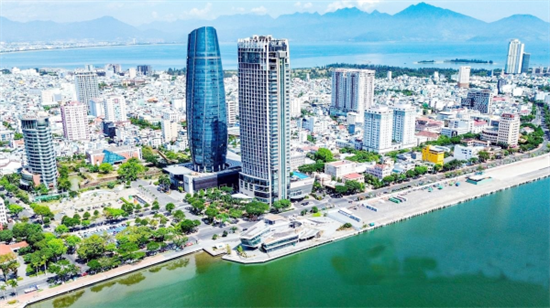 |
| Central area of the city |
Second, developing strategic infrastructure in a modern, synchronised, dual-use direction. The city will concentrate resources on the coordinated development of inter-regional transport networks, seaports, airports, railways, logistics, digital infrastructure, energy systems, water supply, health care, and essential facilities. Priority will be given to projects capable of generating spillover growth across the entire region, enhancing manoeuvrability, and ensuring logistics and technical support, as well as search and rescue capabilities in the event of contingencies. Da Nang will continue investing in and completing key economic infrastructure projects, including Lien Chieu Port, Chu Lai Port, Ky Ha Port, Tam Hiep Port, Da Nang International Airport, Chu Lai Airport, and East - West and North - South routes, among others, so that they become important components of the city's defence posture. The city will synchronously implement solutions to develop Da Nang into a regional logistics hub, establish a modern, multimodal logistics centre to enhance the flow of goods in peacetime and ensure transport, stockpiling, and distribution capabilities in emergency situations, link economic development with defence and security assurance, and maintain connectivity and balanced development among regions.
Third, developing a self-reliant industrial base and the capacity to convert production to serve national defence when necessary. Da Nang will intensify the dissemination and implementation of resolutions by the Party and Government on industrial development, with a focus on Resolution 29-NQ/TW dated 17 November 2022, adopted by the 6th Plenum of the 13th Party Central Committee, on “continuing to accelerate national industrialisation and modernisation towards 2030, with a vision to 2045”, and the Government’s Resolution 82/NQ-CP, dated 3 April 2026, on “approving the policy for the Law on Key Industries”. Priority will be given to developing high-tech industries, supporting industries, precision engineering, electrical and electronic industries, information technology, semiconductors, artificial intelligence, automation, new materials, and green industries. The city will attach importance to establishing an enterprise ecosystem capable of participating in domestic and international supply chains. Alongside attracting major corporations, due regard will be paid to supporting the development of small and medium-sized businesses and science and technology enterprises. Links between enterprises, universities, research institutes, and training institutions will be strengthened to develop technological resources, human resources, and production capabilities that can be mobilised, converted, and adapted when new requirements arise in the performance of defence tasks.
Fourth, developing high-quality human resources as the decisive factor in modern economic potential. Practical experience shows that economic potential in the new era is no longer determined solely by capital, land, natural resources, or machinery, but increasingly depends on the quality of human resources. Therefore, Da Nang will continue investing in education and training, science, technology, and digital transformation, while focusing on developing high-calibre human resources in key sectors such as information technology, semiconductors, finance, logistics, and high-quality services to meet the requirements of economic restructuring. At the same time, it will strengthen human resource training in mountainous, border, remote, and disadvantaged areas, improve the quality of grass-roots officials, and create favourable conditions for ethnic minority communities to participate more deeply in the economic development process. This is not only a task of social development but also contributes to consolidating the “posture of people's hearts and minds”, thereby establishing a firm political and spiritual foundation for the defensive zone.
Fifth, building a highly resilient economy capable of proactively responding to natural disasters and non-traditional security challenges. As a locality with an extensive geographical area, diverse natural conditions, and frequent exposure to storms, floods, and landslides, Da Nang will continue investing in early warning systems, reservoirs, and dams, drainage systems, transport, health care, and communications infrastructure. It will formulate plans for stockpiling essential goods, medicines, and fuel, while developing search and rescue and civil defence capabilities. Essential infrastructure projects will be developed with contingency provisions and the capacity to maintain operations even when certain parts of the system are disrupted. Major enterprises, industrial parks, urban areas, health care facilities, and essential service providers must develop their own plans to ensure business continuity, thereby enhancing the resilience of the entire economy.
Sixth, mobilising and utilising resources for development in tandem with defence and security. Given its substantial investment needs, Da Nang must remove bottlenecks, effectively mobilise all available social resources, and diversify resource mobilisation, with the State budget playing a leading role in creating momentum for attracting resources from society. The city will continue promoting public - private partnerships, attracting strategic investment, and making effective use of land and public assets, while exercising strict control over investment quality, progress, and efficiency. In particular, foreign investment attraction must be linked to requirements for safeguarding defence and security, economic security, and national interests. Priority will be given to projects featuring advanced technologies, modern management practices, strong linkages with domestic enterprises, high added value, and no adverse impacts on the environment, security, or defence.
Seventh, promoting the core role of the armed forces and strengthening coordination among forces, sectors, and localities in building economic potential for national defence. Military agencies at all levels must proactively advise Party committees and local authorities on integrating socio-economic development with defence and security, from the formulation of master plans and development plans to the appraisal of projects related to areas of strategic importance to national defence. The Municipal Military Command will continue improving the quality of training and exercises, building the reserve force and the militia and self-defence force, proactively formulating plans to mobilise economic resources for national defence, and maintaining close coordination in civil defence, natural disaster prevention and control, and search and rescue operations. These efforts will help gradually establish mechanisms for the rapid, accurate, adequate, and effective mobilisation of economic resources in response to contingencies.
Eighth, linking economic development with consolidating the “posture of people's hearts and minds”, ensuring that all development achievements are directed towards improving the People's living standards. An economy can only truly generate strength for national defence when the fruits of development are distributed appropriately, the People's living standards are continuously improved, and their confidence in the Party, the State, and the socialist regime is strengthened. Accordingly, the city will continue prioritising investment in mountainous and border areas and areas mainly inhabited by ethnic minority communities, improving the quality of health care, education, and infrastructure, creating sustainable livelihoods, reducing multidimensional poverty, building new-style rural areas, and developing green, smart, and liveable urban areas. This is precisely the process of building strength from the grass-roots level, enabling every citizen to become an active participant in development and an important component of all-people national defence.
Guided by the viewpoint that economic development provides the material foundation, defence and security constitute the conditions for development, and the People are both the subjects and the centre of the development process, Da Nang will continue striving to build a dynamic and modern economy that is not only strong in scale, modern in technology, and efficient in governance, but also self-reliant. Doing so will enable Da Nang to gradually build strong, modern economic potential for all-people national defence, foster rapid and sustainable development, and make a positive contribution to the cause of building and firmly defending the socialist Vietnamese Fatherland.
NGUYEN MANH HUNG
Deputy Secretary of the Municipal Party Committee
Chairman of the Municipal People's Committee