Ho Chi Minh’s methodology on the unity of strategic thinking and practical action
In Ho Chi Minh's methodology, strategic thinking and practical actions are always closely unified, interacting with and complementing each other. Righteous strategic thinking must originate from reality, be concretised into appropriate methods and steps, and be tested through actions. At the same time, reality is the basis for supplementing and developing strategic thinking. Mastering and creatively applying this methodology is of special significance to the cause of building and safeguarding the Fatherland in the new era of development.
The importance of strategic thinking and practical action in Ho Chi Minh's methodology
The Ho Chi Minh’s methodology was built by him, yet it is not subjectivist. He clearly recognised that the methodology is a harmonious combination of subjectivity and objectivity, of cognition and practice, and of strategic goals with methods, steps, and ways of acting. That is not a method of subjective will, but a method which is formed from the proper perception of objective reality, thoroughly grasping the law of motion of the object, and on that basis, proactively defining goals, choosing methods, and organising practical activities which are appropriate to those laws.
In the process of leading the revolution, President Ho Chi Minh always started from reality to determine the strategic guidelines and goals, while ensuring the unity between strategic guidelines and practical actions. According to him, every guideline and policy must stem from actual conditions, the requirements of the revolution, the correlation of forces, the characteristics of the targets, and changes in the situations. He criticised the practice of “closing the door to draw up plans and write programmes”; at the same time, he affirmed that “The leadership in all practical work of the Party must come from the masses and go back to the masses”. Hence, thinking does not stop at perception and orientation, but must be translated into specific policies, decisions, and actions; conversely, practical actions aim to realise strategic thinking and serve as a basis for testing, supplementing, and developing strategic thinking.
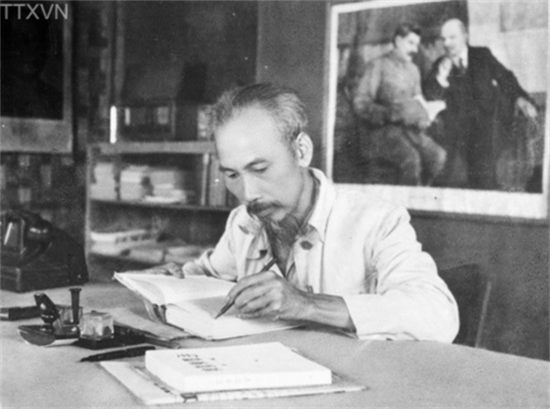 |
| President Ho Chi Minh works at Viet Bac revolutionary base. (Photo: VNA) |
Strategic thinking plays a guiding role in the entire revolutionary process. It is a vision of the overall strategic direction and goals of the revolution, which are defined by the vanguard of the working class in the light of Marxism-Leninism. Right from its inception, our Party and leader Nguyen Ai Quoc defined the strategic guideline of the Vietnamese revolution as “advocating a bourgeois-democratic revolution and an agrarian revolution to advance towards a communist society”. Defining the correct strategic guideline is the primary factor deciding the victory of the revolution. Without a correct strategic guideline and thinking, the revolution could not achieve any victory. Strategic thinking and guidelines govern the method of the revolution; whatever the strategic thinking is, the corresponding revolutionary method follows. However, correct strategic thinking is just a necessary condition, yet not sufficient to ensure the success of the revolution. The victory of the revolution also depends on the methods of implementation, appropriate steps, and correct practical actions. Practical actions include the process of realising strategic thinking and guidelines. At the same time, through practice, the correctness, suitability, and effectiveness of strategic thinking are tested. This holds true values at the level of the entire revolutionary process, in each stage and period of the revolution, and each specific aspect and field.
The unity of strategic thinking and practical actions - President Ho Chi Minh's scientific revolutionary methodology
With the reception of Marxism-Leninism, President Ho Chi Minh applied the worldview and methodology of dialectical materialism to perceive and solve the issues of the Vietnamese revolution. According to him, theory is not merely for understanding the world, but must aim at transforming the world through practical activities. Therefore, guidelines, strategic thinking, and methods of action must be placed in a unified whole; wherein, strategic thinking guides actions, while practical actions include the process of realising and testing strategic thinking.
Ultimately, revolutionary activity poses two closely related issues that need to be resolved. The first is the guidelines, strategic thinking, orientations, and revolutionary goals for the entire revolutionary process, as well as for each stage and period. The second is the revolutionary method, the mode of implementation, and practical actions. If there are only goals without determining how to achieve them, the goals remain merely ideological; if one focuses only on immediate actions without strategic orientation, it is easy to fall into passivity, fragmentation, and even deviation. Therefore, the unity between strategic thinking and practical actions is, first and foremost, the unity between the goal and the method of achieving that goal. Accordingly, strategic goals must be concretised into appropriate tasks, steps, and actions. At the same time, the results of practical actions must be summarised to gain a more thorough understanding of the situation, thereby supplementing and adjusting the methods of implementation and, when necessary, developing the strategic thinking.
The practice of the Vietnamese revolution is a vivid testament to the correctness and scientific nature of Ho Chi Minh’s methodology regarding the unity between strategic thinking and practical actions. A typical example was the establishment of the basic and consistent strategic guidelines for the entire process of the Vietnamese revolution, i.e. national independence combined with socialism. This was a unique and creative theoretical breakthrough by our Party and President Ho Chi Minh. Throughout the revolutionary process, the guideline of national independence combined with socialism was concretised in each period and stage through strategies and tactics including the struggle for national independence; safeguarding the state, resistance and national construction; simultaneously carrying out the two revolutionary strategies, etc. with different specific execution methods and practical actions. In this, the consistent strategic goal was maintained, yet the methods, tactics, and forms of struggle organisation were always adjusted to suit specific circumstances. This represents the creative application of the historical, concrete viewpoint and the revolutionary spirit by V.I. Lenin.
Revolution is a long process that goes through many stages and periods with different conditions, tasks, and balances of forces. Therefore, in each stage, it is a must to identify the right central task and choose an appropriate action method. Being firm in goals but flexible in methods, consistent in guidelines but creative in ways of implementing is a prominent manifestation of the unity between strategic thinking and practical action. President Ho Chi Minh determined that all revolution stages are in a dialectical relationship with each other. At the same time, under actual circumstances, strategic directions and tactics also change, followed by changes in methods and measures of implementation, along with specific practical activities that are unified with the strategic directions. For example, during the 1930 - 1931 period, the focus of the struggle was against the oppression and terror of the imperialist and feudal regimes; during the 1936 - 1939 period, based on the new situation, the focus was shifted to fighting against fascism and demanding democracy, freedom, and peace; during the 1939 - 1945 period, when World War II broke out, it was necessary to act decisively, combining political struggle with armed struggle to seize power for the people.
In May 1941, under the chairmanship of leader Nguyen Ai Quoc, the Eighth Central Conference decided to shift the revolutionary strategy, placing the task of national liberation above all else; practical activities were then adapted. This included the decision to establish the Viet Minh Front; temporarily shelving the slogan of overthrowing landlords, replacing it with the confiscation of land owned by the imperialists and traitors to distribute to poor peasants, alongside reducing the rent and interest; promoting armed insurrection, seizing opportunities, and launching partial uprisings to pave the way for a general insurrection. After the August Revolution in 1945, this approach continued to be reflected in the defence of the young revolutionary government, building of the new regime; focusing on eliminating “hunger, illiteracy, and foreign invaders”; and carrying out an all-people, all-out, long-term resistance based on self-reliance. Each task demanded specific methods of organisation and action, yet all were directed toward the common strategic goal of safeguarding national independence and step-by-step realising socialist objectives.
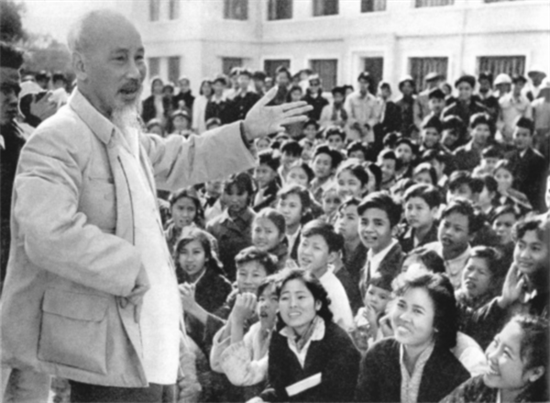 |
| President Ho Chi Minh talks with artistic students in 1961. (A file photo) |
The Party's application in the new era of development
Entering a new era of development, our Party is creatively applying President Ho Chi Minh's methodological values of uniting strategic thinking and practical actions to define guidelines, policies, and implement the national development goals. At first, this is expressed through the unity between strategic vision and specific goals, tasks, and steps. The 14th National Party Congress clearly stated: “… successfully implement the goals by 2030, to become a developing country with modern industry and upper-middle income; realise the vision by 2045, to become a developed with high-income country…”. This is a combination of a long-term vision with a concrete action roadmap, and of strategic requirements with tasks that can be organised and carried out in each period. On the other hand, this unity is also demonstrated by transforming the strategic thinking into breakthrough decisions, focusing on resolving key steps and bottlenecks in practical development. In particular, the 14th National Party Congress identified a strong breakthrough in the development institutions; at the same time, it also promoted science, technology, innovation, and digital transformation. Through this, it converted strategic vision into specific action priorities to unlock resources, create new momentum, and enhance the country's development capacity.
In particular, strategic thinking is increasingly closely tied to the capacity for organisation and implementation, as well as the mechanism of practical testing. The Party Central Committee formulated the Action Plan “to concretise and effectively implement the Resolution of the 14th National Party Congress, closely following the goals, directing viewpoints, orientations, key tasks, and strategic breakthroughs, while ensuring suitability to domestic and international contexts and meeting the requirements for fast and sustainable national development, etc.”. This marks a crucial transition from having sound policies to effectively implementing, using practical results as the basis for evaluating, adjusting, and perfecting policies.
The unity between strategic thinking and practical actions is a distinctive feature of President Ho Chi Minh's revolutionary methodology, harmoniously combining vision, spirit, and intellect with practical implementation capacity, which has been verified through the turning points of the Vietnamese revolution. This method continues to be thoroughly grasped and creatively applied by our Party in formulating guidelines, defining strategic goals, and leading the cause of building a peaceful, independent, democratic, strong, prosperous, civilised, and happy Vietnam, steadily advancing towards socialism.
Assoc. Prof., Dr. BUI DINH PHONG, Ho Chi Minh National Academy of Politics