The entire Military is to thoroughly grasp and effectively implement tasks and solutions for protecting natural resources and the environment
Climate change, environmental pollution, and the degradation and depletion of natural resources are on the rise, exerting increasingly profound impacts on socio-economic development as well as national defence and security. Thoroughly grasping the Party’s guidelines and viewpoints, as well as State policies and laws, Party committees and commanders at all levels across the military must heighten awareness and a sense of responsibility in their leadership, direction, and the synchronised implementation of tasks and solutions, while actively participating in the protection of natural resources and the environment, thereby contributing to strengthening national defence capabilities and safeguarding the Fatherland.
Natural resources and the environment constitute essential resources and a vital living space, playing a crucial role in the country's sustainable development, the assurance of national defence and security, and the improvement of the people's quality of life. Protecting natural resources and the environment is the responsibility of the entire political system, organisations, enterprises, communities, and every individual citizen, in which the active, proactive, and effective participation of Military officers and soldiers is a vital factor.
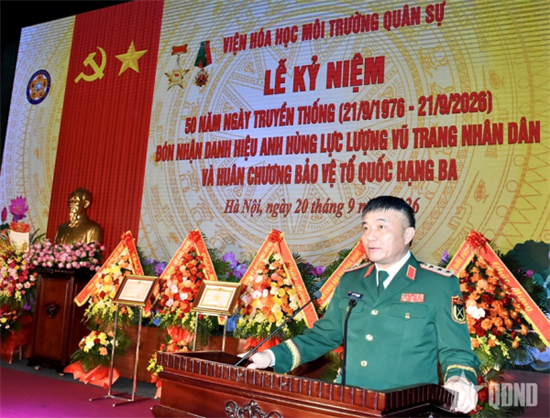 |
| Sr. Lt. Gen. Nguyen Van Hien addesses at the 50th Anniversary of foundation of the Military Chemical and Environmental Institute (Photo: qdnd.vn) |
Currently, amidst the intertwining of traditional and non-traditional security challenges, which profoundly impact national stability, development, and the lives of the People, issues such as the lingering consequences of war, climate change, resource degradation, the loss of biodiversity and ecosystem decline, environmental pollution, energy security, and water security are creating new and urgent demands regarding the management and protection of natural resources and the environment. In particular, the imperative to accelerate industrialisation and modernisation, foster rapid and sustainable national development, strengthen national defence and security, and proactively address non-traditional security challenges necessitates the rational, economical, and efficient management and utilisation of natural resources, environmental protection, and enhanced adaptability and resilience against adverse impacts. This is both an urgent requirement for rapid and sustainable development and a practical measure contributing to building national defence capacity and strength, thereby firmly safeguarding the Fatherland and ensuring the peaceful lives of the People.
In light of this situation, the entire military must continue to thoroughly grasp the Party’s guidelines and the State’s policies and laws, while further enhancing responsibility regarding the management, exploitation, and use of natural resources. The military must uphold its core, leading role in preventing, controlling, responding to, and remediating environmental risks and incidents, thereby contributing to building a modern military, strengthening national defence capabilities, and fostering the country's sustainable development. Accordingly, focus should be placed on effectively implementing the following key measures:
First, strengthen the leadership and direction of Party committees and commanders at all levels regarding natural resource and environmental protection. The entire military, primarily the Party committees and commanders of agencies and units, must continue to deeply internalise the Party’s guidelines and policies, the State’s laws, and the directives, programmes, and plans issued by the Central Military Commission and the Ministry of National Defence concerning natural resource and environmental protection. This task must be clearly identified as a political mission that is both urgent and fundamental for the long term, contributing to the promotion of the fine nature and traditions of our Military. Based on this, specific objectives, requirements, content, and measures for leadership and direction should be determined according to the functions, tasks, and operational areas of each unit, and subsequently incorporated into resolutions and plans for implementation. Party committees and commanders at all levels, especially the heads of these bodies, must directly provide leadership and direction, clearly define the responsibilities and authority of each agency and unit, and be accountable for the implementation results. Furthermore, natural resource and environmental protection efforts must be closely integrated with the performance of military and national defence tasks and the building of all-strong, “exemplary and typical” agencies and units. Concurrently, inspection and supervision must be strengthened to promptly address shortcomings and inadequacies, ensuring that leadership, direction, and implementation do not become lax or merely perfunctory. Periodic assessments and reviews should be conducted to update policies and measures in alignment with mission requirements and practical realities. Furthermore, the results of natural resource and environmental protection efforts should be linked to the performance evaluations of Party committees, Party organisations, agencies, units, and key officials at all levels, thereby fostering a systematic, substantive, and effective approach to this work.
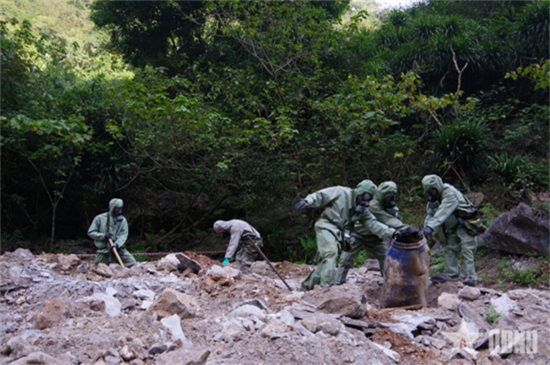 |
| Troops of the Military Chemical and Environmental Institute handle contaminated substances (Photo: qdnd.vn) |
Second, intensify dissemination and education efforts to raise awareness and a sense of responsibility among officers, soldiers, and the public regarding the protection of natural resources and the environment. Agencies and units must effectively carry out communication and educational activities to make sure their personnel deeply understand the significance and role of natural resources and the environment in the nation's sustainable development, the assurance of national defence and security, and the execution of military and defence tasks. They must clearly recognise the importance of the Military's involvement in protecting natural resources and the environment in the current context. This aims to foster a strong, lasting shift in awareness and responsibility, drive behavioural changes, cultivate self-discipline, and build a “green” lifestyle and a culture of environmental and resource protection within every agency and unit. Communication and educational content must be comprehensive and practical, focusing on the Party’s guidelines and policies, the State’s laws and regulations, and the resolutions and directives issued by the Central Military Commission and the Ministry of National Defence regarding the protection of natural resources and the environment.
To ensure the effectiveness of these efforts, content, formats, and methods must be innovated to make it practical and tailored to specific audiences and localities, while addressing the particular environmental issues facing each agency and unit. It is necessary to integrate these topics into political education and legal dissemination programmes, alongside holding contests, seminars, forums, discussions, and dedicated events, such as festivals or awareness weeks, to promote the protection of natural resources and the environment. Close coordination with press and media agencies is required, particularly leveraging the role of the military press, to publicise and spread awareness of effective movements, models, and practices, as well as to highlight exemplary individuals and good deeds across the entire military regarding the protection of natural resources and the environment. Concurrently, agencies and units are proactively coordinating closely with local Party committees, authorities, the Fatherland Front at all levels, and socio-political organisations in their areas of operation to step up public outreach and mobilisation, particularly among communities in remote, border, and island regions, as well as areas frequently affected by natural disasters. These efforts aim to raise awareness of legal compliance, foster habits of resource conservation and environmental protection, and harness the collective strength of the entire population in safeguarding natural resources, the environment, and the Fatherland.
Third, review, develop, and refine mechanisms and regulations while leveraging the role of the entire military, particularly core forces, in protecting natural resources and the environment. To meet the demands of resource and environmental protection in the new context, the Party and State advocate for a continued shift in mindset and management methods: moving from “passive coping” to “proactive response”, and from administrative management to modern, data-driven, and risk-based governance. This approach emphasises proactive prevention, strict control, and early, long-range warning systems regarding risks of pollution, degradation, and environmental incidents. Accordingly, competent agencies must proactively review and advise the Central Military Commission and the Ministry of National Defence on further supplementing and concretising Party guidelines and State policies and laws. They must issue a comprehensive system of regulations on resource and environmental protection within the military and defence sectors that aligns with specific functions and tasks, while clearly defining responsibilities, authority, and coordination mechanisms among various levels, agencies, and units, especially regarding the prevention of, response to, and remediation of environmental incidents. Furthermore, efforts must continue to research, update, and refine the Vietnam People's Army's Environmental Protection Regulations and related provisions, as well as to research and propose specific mechanisms and policies to foster the research, development, transfer, and application of biotechnology in support of military and defence missions and the remediation of war aftermath. During the 2026–2029 period, effectively participate in the amendment and formulation of laws regarding natural resources and the environment, as well as the supplementation and refinement of environmental regulations, standards, and techno-economic norms relevant to the military and national defence sectors.
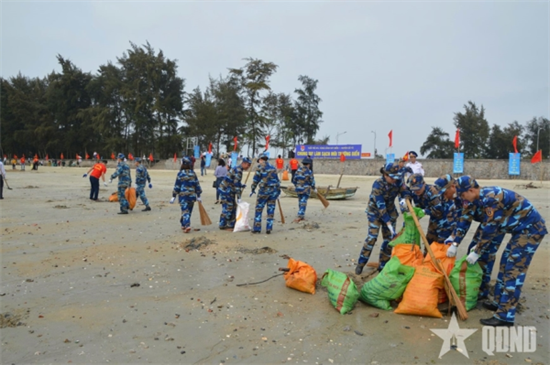 |
| Troops of the Coast Guard Region 1 clear Co To beach (Photo: qdnd.vn) |
Fourth, innovate training content and methods, including drills and exercises, to enhance capabilities in prevention, response, and incident management, as well as the protection of natural resources and the environment. Agencies and units must develop scientifically sound and rigorous plans for training, exercises, and environmental incident management; content and methods should be updated to align closely with practical realities, specific functions, assigned missions, operational areas, and target audiences. Emphasis must be placed on equipping personnel with knowledge and skills regarding risk identification, preventive measures, initial response, and post-incident remediation. Theory must be closely integrated with practice, combining specialised training with the development of capabilities in command, mobility, force and equipment deployment, and on-site coordinated response. Focus should be placed on building and training core forces, particularly chemical and engineering units and other relevant forces.
Drills and exercises must be held with a clear focus, aligned with established plans and potential scenarios, and integrated with civil defence tasks. Priority should be given to complex, unexpected, and cascading scenarios that pose a high risk of significant damage and require the participation and coordination of multiple forces. Attention must be paid to testing command and control mechanisms, mobilisation and coordination capabilities regarding forces and equipment, and response capacities tailored to incident severity levels. Lessons learned must be promptly incorporated to refine and perfect response plans, ensuring close coordination, unified action, and adherence to functional mandates, thereby minimising damage to human life, property, natural resources, and the environment.
Concurrently, international cooperation must be strengthened regarding training, exercises, and experience sharing to enhance capabilities for coordinated responses to natural disasters, catastrophes, and environmental incidents, particularly in maritime environments. Continue to effectively promote joint exercises, exchanges, and search-and-rescue coordination among the militaries of Vietnam, Laos, and Cambodia, as well as with the militaries of other nations. These efforts aim to enhance interoperability, facilitate the sharing of experience, and ensure the timely and effective handling of complex situations, thereby contributing to strengthened civil defence capabilities and the ability to respond to non-traditional security challenges.
Fifth, strengthen research, the application of science, technology, and innovation, and digital transformation; gradually modernise facilities and equipment to enhance capabilities in forecasting, monitoring, and addressing resource and environmental issues. Accordingly, during the 2026–2030 period, relevant agencies and units, spearheaded by the Navy, the Military Science and Technology Institute, the Vietnam-Russia Tropical Centre, and the Chemical Corps, shall formulate and implement schemes and projects to build capacity and boost research. The goal is to ensure that by 2030, the entire marine environment and offshore areas, particularly those of strategic importance for national defence, security, and socio-economic development, are monitored and controlled. Furthermore, these entities will execute tasks, schemes, and projects covering the survey, assessment, monitoring, control, forecasting, mitigation, response, remediation, and improvement of factors related to natural resources, the environment, and climate change in support of military and national defence missions.
Continue to invest in, research, develop, and master strategic, key, and cutting-edge technologies serving national defence, security, effective resource management and utilisation, and environmental protection, such as rare-earth processing, biotechnology, and deep-sea technologies. Prioritise investment in modern technologies that are energy-saving, resource-efficient, and environmentally friendly, while reducing carbon emissions and fostering green and circular economies within military enterprises.
Link digital transformation with the innovation of resource and environmental management methods; build, connect, integrate, share, and effectively utilise databases and digital platforms, gradually transitioning toward data-driven management. Enhance capabilities for analysis, forecasting, early warning, and decision-making support; ensure that information serving command and management functions is updated, interconnected, and consistent across agencies and units. Concentrate resources on completing a synchronised and modern technical infrastructure, as well as systems for environmental monitoring, surveillance, control, and treatment; specifically, prioritise the renovation, upgrading, and operational maintenance of waste monitoring, control, and treatment systems at logistics, technical, and defence industry facilities, production and business sites, service centres, military hospitals, military ports, training centres, and concentrated military barracks, ensuring compliance with environmental technical standards.
Last but not least, proactively and actively engage in domestic and international cooperation, mobilise resources, and enhance capabilities for protecting natural resources and the environment. Prioritise cooperation in scientific research, environmental technology transfer, response to environmental incidents, environmental security and climate change, remediation of toxic chemicals/dioxin, and the clearance of unexploded ordnance (UXO) and landmines; strengthen the exchange of information, data, and experience, as well as training and professional capacity building. Effectively participate in domestic and international forums on military environmental protection; proactively and creatively propose bilateral, multilateral, regional, and international cooperation initiatives regarding the prevention, response to, and control of pollution and inter-regional or transboundary environmental incidents.
With a spirit of proactivity and responsibility, the entire Military should continue to uphold the noble traditions and qualities of “Uncle Ho’s Soldiers”, remaining determined to improve the quality of resource management and ensure their economical and efficient use; proactively prevent, respond to, and effectively address environmental issues, incidents, and climate change, thereby contributing to the successful fulfillment of the mission of national construction and defence in the new era of development.
Senior Lieutenant General NGUYEN VAN HIEN, Member of the Party Central Committee, Member of the Central Military Commission, Deputy Minister of National Defence