Developing Military Technical Academy to meet mission requirements under new circumstances
Thoroughly grasping and implementing the policies of the Party, the Central Military Commission and the Ministry of National Defence on making breakthroughs in education and training under the new circumstances, the Military Technical Academy has been resolutely and comprehensively implementing measures to develop itself into a nationally designated key research university with regional and international standing.
From Campus II of Hanoi University of Science and Technology to a national key university
To meet the demand for Military engineers in support of the resistance war against the United States for national salvation and the development of the Military, on 28 October 1966, the Ministry of National Defence and the Ministry of Universities and Professional Secondary Education (now the Ministry of Education and Training) held a ceremony to announce the establishment of Campus II of Hanoi University of Science and Technology, the predecessor of today's Military Technical Academy. The Academy's inaugural course was also opened in Hanoi on that occasion. This event marked a significant step forward in domestic education and scientific research in Military engineering and laid the foundations for establishing a multidisciplinary technical higher education institution within the Vietnam People's Army.
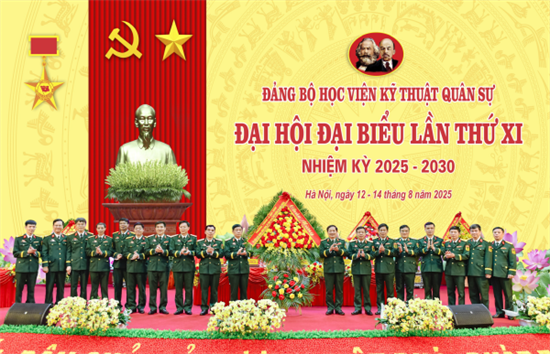 |
| The 11th Party Congress (2025-2030 term) of the Academy |
Over 60 years of development, combat and growth, under the direct leadership and direction of the Central Military Commission and the Ministry of National Defence, successive generations of the Academy's officers, lecturers, cadets, staff and soldiers have upheld solidarity, initiative and creativity, overcoming numerous difficulties to fulfil their missions with distinction. From its modest beginnings as Campus II of Hanoi University of Science and Technology, the institution gradually expanded and developed into the Military Technical University and subsequently the Military Technical Academy as it is known today. Notably, on 31 January 2008, the Government designated the Military Technical Academy as a national key university. This milestone affirmed the Academy's standing, reputation and capabilities within Vietnam's higher education system, while providing a firm foundation for its continued development into a leading centre for training highly qualified technical personnel and conducting advanced military science and technology research, thereby making practical contributions to Military building and national development.
In recognition of its outstanding contributions to education, training and scientific research, the Academy was honoured by the Party and State with the title of Hero of the People's Armed Forces in the Renewal Period in 2005, along with numerous other prestigious awards. These achievements provide a solid foundation for the Academy to continue striving towards becoming a nationally designated key research university, making practical contributions to Military modernisation and accelerating the country's industrialisation and modernisation.
Continuously strengthening internal capabilities, enhancing institutional standing and developing the Academy as a research university
To meet the increasingly demanding requirements of Military building and the task of building and defending the Fatherland, the Academy has identified the need to pursue further comprehensive reform, strengthen its internal capabilities and bring about substantive improvements across all areas of its work. To this end, it will focus on effectively implementing the following key measures:
First, fundamentally renewing leadership methods and promoting the pivotal role of the Party Committee in guiding the Academy’s development as a research university. Based on a thorough understanding of the Party’s guidelines and policies on military affairs, national defence and the protection of the Fatherland, the Academy focuses on the policies for building a modern Military, advancing science and technology, promoting innovation and digital transformation, improving education and training, and strengthening international integration. It continues to translate these policies into specific programmes and plans, clearly defining objectives, targets, roadmaps, priority areas, breakthrough areas and the resources to be allocated. This ensures focused, targeted development suited to the Academy’s specific role as an institution for education, training and scientific and technological research in military engineering.
To enhance leadership effectiveness, the Academy is stepping up the renewal of its leadership methods, shifting decisively from a mindset of “management and administration” to one of “enabling, orienting and guiding development”. It clearly delineates the responsibilities of Party committees, Party organisations and leading officials; emphasises the exemplary role of heads of agencies and units; promotes democracy and collective intelligence; and encourages officials, Party members and the wider workforce to embody the spirit of “seven dare-dos”. Particular importance is attached to creating an environment in which officials and lecturers can fully exercise their professional capabilities and creative thinking, dare to conduct research and innovate, and take responsibility for the Academy’s common development. At the same time, the Academy maintains rigorous inspection, supervision and assessment of implementation progress and quality, while promptly commending and replicating effective models and practices.
 |
| Celebrating the Vietnamese Teachers' Day on 20 November 2024 |
In parallel, the Academy continues to disseminate and vigorously implement the principles of “two steadfast commitments, two priorities for advancement and two preventive measures” and the “five steadfast commitments”, in accordance with the directives of General Secretary and State President To Lam, as well as the Politburo’s Directive No. 07-CT/TW, dated 13 July 2026, on promoting the study and practical application of Ho Chi Minh’s thought, morality, methods and style in the new stage of development. Particular emphasis is placed on translating awareness into practice and linking study and self-cultivation to the performance of official duties, with each official and Party member held accountable for the quality and effectiveness of their work. The Academy strives each year to ensure that 100% of Party committees, Party organisations and Party members fulfil their duties at the required level or above; more than 85% of Party committees and Party organisations and more than 95% of Party members fulfil their duties well or better; and 20% of Party organisations and Party members fulfil their duties excellently. These efforts will strengthen the Academy’s leadership capacity in achieving its development objectives under the new circumstances.
Second, developing a contingent of educators, scientists and leading experts capable of meeting the Academy’s development requirements. Human resources are an endogenous resource and a decisive factor in the quality of education, training and scientific research. Accordingly, the Academy continues to lead efforts to develop a contingent of lecturers, research personnel and experts with firm political resolve, high professional qualifications, modern scientific thinking, the ability to work in international environments and the capacity to master new technologies. It also seeks to deepen awareness of the Academy’s position and mission in building the Military and developing the defence industry, while fostering self-reliance, the aspiration to contribute, a strong sense of responsibility and a passion for scientific and technological innovation.
The Academy places particular emphasis on workforce planning, training, professional development, deployment and the creation of an enabling environment for career advancement. These efforts will gradually build a contingent of leading experts, eminent scientists and chief engineers, supported by strong research teams, key laboratories and centres of excellence in priority areas of the defence industry. The Academy will effectively implement the scheme “Policies for attracting and making effective use of talented personnel for the Vietnam People’s Army to 2030, with a vision to 2050” and the scheme “Training military engineers, talented master’s students and high-quality doctoral candidates”. It will proactively identify, select and train young personnel with outstanding abilities, creating a pool of successors in key disciplines and priority fields. The Academy will also study and propose special mechanisms to attract and make effective use of leading experts, enabling talented individuals to realise their potential and make long-term contributions.
Overseas training will be closely linked to the development of domestic research capacity, knowledge transfer, the growth of research teams and the development of experts capable of leading priority scientific and technological research directions. By 2030, the Academy aims to ensure that more than 95% of its full-time lecturers and research personnel hold a master’s degree or higher; 55–60% hold doctoral or doctor of science degrees; more than 15% hold the titles of professor or associate professor; and more than 1.5% receive the titles of People’s Teacher or Meritorious Teacher. The Academy will build a contingent of leading experts with regional and international reputations, capable of spearheading key research directions, improving the quality of education and training, and enhancing its standing in science and technology.
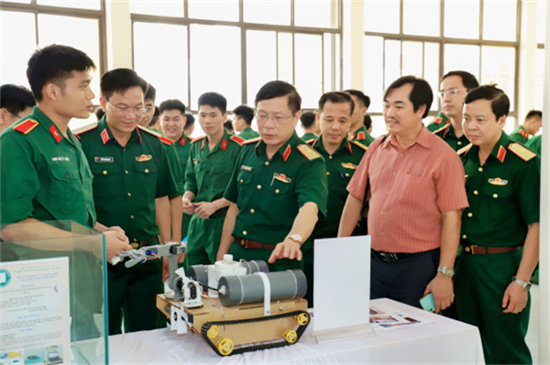 |
| One of the products made from the Innovative Youth Movement of the Academy |
Third, making breakthroughs in improving the quality of education and training and developing high-quality human resources for the Military and the country. The Academy continues to thoroughly grasp and vigorously implement Resolution No. 71-NQ/TW, dated 22 August 2025, of the 13th Politburo, and Resolution No. 290-NQ/QUTW, dated 7 January 2026, of the Central Military Commission on making breakthroughs in the development of education and training in the Military. Accordingly, it remains committed to the guiding principle that “the quality of training at Military educational institutions determines the combat readiness of the units”. It focuses on reviewing, updating, supplementing, developing and refining training programmes to make them modern, practical, interconnected and internationally integrated, in line with the requirements of building a modern Military and advances in science and technology, particularly those arising from the Fourth Industrial Revolution.
The Academy gives priority to expanding high-quality and talent-oriented training and developing disciplines and specialisations in foundational, core and strategic technologies, including artificial intelligence, the Internet of Things, 5G, nanotechnology, machine learning, big data, autonomous systems, geospatial technology, semiconductor integrated circuits, automated command systems, electronic design and embedded systems. It renews teaching and learning methods to foster independent thinking, research capacity, creativity and problem-solving skills. Theory is closely integrated with practical training, experimentation, research, testing and the resolution of real-world engineering problems. The Academy also promotes the application of digital learning resources and intelligent pedagogical methods, linking education and training with military training, combat readiness, Military modernisation and the development of the defence industry. Particular attention is paid to internal quality assurance, with rigorous self-assessment and accreditation of training programmes and educational institutions. Examinations, testing and assessment are reformed to ensure substantive and objective evaluation of learners’ actual capabilities, while combating achievement-oriented practices and misconduct.
Fourth, accelerating the development of science and technology, innovation and digital transformation to lay the foundations for developing the Academy as a research university. In the immediate term, the Academy is making a decisive shift from “mission-driven research” towards building proactive, long-term research capabilities focused on the technologies needed in the Military in the future. Practical requirements serve as the starting point, while the value and applicability of research outputs provide the principal measures of research effectiveness. The Academy actively identifies new and challenging problems arising from military training, combat readiness, technical support and defence industry development to formulate research tasks and commission research projects. It proactively proposes and undertakes national-level and Ministry of National Defence research projects, along with large-scale, interdisciplinary and cross-sectoral initiatives. Its annual targets include launching three to four new national-level research projects and three to four international collaborative research projects, developing an additional three to four products under the Academy’s own brand, and ensuring that more than 90% of completed science and technology projects produce results applied in practice.
The Academy integrates research with education and training, making research an integral part of the educational process. It creates opportunities for cadets and students to participate in research projects and teams, work in laboratories, and directly test and refine products. This approach develops their scientific thinking, research skills, creativity and practical understanding of technology. The Academy also accelerates reform of science and technology management, placing greater emphasis on research outputs. It establishes an enabling framework for research, accepts reasonable risks and encourages new ideas and promising research directions. At the same time, it modernises laboratories, research centres and data infrastructure to facilitate shared use, connectivity and information sharing within appropriate boundaries. Digital transformation is advanced across governance and research, alongside the development of a data ecosystem, digital laboratories, simulation models and platforms supporting research and testing. These efforts will create an integrated research environment spanning problem identification, idea generation, research, education and training, testing, refinement and practical application, thereby shortening the time required to translate scientific and technological advances into practical outcomes.
Fifth, expanding cooperation and international integration, enhancing the Academy’s standing, and creating favourable conditions for its rapid and sustainable development. In line with the Party’s foreign policy and guidelines on international integration, particularly Politburo Resolution No. 59-NQ/TW, dated 24 January 2025, on international integration under the new circumstances, and Central Military Commission Resolution No. 2662-NQ/QUTW, dated 26 February 2024, on international integration and defence diplomacy through 2030 and beyond, the Academy is pursuing a fundamental shift in its approach, moving from cooperation on individual programmes and tasks towards building stable, long-term and substantive partnerships. Priority is given to reputable educational institutions, research institutes and technology corporations, particularly partners possessing source, foundational and core technologies that support Military modernisation and defence industry development.
The Academy will refine its management mechanisms and proactively mobilise international resources, while creating opportunities for its officials, lecturers and scientists to undertake research and training overseas. It will actively participate in international academic forums and networks and further promote the reputation of Le Quy Don Technical University. Cooperation in education and training, research and technology transfer will be expanded, while advanced university governance practices will be adopted. These efforts will help place the Academy among Vietnam’s leading institutions in engineering and technology and, by 2045, among the world’s top 500 leading universities.
In response to the increasingly demanding requirements of Military building and national development, the Military Technical Academy will continue to uphold its tradition of “Unity, Resolve, Intellect and Excellence”. With a firm commitment to reform, it will strengthen its capacity for education and training, scientific research and technological development, and consolidate its position as a nationally designated key university and the leading centre for military engineering education, training and scientific research in the Military and the country. In doing so, the Academy will meet the requirements of its mission under the new circumstances and live up to the trust placed in it by the Party, the State, the Army and the People.
Lieutenant General TRAN VAN THUONG, Political Commissar of the Military Technical Academy