Cultural values of “Uncle Ho’s Soldiers”: from more than eighty years of tradition to a national resource in the new era
Throughout more than 80 years of construction, combat, victory, and development of the Vietnam People’s Army (VPA), cultural values of “Uncle Ho’s Soldiers” have been continuously enriched and spread, becoming not only a source of pride for our Military but also a shared spiritual asset of the entire nation. Resolution 80-NQ/TW, dated 7 January 2026, by the 13th Politburo has incorporated the promotion of these values into the building of Vietnamese people and cultural environment. This necessitates a deeper understanding of the substance and role of the cultural values of “Uncle Ho’s Soldiers” in the new period.
The VPA was organised, led, educated, and trained by the Communist Party of Vietnam and President Ho Chi Minh. It is an army that comes from the People and fights for the People.
During the resistance war against French colonialists, our People gave soldiers who shared their meals and lived under the same roofs with them a simple name: “Uncle Ho’s Soldiers”. This is a unique appellation in the world, bestowed out of the people’s trust and the military - civilian relationship, rather than imposed by orders or official regulations.
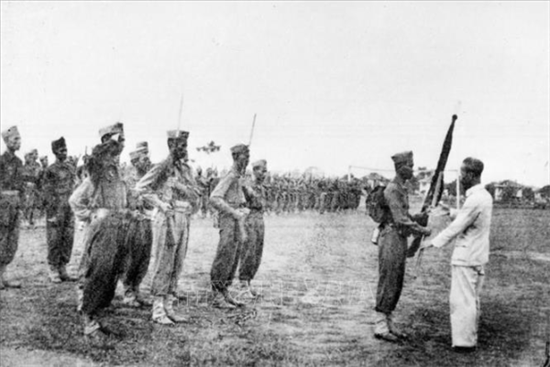 |
| President Ho Chi Minh presents the flag embroidered with the golden words “loyal to the country, devotion to the people” to Tran Quoc Tuan Military School (photo: VNA) |
Like all genuine cultural values, the appellation “Uncle Ho’s Soldiers” has its roots in everyday life and has been nurtured by the people’s affection. Therefore, it has never faded but has endured and grown stronger over time. Originating from the “people’s hearts”, this value has become the “Party’s will”. Nearly 80 years after the First National Cultural Conference (24 November 1946), the Politburo’s Resolution 80-NQ/TW, “on the development of Vietnamese culture”, designated 24 November every year as “Vietnamese Culture Day”. At the same time, it recognised and elevated this appellation, incorporating it into the task of building Vietnamese people with the requirement to: “promote the cultural values of ‘Uncle Ho’s Soldiers’, the six teachings of President Ho Chi Minh to the People’s Public Security, the model of ‘public servants of the people’, and the exemplary culture of cadres, Party members, civil servants, and public employees, in association with culture building within the Party and the political system”.
Thus, the title “Uncle Ho’s Soldiers” is not merely an appellation or a set of qualities associated with a particular force; it has become a cultural value of the nation. The transition from “qualities” to “cultural values” affirms that the title “Uncle Ho’s Soldiers” has been recognised by the People, crystallised into standards, deeply embedded in people’s ways of thinking and living, and passed down through successive generations.
As the country enters the new era, with the 14th National Party Congress advocating the policy of “effectively promoting the cultural values and spirit of dedication of the Vietnamese people, so that culture truly becomes an internal resource, a driving force, and a regulating factor for national development”, these values must not merely be preserved as a legacy. They must also serve as a resource for inspiring and enriching national culture and the culture within the Party, strengthening the “people’s hearts and minds posture”, and contributing to the country’s soft power. Once they become a resource, the cultural values of “Uncle Ho’s Soldiers” must themselves be supplemented and developed to meet the new demands of the times.
“Uncle Ho’s Soldiers” - from an affectionate appellation to a national cultural value
The qualities of revolutionary soldiers existed before the title “Uncle Ho’s Soldiers” came into being. From the establishment of the Vietnam Propaganda Liberation Army Team in late 1944, the Ten Oaths of Honour had already laid down the first standards for soldiers concerning loyalty to the Fatherland, discipline, and relations with the People. On 26 May 1946, at Tran Quoc Tuan Military School, President Ho Chi Minh summarised these standards in his sacred instructions: “Loyalty to the country, devotion to the people”. The Ten Oaths of Honour and President Ho Chi Minh’s teachings represented the requirements imposed by the organisation and the Leader on soldiers and the VPA. However, for these requirements and qualities to become cultural values of the nation, they had to undergo a continuous process of cultivation and development, comprising three fundamental elements.
Recognition by the People. During the resistance wars, soldiers worked and fought alongside their compatriots. Wherever they were, they helped the people with production, protecting villages, hamlets, and their homeland. In return, the people sheltered and protected them, affectionately addressing them using the name of their beloved Leader. Through this appellation, the people also placed a great expectation on the soldiers: they had to live up to President Ho Chi Minh. Alongside this appellation, the people also used other affectionate forms of address for members of the armed forces, such as “Brother/Uncle”, incorporating the armed forces into the familiar forms of address used within Vietnamese families. This is also a rare phenomenon in the world, affirming the People’s respect and recognition of the noble values and qualities embodied by “Uncle Ho’s Soldiers”.
Crystallisation into standards and integration into people’s ways of thinking and living. From the practical conduct of soldiers, what they should and should not do gradually took shape as rules, such as the “Twelve Admonitions” (5 April 1948), in which President Ho Chi Minh reminded soldiers, Government agencies, and unions of what they must remember and practise when interacting and living alongside the People. In 1964, on the occasion of the 20th founding anniversary of the VPA, he summarised the qualities of our soldiers in his words of praise: “Our Army is loyal to the Party and devoted to the people, always ready to fight and sacrifice itself for the independence and freedom of the Fatherland and for socialism; It fulfils every task, overcomes every difficulty, and defeats every enemy”. The transition from “loyalty to the country” (1946) to “loyalty to the Party” (1964) represents a close and consistent relationship. This is because “apart from the interests of the working class, the people, and the nation, our Party has no other interests”. Hence, loyalty to the Party means remaining faithful to the path of national independence associated with socialism, which the Party and the People have chosen.
“Loyalty to the Party, devotion to the people” means absolute loyalty to the Fatherland, the Party, the State, and the People, together with a close-knit bond with the People. These two values define the revolutionary and people-orientated nature of the VPA. Surrounding this core are the constituent values, including revolutionary heroism and optimism, solidarity and self-discipline, and diligence, thrift, integrity, uprightness, and public-mindedness. Looking outwards, these values are reflected in a pure spirit of international solidarity, benevolence, and a love of peace, taking up arms for just causes and humanely treating prisoners of war and those who surrender. These layers of values are closely interconnected. The discipline of “Uncle Ho’s Soldiers” is founded on a conscious understanding of revolutionary ideal rather than enforced obedience, while revolutionary heroism is forged through loyalty to the Party and the close-knit bond between the Military and the people.
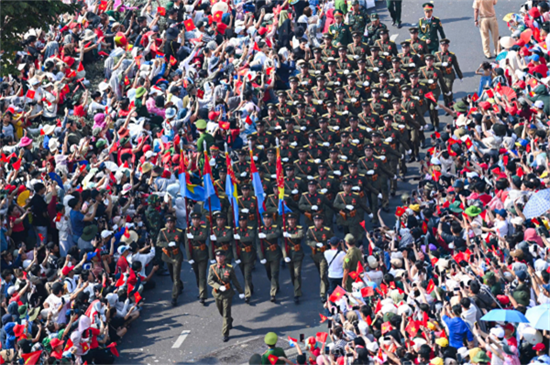 |
| The 50th anniversary of the South Liberation and National Reunification (photo: laodong.vn) |
Transmission from one generation to the next. The qualities recognised and crystallised among the generation of soldiers who fought against the French were inherited and further elevated by the generation of soldiers who fought against the US, before being further tested during the wars to defend the Fatherland’s borders and the fulfilment of international missions. However, this transmission does not happen automatically. During the Đổi Mới (Renewal) period, the negative impacts of the market economy could cause these values to fade unless they were consciously preserved. The Campaign to promote tradition, devote talent, and deserve to be “Uncle Ho’s Soldiers” in the new era, Resolution 847-NQ/QUTW of the CMC, and the 14th National Party Congress’s continued affirmation of the requirement to preserve and promote the noble qualities of “Uncle Ho’s Soldiers”, ... are all organised efforts to preserve and pass on these values.
These three fundamental aspects demonstrate that “Loyalty to the Party, devotion to the people” has maintained its enduring position as the core throughout every period, while the content and forms of expression of other values have been supplemented in each revolutionary stage. Through successive stages, the qualities and cultural values of “Uncle Ho’s Soldiers” have become a shared spiritual asset of the nation, contributing to enriching the culture of the entire community, as well as the culture within the Party and the political system.
The cultural values of “Uncle Ho’s Soldiers” in Vietnamese culture and the culture within the Party
With regard to Vietnamese culture, the 14th National Party Congress states: “Building and developing an advanced Vietnamese culture imbued with national identity, in a comprehensive manner on the foundation of the system of national values, cultural values, family values, and Vietnamese human standards”. The system of national values has a distinctive feature: its three foremost values - “Peace, Unity, and Independence” - were not inherited but had to be won and defended through the blood and sacrifice of the People and successive generations of military cadres and soldiers. Therefore, for Vietnamese people, the title “Uncle Ho’s Soldiers” provides the most tangible way of understanding values that are otherwise highly abstract. The standards for Vietnamese people identified in Resolution 80-NQ/TW, such as “patriotism, solidarity, self-reliance, compassion, honesty, responsibility, discipline, creativity”, are practised by our soldiers every day in their combat, work, and daily life.
The cultural values of “Uncle Ho’s Soldiers” are also widely disseminated by generations of war veterans and former military personnel when they return to their localities, bringing a disciplined way of life, comradeship, and a sense of responsibility to their families, villages, and workplaces. They also play an important role in educating younger generations about patriotism and revolutionary heroism.
In addition, the cultural values of “Uncle Ho’s Soldiers” are deeply portrayed in art and collective memory. The image of “Uncle Ho’s Soldier”, with its noble qualities depicted in literary works, textbooks, and other publications, has been deeply imprinted in the minds of countless Vietnamese people. It has not faded, even among generations who have never experienced war. The popularity of the film Red Rain, hundreds of thousands of visits to the Vietnam Military History Museum, and the large numbers of people who stay up throughout the night to immerse themselves in the atmosphere of military parades commemorating the country’s major anniversaries, ... all demonstrate that the cultural values of “Uncle Ho’s Soldiers” have touched people’s emotions and become a source of pride for people from all walks of life. They can also serve as material for the development of cultural industries.
With regard to the culture within the Party and the political system, the 14th National Party Congress sets out the task of “continuing to refine the theory of Party building in terms of ethics, so that ours truly becomes a moral and civilised Party in the new situation”. The People’s trust in the Party is built not only through Party documents but, first and foremost, through individual cadres and Party members who work and interact with the People on a daily basis. Across the country, particularly in border, island, remote, and isolated regions, military and police troops are always among the forces closest to the People. Therefore, the Party’s morality and civilisation are partly reflected through them. Morality is demonstrated through loyalty, dedication, and readiness for sacrifice. Civilisation is reflected in self-discipline, respect for the customs and property of the People, and humane conduct both in combat and in international relations.
What is essential is not merely the possession of these qualities themselves, but also the way the VPA translates them into practical life. The standards of revolutionary morality identified in the Politburo’s Regulation 144-QĐ/TW, dated 9 May 2024 (13th tenure), “on standards of revolutionary morality for cadres and party members in the new period”, such as “patriotism, respect for the People, and absolute loyalty to the Party and the Fatherland”, and “diligence, thrift, integrity, uprightness, and public-mindedness”, ... have long been embedded in the way of life of successive generations of military cadres and soldiers. This has been achieved through many factors, among which party and political work serves as the “soul and lifeblood” of the VPA, motivating cadres and soldiers to constantly foster their determination to train and improve themselves. Discipline is maintained through conscious understanding rather than solely through orders. As a result, political culture within the VPA does not remain at the level of awareness but is translated into voluntary action. This is highly practical for implementing the policy of “placing emphasis on the development of political culture” set out by the 14th National Party Congress.
From this perspective, it can be seen that the VPA’s quality of “devotion to the people” and the model of “public servants of the people”, the two points placed side by side in Resolution 80-NQ/TW, share the same roots. Immediately after the August Revolution, President Ho Chi Minh clearly stated that government agencies “are all public servants of the people, meaning that they are there to shoulder common tasks on behalf of the people, not to lord it over them”, and that “whatever benefits the people, we must do our utmost to accomplish; whatever harms the people, we must do our utmost to avoid”. Within the VPA, this ideology is put into practice through mass mobilisation, through task forces stationed in villages and closely attached to people in remote and isolated areas, and through the “Good Mass Mobilisation” emulation movement. As our country adopts the two-tier local government model, the requirement for cadres and civil servants to stay close to and maintain close contact with the people has become increasingly urgent. Therefore, the VPA’s motto “When we stay, the people love us; when we leave, the people miss us” provides valuable experience for building public service ethics, renewing mass mobilisation work, and cementing the close-knit bond between the Party and the People.
The culture of “Uncle Ho’s Soldiers” is noble and represents a distinctive source of pride for our Party, our People, and our VPA. However, these values are not immune to erosion. Therefore, promoting the cultural values of “Uncle Ho’s Soldiers” must go hand in hand with strictly observing Party and military discipline and fulfilling the responsibility to set an example among cadres. (To be continued)
Associate Prof. LE HAI BINH, PhD
Member of the Party Central Committee
Permanent Deputy Director of the Ho Chi Minh National Academy of Politics