The evolution of the Party’s thinking on “partners” and “adversaries” in foreign relations
The Party’s conceptualisation of “partners” and “targets” has been continuously refined and developed through successive National Congresses. This evolution not only reflects progress in the Party’s strategic thinking regarding national construction and defence but also directly shapes and refines its foreign policy within the new context.
Vietnam is a peace-loving nation. We understand the value of peace more profoundly than anyone, just as we deeply comprehend the suffering and loss wreaked by war. Nevertheless, when faced with the threat of aggression, we have never submitted. Instead, we have always stood up with courage to defeat the unjust wars waged by invaders, securing and preserving our national independence and freedom, while simultaneously contributing to the defence of world peace. Just war of such kind is needed as without it, there could be no peace, no independence, and no freedom. It was for this very reason that, during our heroic resistance against the United States for national salvation, Romesh Chandra, President of the World Peace Council, declared: “Vietnam is the conscience of our era”. This statement reflects the profound admiration of the international community for the just struggle of the Vietnamese People in pursuit of their independence and freedom.
The more we perceive the value of peace, the more proactive we should be in safeguarding it through every possible way, including foreign affairs, to both establish and maintain a peaceful environment for our nation, while simultaneously contributing to peace and stability in the region and the world. This imperative requires our Party to continuously innovate its foreign policy thinking, proactively identifying and correctly managing international relations in each period. The evolution of the Party’s conceptualisation of “partners” and “adversaries” has likewise emerged and developed in response to these practical demands.
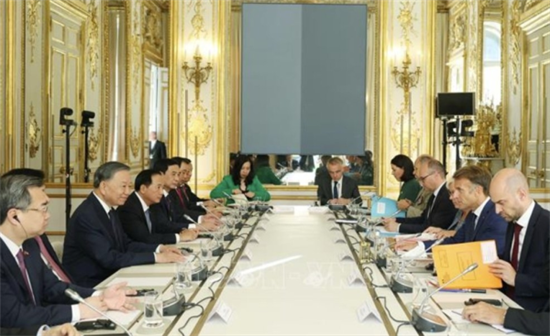 |
| Party General Secretary To Lam held talk with French President Emmanuel Macron in his official visit to France in September 2026 (Photo: vov.vn) |
Immediately after the victory in the resistance war against America, our country faced immense challenges resulting from war, coupled with the encirclement, embargoes, and fierce opposition from hostile forces while international relations were deeply affected by the bipolar world order. In such a context, the requirements for cooperation and struggle were distinct. However, as the global political landscape shifted, especially when peace, cooperation, and development increasingly became the mainstream, the Party approached foreign relations differently.
This shift became clearly evident in the late 1980s, when Resolution No. 13-NQ/TW, issued by the Politburo (6th Tenure) on 20 May 1988, regarding foreign policy tasks in the new situation, introduced a foundational new approach. This marked a significant innovation of the Party’s foreign policy thinking, characterised by “diversification and multilateralisation”, the integration of struggle and cooperation, and the principle of peaceful coexistence. Step by step, the nation dismantled the state of encirclement and isolation, fostering an international environment conducive to the development and defence of the Fatherland. This was not merely a tactical adjustment; it reflected a fundamental shift in the perception of the international landscape and the nation’s own interests, moving away from an approach defined primarily by confrontation toward broadening cooperation on the basis of similarities to leverage favourable external factors.
Building upon this foundation, the Party’s foreign policy thinking has been continuously supplemented and developed through its National Congresses, increasingly demonstrating a proactive, open, and flexible approach to identifying and managing international relations. At the 7th National Congress, our Party established the policy: “Vietnam wishes to be a friend to all countries in the global community, striving for peace, independence, and development”. Then, the Resolution of the 8th Plenum of the Party Central Committee (9th tenure) on the Strategy for Fatherland defence in the new situation, the conceptualisation of “partners” and “adversaries” was more clearly defined with guiding principle of more friends, less enemy, and leveraging maximum sympathy and support from progressive people worldwide. What is noteworthy is not merely the introduction of the categories of “partners” and “adversaries”, but the evolution in how these relationships are perceived and managed.
In the Resolution No. 28-NQ/TW of the 8th Plenum of the Party Central Committee (11th tenure) on the Strategy for Fatherland defence in the new situation, the Party’s thinking regarding partners and adversaries reached a new, more flexible, and dialectical level. Accordingly, any entity that respects Vietnam’s independence and sovereignty, and establishes or expands friendly relations and cooperation based on equality and mutual benefit, is considered a partner; conversely, any force that harbors schemes or engages in actions aimed at undermining Vietnam’s objectives in the cause of national construction and defence is considered an “adversary”. Nevertheless, even within such adversarial entities, there may still be aspects that can be leveraged for cooperation or engagement. Within any partnership, there may exist conflicts that require struggle.
Given the context of deepening globalisation and international integration, alongside a shifting landscape of international relations characterised by complex, intertwined interests, our Party has become increasingly proactive, flexible, and creative in its foreign policy. We seek cooperative relationships based on equality and mutual benefit, an objective shared by our partners, for the sake of each nation’s own interests, as well as for the peace, stability, and development of the region and the world. Accordingly, elevating diplomatic relations with any partner must meet the following conditions: first, it must not harm, but should ideally benefit our national development and the defence of our Fatherland, while ensuring non-interference in each other’s internal affairs; second, it must contribute to maintaining peace, stability, and development globally; and third, it must not negatively affect or cause harm to any other nation.
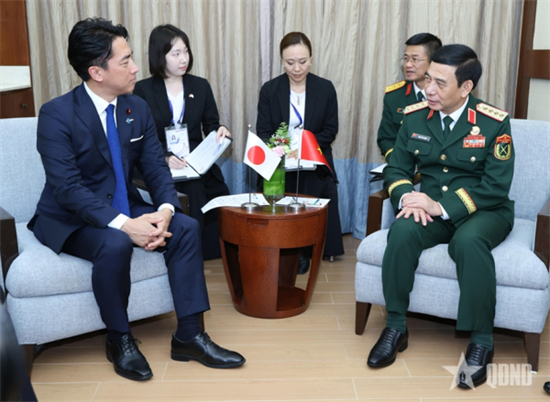 |
| General Phan Van Giang talked with Japan's Defence Minister Koizumi Shinjiro in the framework of the 20th ADMM and 13th ADMM+ Meetings in Cebu, the Philippines (Photo: qdnd.vn) |
At the 14th National Congress, our Party adopted a more proactive stance in its foreign relations, strengthening the partnership dimension within its cooperative relations. This does not signify a “lowering of vigilance”; rather, it is a proactive approach to preventing and limiting conflicts and disagreements. When interests become intertwined, trust is solidified, and cooperative ties are expanded, the space for confrontation and conflict naturally shrinks. This demonstrates that the Party’s foreign policy thinking is not merely reactive, i.e. addressing events as they unfold, but is also geared toward actively shaping a favourable international environment and leveraging areas of consensus to serve the nation’s interests. Furthermore, the Party’s perspective on “partners” and “adversaries” is also very clear, leaving no room for ambiguity or the conflation of distinct categories. Beyond establishing a unified stance on these concepts, the Party also highlights the complex, overlapping nature of these roles, providing a basis for discernment and caution in our cooperative endeavors.
Consequently, the assessment and differentiation between partners and adversaries are highly flexible rather than rigid, depending on specific circumstances, as well as the conduct, policies, and actions of other nations toward us. In fact, a single country may simultaneously be both a partner and an adversary, or, more precisely, they may act as a partner at one time and an adversary at another, or serve as a partner in one domain while acting as an adversary in another (and vice versa). Therefore, we must maintain utmost vigilance, exercising careful judgment and applying the Party’s perspectives on partners and adversaries, and on the balance between cooperation and struggle with both accuracy and flexibility. This is essential to avoid avoidable errors in our foreign relations that could otherwise compromise the cause of national construction and defence in this new era.
The evolution of the Party’s thinking regarding “partners” and “adversaries” stands as a significant achievement in the conceptual framework for national development and defence. It has fostered a dialectical and flexible approach to identifying and managing international relations, serving as a foundation for formulating and continuously refining the nation’s foreign policy. Over the 40 years of Renewal, a period that began when Vietnam faced embargoes, encirclement, and isolation, the country has transformed remarkably. As of September 2026, Vietnam has established diplomatic relations with 195 countries and territories, including comprehensive partnerships and higher levels with 42 nations (all G7 members and 17 of the 20 G20 members), as well as comprehensive strategic partnerships with all five permanent members of the UN Security Council. Never before has Vietnam possessed such a strong foundation, potential, international standing, and prestige as it does today. This reality reflects the Party’s strategic vision and keen insight into foreign affairs and international integration in the new era. It also affirms the soundness of its foreign policy built upon three pillars: Party diplomacy, State diplomacy, and people-to-people diplomacy, all within a global context defined by epochal shifts that present both significant opportunities and complex challenges for Vietnam.
Reflecting on the remarkable achievements in foreign affairs over the 40 years of Renewal, it is clear that the decisive factor has been the Party’s sound foreign policy. This policy is consistently rooted in the principles of independence, self-reliance, resilience, peace, friendship, cooperation, and development, alongside the multilateralisation and diversification of external relations, all while prioritising the national interest above all else. A key breakthrough in this process has been the evolution of the Party’s conceptual framework regarding “partners” and “adversaries”. This represents a shift away from viewing international relations primarily through a binary lens of “friend versus foe” toward a more dialectical and flexible approach. Furthermore, it encompasses a sophisticated, dialectical understanding of the complex, intertwined nature of international relations, characterised by a dynamic interplay of both cooperation and struggle. This has opened up a broader, more proactive and effective diplomatic space for the nation in this new era.
Major General NGUYEN MANH HUNG