The entire military promotes the study and practice of Ho Chi Minh’s ideology, morality, method, and style in the new development period
On 13 July 2026, the Political Bureau issued Directive No. 07-CT/TW on promoting the studying and practicing of Ho Chi Minh’s ideology, morality, method, and style in the new development period. The Directive affirms the important role and the necessity of further promoting the value of Ho Chi Minh’s heritage in the country’s new development period. Therefore, thoroughly grasping and effectively implementing the Directive is an urgent requirement to inherit and promote the results of Directive No. 05-CT/TW of the Political Bureau, creating a solid foundation for the entire military to constantly promote the cultural value of “Uncle Ho’s Soldiers” in the new era, contributing to building a politically strong military that successfully completes all assigned tasks.
Over the past 10 years, under the leadership of the Central Military Commission and the Ministry of National Defence, and the direction of the General Political Department, the entire military has thoroughly grasped and implemented the Political Bureau’s Directive No. 05-CT/TW dated 15 May 2016, on promoting the studying and following of Ho Chi Minh’s ideology, morality, and style, achieving many outstanding results. The studying and following of Uncle Ho within the entire military have been increasingly promoted, creating a profound widespread impact, step by step becoming a self-conscious awareness, an internal need, and a regular action of cadres, party members, and the masses. This has contributed to building clean, strong, and exemplary party committees and organisations, as well as comprehensively strong “exemplary and typical” agencies and units, constantly fostering and spreading the cultural value of “Uncle Ho’s Soldiers” in the new era.
The results of studying and following Uncle Ho have become a strong driving force, encouraging and motivating cadres and soldiers across the entire military to overcome all difficulties and challenges, upholding the spirit of self-reliance, self-strengthening, proactiveness, and creativity, excellently completing assigned tasks. This contributes to effectively performing functions and tasks, improving the overall quality and combat strength of the Military; firmly protecting the independence, sovereignty, unity, and territorial integrity of the Fatherland; and protecting the Party, the State, the People, and the socialist regime. The more difficult and arduous the circumstances, the more affirmed the loyalty, political mettle, belief, and will to fight and win, the spirit of solidarity, the love for comrades, and the flesh-and-blood attachment to the People among military cadres and soldiers become, making the qualities of “Uncle Ho’s Soldiers” shine brighter, worthy of the trust and love of the Party, State, and People.
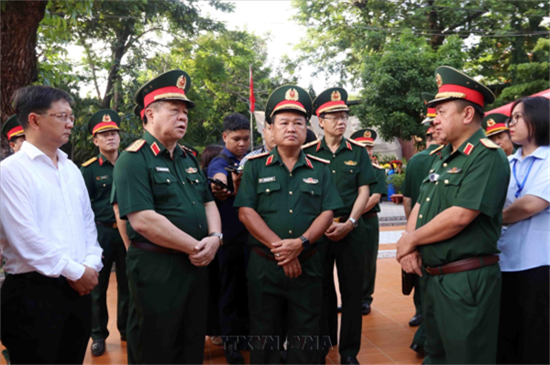 |
| General Nguyen Trong Nghia listens to report of the search and recovery of martyrs' remains at Le Thi Rieng Park, Ho Chi Minh city (Photo: VNA) |
Currently, the world and regional situations continue to evolve complicatedly; peace, cooperation, and development remain major trends, but also face many new difficulties and challenges. Strategic competition among major powers, military conflicts, trade wars, and non-traditional security issues deeply and comprehensively impact all nations. Science and technology, especially artificial intelligence, are creating profound changes in all fields, including the field of military and defence. Our country has entered a new era of development with strong belief and motivation. However, hostile, reactionary, and politically opportunistic forces are intensifying their sabotage against the Party, the State, and the Military with increasingly sophisticated, open, and direct tactics. The missions of building the Military, consolidating national defence, and protecting the Fatherland are supplemented and developed with increasingly high requirements.
Based on the 10-year review of the implementation of Directive No. 05-CT/TW, the 14th Political Bureau issued Directive No. 07-CT/TW to continue affirming the significance and importance of promoting the studying and practicing of Uncle Ho in the new development period (herein after the study and practice). Accordingly, our entire Party, People, and military will strongly shift from studying and following Uncle Ho to regularly and self-consciously practicing His ideology, morality, method, and style, practically attached to the quality and efficiency of task performance. This is a requirement of particularly important significance to constantly improve political mettle, maintain the revolutionary nature, promote the noble qualities of “Uncle Ho’s Soldiers”, and build a revolutionary, regular, elite, and modern people’s army, meeting the requirements of firmly protecting the Fatherland in the new development stage. To successfully achieve this goal, it is necessary to synchronously implement guidelines and solutions, focusing on the following main contents:
Firstly, strengthening the work of leading and directing the thorough grasp and implementation of the Directive No. 07-CT/TW of the Political Bureau, creating a strong transformation from awareness to action across the entire military. Party committees and organisations at all levels must thoroughly grasp the significance, content, requirements, and new points of the Directive; identify that the study and practice is a key and regular political task, closely attached to the work of Party building and rectification, and building a revolutionary, regular, elite, and modern Vietnam People’s Army.
Functional agencies at all levels need to proactively advise on developing synchronous and scientific action plans and programmes, concretising the Directive’s requirements into goals, targets, contents, and solutions suitable to the functions and tasks of each agency and unit; ensuring unity in leading, directing, and implementing, inspection, and supervision. This will make the study and practice truly a routine, creating substantial changes across the entire military.
Closely link the thorough grasp and implementation of Directive No. 07-CT/TW with the implementation of resolutions, directives, conclusions, and regulations on Party building and rectification, with the central is newly issued breakthrough and strategic resolutions of the Central Committee; Regulation No. 144-QĐ/TW dated 9 May 2024, of the Political Bureau on the standards of revolutionary morality for cadres and party members in the new period; Regulation No. 19-QĐ/TW dated 8 April 2026, of the Party Central Committee on political and ideological work within the Party; Regulation No. 207-QĐ/TW dated 26 July 2026, of the Party Central Committee on things party members are not allowed to do; Resolution No. 847-NQ/QUTW dated 28 December 2021, of the Central Military Commission on promoting the qualities of “Uncle Ho’s Soldiers” and resolutely fighting individualism in the new situation; Directive No. 855-CT/QUTW dated 12 August 2019, on stepping up the Movement Campaign “Promoting traditions, dedicating talents, worthy of “Uncle Ho’s Soldiers” in the new era”; as well as emulation movements and campaigns at all levels and sectors across the entire military. This contributes to achieving the goals and breakthroughs set by the 14th Party Congress Resolution, the Resolution of the 12th Military Party Congress, the resolutions of party congresses at all levels, and successfully fulfilling the political tasks of agencies and units.
The leadership and direction of the study and practice at all levels must thoroughly grasp and clearly demonstrate the spirit: “turning will into action, turning decisions into concrete results”; closely link with the strict organisation and implementation of the directives of General Secretary, President, and Secretary of the Central Military Commission To Lam on “2 steadfastnesses, 2 intensifications, 2 preventions”, the principle of “5 steadinesses”, and “4 strategic orientations”. At the same time, thoroughly grasp and effectively implement the spirit of “6 clarities” in organising the implementation. Proactively “translate” strategic orientation requirements into specific, practical, and highly feasible leadership contents, ensuring unity between awareness and action, quantified by specific goals and targets, creating substantial and clear changes in each agency and unit. Proactively forecast the situation, promptly supplement and adjust leadership contents to suit the requirements of the cause of building and protecting the Fatherland in the new situation, especially given the strong development of science, technology, and digital transformation, ensuring acumen and flexibility while remaining steadfast in principle.
Improve the effectiveness and efficiency of inspection and supervision, ensuring that the study and practice are implemented seriously, effectively, and substantially right from the start. Strongly shift from inspecting and supervising the building of plans and registrations to inspecting and supervising the results of political task performance, the effectiveness of solving difficult and challenging issues, weak links and aspects. Concurrently, attach this to the implementation of the Party’s resolutions and regulations on building and rectifying the Party and the political system, struggling against bureaucracy, corruption, wastefulness, and negativity. Promptly detect and overcome limitations and shortcomings, resolve obstacles and inconsistencies, and resolutely and strictly handle party organisations, cadres, and party members who violate Party discipline, State laws, and Military discipline.
Maintain the effective and substantial of preliminary, final reviews, and lesson-drawing processes regarding the study and practice. Continue to honour and replicate good models, creative methods, advanced examples, and typical role models at all levels; promptly praise and reward collectives and individuals with outstanding achievements, ensuring objectivity, impartiality, accuracy, and the right person for the right job. Promote the combined strength of organisations and forces, regularly coordinating closely among functional agencies and units inside and outside the Military, creating a synergy in the study and practice.
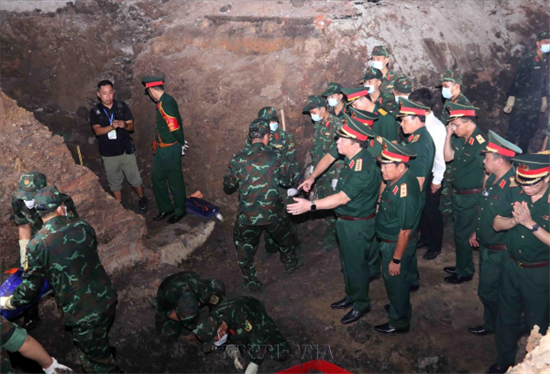 |
| General Nguyen Trong Nghia comes down to the site to check the search and recovery of martyrs' remains at Le Thi Rieng Park, Ho Chi Minh city (Photo: VNA) |
Secondly, closely combining the study and practice with creating breakthroughs in promoting the cultural value of “Uncle Ho’s Soldiers” in the new era. Agencies and units need to thoroughly grasp and effectively implement Directive No. 676-CT/QUTW dated 20 June 2026, of the Standing Committee of the Central Military Commission on strengthening the leadership and direction of promoting the cultural value of “Uncle Ho’s Soldiers” in the new era; and Resolution No. 18-NQ/TW dated 28 July 2026, of the Party Central Committee on building a disciplined, safe, civilised, harmonious, and developing society. Focus on developing political culture and military culture; participate in building, concretising, and implementing the national value system, cultural value system, family value system, standards of Vietnamese people, and standards of “Uncle Ho’s Soldiers”. Establish and effectively implement the cultural standards of leadership, public duty culture, and behavioural culture of cadres and party members, as well as the code of conduct for military personnel, defence workers, and officials, with a focus on strictly implementing military regulations and discipline, maintaining military style, and promoting the qualities and cultural value of “Uncle Ho’s Soldiers”.
Strongly arouse the spirit of patriotism, autonomy, self-confidence, self-reliance, self-strengthening, national pride, and the heroic tradition of the Military, making traditional cultural values and the culture of “Uncle Ho’s Soldiers” an endogenous resource and driving force for building a revolutionary, regular, elite, and modern Military. This contributes to building Vietnam into a socialist country with a high level of development, civilisation, modernity, distinct identity, creativity, and enduring vitality, as oriented by the vision to 2130 identified in Resolution No. 19-NQ/TW dated 28 July 2026, of the Party Central Committee on innovating Vietnam’s development model.
Continue to uphold the responsibility of party committees, cadres, and party members, and the pioneering role of union members in spreading the cultural value of “Uncle Ho’s Soldiers”, building agencies and units with a healthy and vibrant cultural environment; ensure that Uncle Ho’s ideology deeply permeates every action and behaviour of cadres and soldiers; so that every manifestation of the culture of “Uncle Ho’s Soldiers” bears the distinct mark of Ho Chi Minh’s ideology, morality, method, and style. When ideology becomes culture and culture guides action, a sustainable endogenous strength will be formed, contributing to building a politically strong Military in the new situation.
Thirdly, focusing on promoting the “practice” of Ho Chi Minh’s ideology, morality, method, and style, creating a solid change in both awareness and action across the entire military. The 14th Party Congress emphasised the spirit of drastic action: talking is doing, doing immediately, doing correctly, doing drastically, doing to the end, and doing effectively, considering this a decisive factor for the effectiveness and efficiency of the Party’s leadership and the success of the cause of national development in the new period. President Ho Chi Minh also pointed out: “Theory and practice must go together. Learning without practice is useless. Practice without learning is not smooth”. Therefore, promoting “practice” is the decisive factor to realise the value of Ho Chi Minh’s ideology, morality, method, and style in life and military activities.
Regarding content, it is necessary to practice Ho Chi Minh’s ideology, morality, method, and style comprehensively and synchronously, but with focus and emphasis, attached to the performance of functions and tasks of the Military, agencies, and units. First and foremost, practice Ho Chi Minh’s ideology, morality, method, and style regarding mettle and innovative thinking: daring to think, daring to speak, daring to do, daring to take responsibility, daring to innovate, daring to face difficulties and challenges, and daring to act for the common good; being steadfast in the goal and ideal of national independence and socialism; dedicating one’s whole life to serving the Fatherland and the People; upholding the ideology of “people first, guns later”; upholding responsibility, discipline, and dedication to work, to agencies, and units.
Along with that, practice a democratic, scientific, and effective working method and style that is close to reality, close to the people, and for the people; thoroughly implement the viewpoint “The people are the root”; maintain independent, autonomous, and creative thinking, always linking theory with practice, avoiding dogma and academic; have a strategic vision but a simple, easy-to-understand, and practical approach. The method and style of expression (speaking and writing) should be authentic, easy to understand, easy to remember, and easy to implement, suitable for the target audience and purpose of delivery. The method and style of behaviour should be humble, approachable, sincere, tactful, and polite. The lifestyle should be simple but demonstrate high regularity, firmly maintaining “military discipline and conduct”; upholding the method and style of setting an example, matching words with actions. Along with that is the spirit of self-study and research in the context of digital transformation and scientific and technological development, forming a scientific and modern working method and style, systemic thinking, fast and accurate manners, and high adaptability to the digital and international environments.
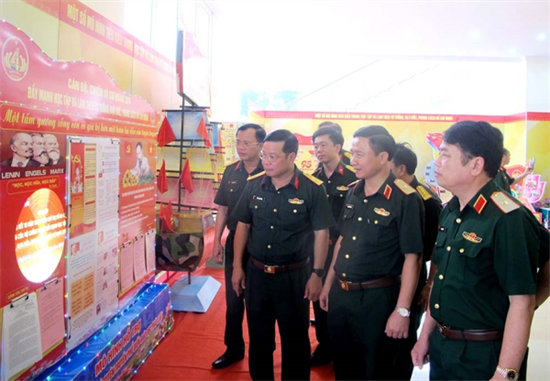 |
| Leader of Military Region 4 watches the materials serving for the study and practice of Ho Chi Minh's thought, morality, method and style (Photo: qdnd.vn) |
Fourthly, closely combining the study and practice with the performance of political tasks and the exemplary role of cadres and party members. Closely combine the study and practice with the performance of political tasks of each agency and unit and the work of Party building and rectification; effectively implement the goals, development orientations, and breakthroughs according to the Resolution of the 14th Party Congress and the Resolution of the 12th Military Party Congress. The study and practice must truly aim at overcoming specific limitations, focusing on promptly and completely removing “bottlenecks” and “knots”, creating clear and measurable changes, avoiding spreading thin and lacking focus, and contributing to improving the quality and efficiency of political task performance and the leadership capacity and combat strength of party committees and organisations at all levels. Implement synchronously between “building” and “preventing”; taking “building” as the basic, strategic, and long-term task, and “preventing” as an important and urgent one. Promote the advisory and guiding role of political agencies and advisory departments at all levels; make the study and practice truly go into life and activities, truly accessible so that soldiers can easily implement.
Party committees and commanders at all levels must regularly pay attention to leading and directing the upholding of the exemplary responsibility of the contingent of cadres, party members, and union members - especially the heads of party committees and presiding cadres at all levels - in studying and practicing while also complying with the Party’s and Central Military Commission’s regulations on the responsibility of setting an example, implementing the moral standards of cadres and party members according to the principle “superiors first, subordinates later”, matching words with actions. The heads of party committees, agencies, and units need to clearly demonstrate their pioneering and exemplary role; implement superiors setting examples for subordinates, and party members setting examples for the masses with specific actions, and concretise them into evaluation criteria in cadre work, focusing on three groups of contents: (1) Political mettle, innovative thinking, and organisational and implementation capacity: demonstrated in steadfastness in goals and fighting ideals; proactively grasping the situation, forecasting accurately, making timely decisions; daring to think, daring to speak, daring to do, daring to take responsibility for the common good. (2) Public duty morality and enforcement discipline: exemplary in moral qualities and lifestyle; matching words with actions; working scientifically, closely to reality, with concrete results and products; not avoiding or shifting responsibility; practicing diligence, thrift, integrity, uprightness, and absolute impartiality; resolutely preventing and combating corruption, wastefulness, and negativity; being honest, impartial, objective, open, and transparent; fighting bureaucracy, localism, factionalism, and group interests. (3) Spirit of serving the People: being close to the People, respecting the People, understanding the People, learning from the People, relying on the People, and working for the People; soldiers proactively come to the People without letting them in difficulty have to find the soldiers; ensuring the Military is worthy of being the exemplary force at the forefront of the study and practice.
Fifthly, innovating and improving the quality of research, application, creative development, propaganda and dissemination of Ho Chi Minh’s ideology, morality, method, and style. Military research agencies, academies, and schools need to focus on building plans to research, study, apply, and creatively develop Ho Chi Minh’s ideology, morality, method, and style for target groups, attached to organising research on scientific projects and topics from the grassroots to the national level. The focus is on researching and clarifying the theoretical and practical value of Ho Chi Minh’s heritage in the face of new requirements; topics on researching, applying and creatively developing Ho Chi Minh’s thought in building a politically strong Military, a strong and modern all-people national defence, and the all-people national defence posture in the new era; Ho Chi Minh’s thought on revolutionary morality, fighting individualism, and Uncle Ho’s example in self-cultivation and training of revolutionary morality, as well as resolving relationships: “towards oneself, towards others, towards work”, etc.
Innovate propaganda content in a concise direction, closely following the reality of tasks, highlighting the core value and significance of Ho Chi Minh’s ideology, morality, method, and style for building the Military in the new situation. The content must have focus and target, avoiding spreading thin; emphasis should be placed on directly addressing issues related to training, combat readiness, troop management, regularity building, and discipline observance. Concurrently, fundamentally innovate propaganda methods and forms in a modern, flexible direction, suitable to the characteristics of each audience. Maximise the advantages and power of press agencies, media, and social networks in propagating and widely spreading the results of the implementation of Directive No. 07-CT/TW, especially models, examples, and creative and effective methods. Accelerate the application of science and technology, especially information technology, digital transformation, and artificial intelligence in building data systems, digital learning materials, and studying and practicing, ensuring it is concise, easy to understand, easy to remember, easy to implement, and easy to inspect and evaluate. Diversify forms and means of propaganda in a visual, vivid, easily accessible, and fast-spreading direction; improve the effectiveness of creative, literary, artistic, press, and publishing activities on the topic of studying and practicing. Thereby, expand the scope of impact, enhance the spread, and create positive effects throughout the military, society, and the international community.
Sixthly, resolutely fighting and refuting wrong and hostile viewpoints, firmly protecting the ideological foundation of the Party. Closely combine propaganda and education with fighting and refuting wrong and hostile viewpoints. Strengthen leadership and direction, promote the role of Steering Committee 35 at all levels, with core and specialised forces in grasping the situation, advising, and proposing solutions to protect the Party’s ideological foundation. Regularly share positive news, articles, and information; increase “building” articles, affirming the achievements of the country, the Military, and Vietnam’s national defence foreign affairs activities; at the same time, strengthen “preventing” articles, fighting and refuting wrong and hostile viewpoints. Maintain effectively the annual writing contest on protecting the Party’s ideological foundation at all levels and participate in the national-level contest. Concurrently, effectively conduct the Party’s ideological work according to the principle of “proactive, sharp, persuasive, and effective”.
Strengthen speaking discipline and the behavioural culture of cadres and party members on cyberspace; proactively spread official and positive information, create mainstream currents to orient and lead public opinion; firmly grasp the ideological situation, promptly detect, identify, and resolutely fight against distorted arguments about Ho Chi Minh’s life, career, ideology, morality, method, and style; about the functions and tasks of the Military; and about the tradition, nature, and noble image of “Uncle Ho’s Soldiers”. The fight must ensure a scientific, sharp, and persuasive nature, based on the theoretical and practical foundation of the cause of building and protecting the Fatherland, and the cause of building and fighting of the Military.
Promoting the study and practice of Ho Chi Minh’s ideology, morality, method, and style is both the responsibility and reverence of cadres and soldiers across the entire military towards Uncle Ho, and a strategic and long-term task that needs to be implemented with the highest political determination, scientific methods, and the most drastic and effective actions. This directly contributes to building a revolutionary, regular, elite, and modern people’s army; constantly improving the overall quality and combat strength, and firmly protecting the Fatherland in the new development era.
General NGUYEN TRONG NGHIA, Member of the Political Bureau, Secretary of the Party Central Committee, Standing Member of the Central Military Commission, Chief of the General Political Department of the Vietnam People’s Army