The entire Military makes breakthroughs in raising the quality of regularity building and discipline management
Improving the quality of regularity building and discipline management is one of the key breakthroughs in building a revolutionary, regular, elite, modern Vietnam People's Army (VPA), as identified in the Resolution of the 12th Military Party Congress. Hence, all-level party committees and commands should resolutely, comprehensively, effectively exercise their leadership and direction over this important task to contribute to raising the VPA’s overall quality and combat strength and meeting the requirements of Fatherland protection in the new situation.
In recent times, the entire Military has thoroughly grasped and vigorously implemented the Resolutions of the 14th National Party Congress and the 12th Military Party Congress, focusing on continuing to adjust its organisational structure and adopt measures to build a revolutionary, regular, elite, modern VPA.
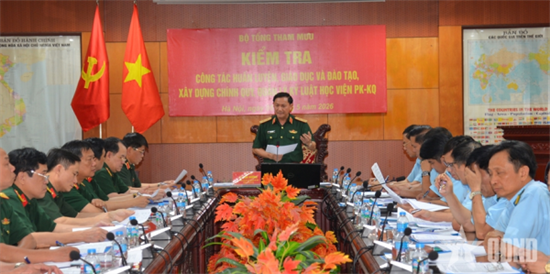 |
| The General Staff of the VPA inspects the work of education and training, regularity building, discipline management at Air Defence - Air Force Academy (photo: qdnd.vn) |
In the process, agencies and units across the VPA have continued to regard regularity building and discipline management as an important task, exercising their leadership and direction over this task in a serious, rigorous, coordinated manner, thereby producing clear improvements. The quality of building “exemplarily, typically” comprehensively strong units has been continuously enhanced. Awareness and a sense of responsibility among officers, party members, professional servicemen, employees, non-commissioned officers, and soldiers towards regularity building and discipline management have been raised. Regular order has been maintained in a unified, in-depth, sustainable way; military etiquette has become increasingly standardised. There has been a positive change in troops’ observance of State law and military discipline, thus contributing to improving the VPA’s overall quality and combat strength.
However, the results achieved have yet to be truly sustainable. Regularity building and discipline management in a number of agencies and units still contain potential risks. Although violations of military discipline and State law have been restrained, they have not been completely eliminated. Inspection and supervision work aimed at detecting and handling violations in some agencies and units remains insufficiently proactive and resolute. The capability of a section of cadres, especially at grass-roots level, in discipline management and education has yet to keep pace with their task requirements. The political steadfastness, discipline-abiding awareness, and life skills of some servicemen remain limited in certain respects. Coordination between military units, troop families, and local authorities in educating troops and managing these staff members’ ideology and social relationships has, at times, proved ineffective.
At present, more demanding requirements are being imposed on the tasks of VPA building and Fatherland protection. Organisational adjustment, science and technology development, innovation, digital transformation, and intensive international integration both create favourable conditions and pose new challenges for regularity building and discipline management. Notably, the rapid expansion of cyberspace and the adverse effects of the market economy continue to influence troops’ awareness and behaviours. Hostile and reactionary forces are intensifying their sabotage via increasingly sophisticated tactics in an attempt to promote “self-evolution” and “self-transformation” within the Military as well as their plot to “depoliticise the VPA”.
That situation necessitates military agencies and units making greater breakthrough progress in regularity building and discipline management, considering this a fundamental factor in preserving and enhancing the VPA’s revolutionary nature, overall strength, and combat readiness. To that end, priority should be given to effectively implementing several key measures as follows.
First, strengthening the leadership and direction of all-level party committees and commands over regularity building and discipline management. Party committees and commands of agencies and units across the Military should continue to thoroughly grasp, concretise, and rigorously implement the breakthrough tasks identified in the Resolution of the 12th Military Party Congress, while realising resolutions, directives, and conclusions by the Party, the State, the Central Military Commission (CMC), and the Ministry of National Defence (MND) on VPA building, defence consolidation, and Fatherland protection in the new situation. It is essential to actively renew and improve the work of education and communication to render officers and soldiers fully aware of the importance of regularity building and discipline management as well as the principle “discipline is the strength of the Military”, thereby heightening their sense of responsibility and fostering their self-discipline. Attention should be paid to grasping and strictly executing Directive 76/CT-BQP, dated 28 April 2026, by the Minister of National Defence on strengthening political education, ideological management, discipline maintenance, and safety assurance within the VPA. Agencies and units should proactively develop resolutions and action programmes with specific targets and measures suited to their practical conditions and assigned tasks. Due regard should be paid to improving the knowledge, skills, and command experience of officers at all levels, while importance should be attached to cultivating political qualities, revolutionary ethics, aspirations for dedication, and comradeship among grass-roots and young officers.
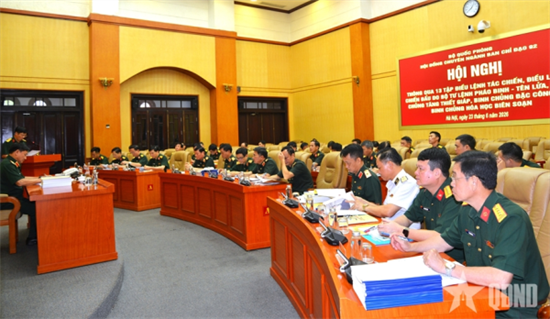 |
| Conference to approve regulations on combat operations (photo: qdnd.vn) |
Party committees, commanders, and political commissars at all levels should directly lead, direct, and inspect the work of political education, ideological management, regularity building, discipline management, and safety assurance within their respective agencies and units; they shall take responsibility for the quality of this work. At the same time, this work should be seen as a central political task and included in party committee resolutions, routine briefings, preliminary reviews, and annual reviews. It should also be one of the principal criteria for assessing the annual task performance of cadres, party members, and the masses. Greater efforts should be devoted to disseminating and multiplying “good people, good deeds” examples, effective models, and innovative practices, strictly handling units and commanding officers that conceal shortcomings, cover up violations, submit dishonest reports, or fail to opportunely report incidents.
Second, focusing on building a unified, synchronised, modern regular order. Party committee members and commanders at all levels should grasp and properly perform their functions and tasks, and strictly comply with military regulations, State law, and the example-setting responsibility of cadres and party members; superiors shall set examples for subordinates, officers shall set examples for soldiers, and agencies shall set examples for units. It is important to continue promoting the application of science, technology, and digital transformation in troop management, regularity building, work administration, and shared database development, thereby gradually forming scientific, accurate, transparent, efficient management methods.
Daily and weekly routines should be maintained stringently, while the quality of Political and Cultural Days and Legal Study Days should be raised. Efforts should be intensified to standardise working procedures, operational regulations, and management methods in a scientific, unified way with clearly defined responsibilities and authority. Agencies and units should proactively review and improve their document systems relating to regularity building, military administration, environmental landscaping, and cultural institutions to ensure that all activities are conducted in a rigorous, unified, effective fashion. Greater value should be attached to building “exemplarily, typically” comprehensively strong units with “strict discipline”, a healthy cultural environment, and good material and spiritual conditions for troops. Besides, due regard should be paid to cementing internal solidarity and heightening self-discipline and discipline-abiding awareness. For newly established or reorganised units, regularity building must be identified as a key and routine task from the very outset. These units should promptly stabilise their organisational structure, complete their work and management regulations, and establish a unified regular order in organisation, command, and task performance from the first day of operation.
Third, renewing the work of discipline management, with a focus on preventing violations “early and from afar”. Agencies and units should closely manage troops’ observance of State law, military discipline, orders issued by superiors, and the rules governing social conduct. They must maintain a firm grasp of troops’ ideological developments, family circumstances, and social relationships, strictly manage troop strength, weapons, technical equipment, vehicles, and all military activities, especially during off-duty hours and among dispersed personnel. Potential risks that may lead to disciplinary violations should be forecast proactively, while emerging issues should be detected and resolved promptly at grass-roots level so that minor shortcomings do not accumulate into complex incidents, and military personnel are not driven into deadlock and resort to negative actions.
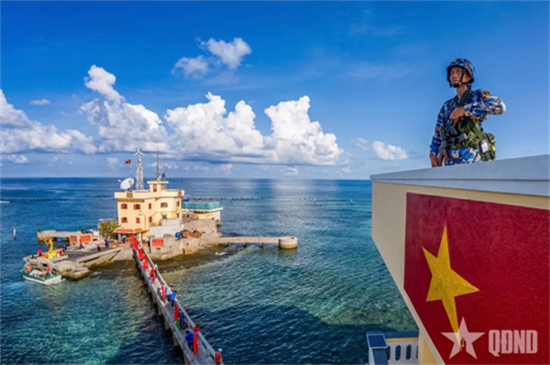 |
| Guard duty at Truong Sa Archipelago (photo: qdnd.vn) |
In the context of digital transformation and the rapid development of cyberspace, military personnel management in cyberspace should be considered an important responsibility of all agencies and units. Accordingly, party committees and commands at all levels must strengthen the management of military personnel in cyberspace, raise their troops’ awareness, responsibility, and standards of conduct in the use of social media, and proactively prevent and combat harmful information, as well as manifestations of ideological, moral, lifestyle, and behavioural deviations. In particular, commanders at battalion level and below should closely monitor all activities of their units, participate directly in activities alongside their troops, and adopt appropriate measures to manage military personnel via social media.
Fourth, improving troops’ life skills, adaptability, and mental and physical health. Agencies and units should strengthen education on revolutionary ethics and the virtues of “Uncle Ho's Soldiers” in the new era, intensify legal dissemination and education, grasp and disseminate the “seven dares” spirit, the principle of “two steadfast commitments, two accelerations, and two preventions”, together with the “five pillars” and “six clear things” mottos to enable officers and soldiers, particularly leaders at all levels, to achieve strong improvements in their awareness and responsibility towards regularity building and discipline management.
Priority should be given to fostering political steadfastness, healthy lifestyle, optimism, determination, adaptability, and self-protection against negative impacts of social life among troops. Due attention should be paid to improving troops’ skills in emotional management, coping with pressure, resolving conflicts, and handling unexpected situations arising from their own thoughts and feelings. The role of mass organisations, military collectives, three-person teams, mass mobilisation soldiers, security soldiers, and psychological and legal counselling groups in encouraging and supporting troops should continue to be promoted. Coordination between military units, families, and localities in troop management and education should be enhanced to promptly detect and address psychological and ideological difficulties.
Safety regulations, procedures, and measures should be strictly maintained at all times. Any complacent, negligent, or simplistic approach to task execution must be resolutely handled. Agencies and units should proactively review and supplement preventive plans, step up inspection and supervision, and respond promptly to situations that pose safety risks, with a view to ensuring that no safety incidents occur as a result of subjectivity, violation of procedures, or irresponsibility.
Regularity building and discipline management constitute an important task and a direct factor in creating the VPA's overall strength and combat readiness. Hence, the entire Military should continue to strengthen education and dissemination and resolutely adopt the above measures to contribute to building a revolutionary, regular, elite, modern VPA capable of firmly safeguarding the Fatherland under all circumstances.
Lt. Gen. LE VAN HUONG
Deputy Chief of the General Staff of the VPA