Military Region 7’s armed forces accelerate efforts and make breakthroughs to fulfil their sacred mission
With strong political determination, a profound sense of responsibility, and a “command from the heart”, the armed forces of Military Region 7 have been taking comprehensive measures to achieve breakthroughs in fulfilling the “500-day-and-night Campaign to accelerate the search, repatriation, and identification of martyrs’ remains”.
Honouring fallen comrades through responsibility and a “command from the heart”
More than half a century after national reunification, thousands of martyrs’ remains are still awaiting recovery on former battlefields within the area of responsibility of Military Region 7 and in neighbouring Cambodia, while many graves remain unidentified. This continues to weigh heavily on the hearts of martyrs’ families and comrades, remaining a source of concern for the present generation.
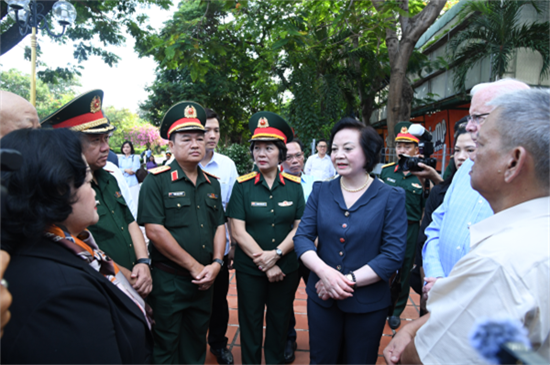 |
| Deputy Prime Minister Pham Thi Thanh Tra and Lt. Gen. Tran Vinh Ngoc, Political Commissar of Military Region 7 talk with eyewitnesses in Le Thi Rieng Park search area |
Grasping the Party’s lines on carrying out the “500-day-and-night Campaign to accelerate the search, repatriation, and identification of martyrs’ remains” as Phase I of the 2026 - 2030 Plan, Military Region 7 has demonstrated the highest level of political resolve, promoting the combined strength of all organisations and forces to accomplish this sacred mission.
From 15 March 2026 to 27 July 2027, Military Region 7 focuses on collecting samples from 41,083 unidentified graves in martyrs’ cemeteries located in Ho Chi Minh City, Dong Nai city, Lam Dong province, and Tay Ninh province. It continues DNA sampling from graves that contain partial information but have not been confirmed yet. This is a new, large-scale, unprecedented mission. Hence, the Military Region has demanded close coordination between its affiliates and localities in performing the mission with the highest sense of responsibility according to the “six clear things”: clear personnel, clear tasks, clear timelines, clear responsibilities, clear authority, and clear outcomes.
The Military Region’s Steering Board 515 has directed the Ho Chi Minh City Military Command to take the lead in performing the mission so that experience could be drawn before wider deployment. In the process, the Military Region has required all forces to promptly establish inter-sectoral working groups and teams responsible for sampling and handing over martyrs’ remains, assign specific duties to each section and individual, and actively work with competent agencies of the Ministry of National Defence and relevant localities to guarantee the strictness in the management, digitalisation, transport, and handover of samples from martyrs’ remains.
Immediately after the Ho Chi Minh City Military Command launched the pilot project, inter-sectoral working groups excavated the first 100 graves and successfully collected samples from 61 sets of martyrs’ remains. These initial results have opened up new hope for identifying many fallen heroes. The digitalisation of information and the updating of data on martyrs’ remains into specialised management software and national data systems on people with meritorious services have been carried out in a coordinated manner, thus laying an important foundation for long-term comparison and verification.
In Cambodia, Military Region 7 has directed teams K70, K71, K72, and K73 to work closely with local authorities, armed forces, and people to conduct field surveys, verify information, and search for the remains of Vietnamese volunteer soldiers and experts who had laid down their lives there. In the process, officers and soldiers have patiently reviewed and cross-checked information, combining witness testimonies with relevant documentation in order to improve the effectiveness of search and repatriation efforts. From the beginning of the “500-day-and-night Campaign” on 15 March 2026 to 20 June 2026, units and localities across Military Region 7 recovered 379 sets of martyrs’ remains. Samples were collected from 4,596 graves, while 3,269 specimens from martyrs’ cemeteries were taken for identification purposes. These initial achievements demonstrate the perseverance, dedication, responsibility, and deep gratitude of the armed forces of Military Region 7 towards the nation’s fallen heroes.
Determined to accelerate efforts and achieve breakthroughs to fulfil this sacred mission
In preparation for the 80th anniversary of War Invalids and Martyrs’ Day (27 July 1947 - 27 July 2027), Military Region 7 has resolved to accelerate efforts and make breakthroughs to complete the Campaign with the highest possible results.
Collecting, digitalising, and handing over samples from martyrs’ remains is an extremely challenging task requiring a high degree of accuracy. Moreover, due to the effects of time and environmental conditions, many remains are no longer suitable for sampling, while DNA identification via martyrs’ relatives faces numerous difficulties. Therefore, the Military Region has required localities to carry out thorough reviews, statistics, and standardisation of information regarding the number and characteristics of martyrs’ cemeteries and graves within their respective areas to formulate scientific, well-organised plans for force deployment and sample collection, digitalisation, and handover in strict compliance with prescribed procedures. It has also directed localities to learn from the pilot project carried out by the Ho Chi Minh City Military Command, identify appropriate cemeteries for their own pilot project, draw lessons, and supplement plans, personnel, and means before expanding operations throughout their entire area of responsibility.
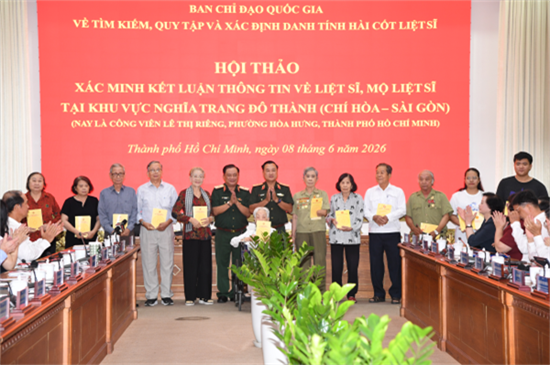 |
| Conference to verify information about martyrs and martyrs’ graves at Le Thi Rieng Park |
The Military Region’s Steering Board 515 has instructed localities to hold meetings to assign specific duties to relevant agencies and sectors according to their respective functions and tasks, strengthen coordination, and carefully conduct surveys to grasp and report the number of cemeteries and graves requiring sampling to the Military Region’s Policy Division. Localities has been required to make synchronised plans for sample collection, digitalisation, and handover of martyrs’ remains according to the principle of “conducting detailed surveys of each cemetery to identify grave structures and adopt appropriate sampling methods, collecting samples from easier graves first and more difficult graves afterwards while drawing lessons in the process”. After sample collection, graves must be carefully, meticulously, respectfully restored to their original condition to preserve the appearance of both individual graves and martyrs’ cemeteries. Commanders at all levels have been directed to strengthen inspection, closely monitor situational developments, and update data on sample collection, digitalisation, and handover into martyrs’ remains information management software and 500-day-and-night Campaign progress management systems in accordance with higher-level directives. The entire Military Region is determined to complete this work before May 2027.
The search and repatriation of martyrs’ remains now faces many challenges, as considerable time has passed, terrain has changed, the number of eyewitnesses and information sources have been increasingly limited. Hence, Military Region 7 has resolved to continue accelerating efforts and making breakthroughs in this work, with emphasis placed on key areas where information suggests that unrecovered graves remain, especially in former revolutionary base areas such as Ho Chi Minh City, Dong Nai, and Tay Ninh. The Military Region has directed agencies, units, and localities to intensify public communication, encourage organisations and individuals to provide information about martyrs and martyrs’ graves, strengthen cooperation with the press to increase both the number of articles and broadcasting time devoted to search and repatriation efforts, thereby creating positive effects among officers, soldiers, and the people.
Units and localities have attached importance to implementing a variety of innovative and effective approaches, such as distributing leaflets, organising seminars, dispatching officers to villages and hamlets, particularly in remote and isolated areas, to both provide free medical examinations and medicines, and gifts and encourage local people to give information about martyrs’ graves. Meetings between key leaders and eyewitnesses have been held to gather reliable information. For the graves which have already been surveyed and searched multiple times without success, further verification will continue while specialised workshops will be organised to establish a more accurate basis for future searches. In the search and repatriation process, science and technology will be exploited to carry out reconnaissance, surveys, and subsurface scanning across entire search areas as well as to expedite the completion of dossiers and lists of martyrs. Efforts to verify and determine search areas, establish search and repatriation maps, and complete documentation and mapping products under the new administrative boundaries will be intensified under the motto: “Areas that are easy and clearly verified will be concluded first; difficult or unclear cases will be verified and concluded afterwards”.
According to the Military Region’s directive, from 15 to 25 August 2026, the K Teams will commence their first deployment (2026 - 2027 dry season). The teams are required to establish contacts with village elders and community leaders, meet historical witnesses and long-term local residents living near former burial sites, and maintain coordination with units that directly participated in combat and combat support operations to review available information. Priority will be given to key locations such as Le Thi Rieng Park; Tan Son Nhat, Loc Ninh, and Dong Nai airfields, Hospital K74B - Duong Minh Chau, Dau Tieng, Xuyen Moc, Nhon Trach, Bac Son Military Medical Hill - Bu Gia Map, and Can Le Bridge - Tong Le Chan, among others. Upon completion of each stage of search and repatriation, ceremonies for receiving, commemorating, and reinterring the recovered remains will be organised in a meticulous, respectful, dignified, absolutely safe manner.
Furthermore, Military Region 7 has recommended the Ministry of National Defence to establish two additional temporary K Teams, each comprising 37 personnel. It has also directed four specialised task groups (established by the Military Region itself) to strengthen supervision, guidance, and inspection of localities in the processes of sample collection, digitalisation, and repatriation and handover of martyrs’ remains. Divisions and brigades under the Military Region shall stand ready to provide personnel and equipment to support localities whenever required. Commune-level military commands shall coordinate with local agencies and unions to effectively implement the “supporting the 500-day-and-night Campaign” model, providing spiritual encouragement for the core forces in carrying out this mission. Military Region 7 is striving to exceed its pre-set targets, complete the “500-day-and-night Campaign” two months ahead of schedule (by May 2027); Dong Nai city and Lam Dong province shall strive to achieve their assigned targets by the end of 2026.
The “500-day-and-night Campaign to accelerate the search, repatriation, and identification of martyrs’ remains” represents a powerful initiative, demonstrating the strong political determination of the entire Party, State, and society in fulfilling the sacred responsibility owed to the nation’s fallen heroes. Upholding the tradition “When drinking water, remember its source”, guided by the spirit of self-reliance, solidarity, creativity, unwavering resolve, great effort, and resolute action, Military Region 7 will accomplish this sacred mission to enable more fallen heroes to be reunited with their names, their hometowns, and their families, thereby fulfilling our duty to those who sacrificed their blood and lives for the country’s peace and reunification and the people’s prosperity and happiness.
Maj. Gen. TRAN CHI TAM
Deputy Political Commissar of Military Region 7