Military Region 1 steps up the implementation of Project 1371 in the new situation
The implementation of the Project entitled “Promoting the role of the Vietnam People’s Army (VPA) in law dissemination and education and encouraging the People to comply with the law at grass-roots level for the 2021 - 2027 period” (Project 1371) is a practical measure for Military Region 1 to effectively perform its function as an army ready for work, contributing to bringing the Party’s lines and the State’s policies and laws to life, raising the People’s law-abiding awareness, consolidating the People’s trust, and strengthening the close-knit bond between the Military and the People.
Over the years, all-level Party committees and commands across the armed forces of Military Region 1 have exercised their leadership and direction over the implementation of Project 1371, with many creative, effective approaches, thereby greatly contributing to building pure, strong Party organisations, “exemplarily, typically” comprehensively strong agencies and units, and safe areas, successfully accomplishing all assigned tasks.
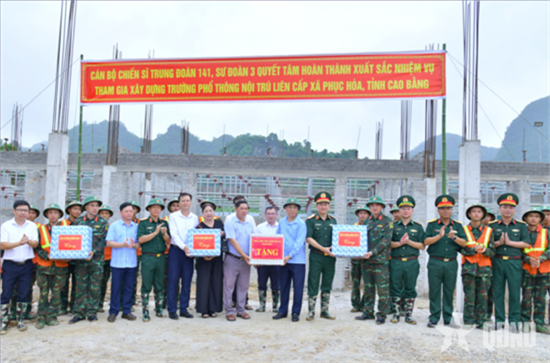 |
| Leaders of Military Region 1 and Cao Bang province give presents to the forces in charge of constructing a boarding school (photo: qdnd.vn) |
Starting from grass-roots level and taking realities as the basis for the process of implementation
Thoroughly grasping the viewpoints that “the People are the root”, the People are the subjects and the centre of the cause of national renovation, construction, and protection, and that all lines and policies must stem from the needs, aspirations, and legitimate rights and interests of the People, the Party Committee and Command of Military Region 1 have determined that the implementation of Project 1371 must start from grass-roots level and take realities in the localities and the needs of the People, issues arising in daily life, regulations that people need to know, difficulties that need to be addressed, and potential risks that may affect local stability, etc., as the basis for defining the content, methods, and forces involved, thus ensuring that the law truly becomes part of daily life and serves as the foundation for the People to exercise their rights, fulfil their obligations, participate in social management, and contribute to local development.
Accordingly, agencies and units across the Military Region have proactively formulated plans and consolidated their Steering Boards for Project 1371 and their councils for coordination in law dissemination and education, bringing into full play the roles of political bodies, legal affairs sections, political cadres, and commanders in each area of work. They have directed activities towards grass-roots areas, coordinating with party committees, authorities, the Vietnam Fatherland Front, and political - social organisations to grasp the situation and select appropriate content and forms of dissemination. They have focused Project activities on key areas, remote and isolated areas, border areas, areas mainly inhabited by ethnic minorities, mountainous areas, industrial parks, and places where the people’s law-abiding awareness is limited. The content of dissemination has been selected to be practical, with emphasis placed on regulations directly related to military and defence affairs, citizens’ rights and obligations, issues concerning land, marriage and family, security and order, borders, ethnicity, and religion, and matters arising at grass-roots level. Cadres and soldiers have not only conducted law dissemination and education for the People, but they have also listened to the People, exchanged views with the People, explained to the People, encouraged the People, and worked with local authorities to address issues arising in the People’s daily life. Those approaches have enabled legal content to be associated with each locality, each target group, and each specific issue, making it easier for the People to access, understand, and comply with the law, creating conditions for agencies and units to promptly identify issues at grass-roots level and proactively coordinate with local Party committees and authorities to handle such issues early and from afar.
Renewing methods and improving the effectiveness of dissemination and mobilisation
Amid rapid developments in communications technology and significant changes in the People’s ways of receiving information, law dissemination and education require innovation; in this regard, it is vital to renew approaches to the People and take their understanding, consensus, and voluntary observance of the law as the objective. Hence, agencies and units have concentrated on renewing methods and raising the effectiveness of direct dissemination and education, such as legal talks, consultation, and guidance, and the provision of legal information and materials. They have also applied information technology and digital transformation to dissemination, promoting the role of the press, diversifying dissemination and publicity systems, renewing legal knowledge contests, forums, and discussions, developing models suitable for each locality.
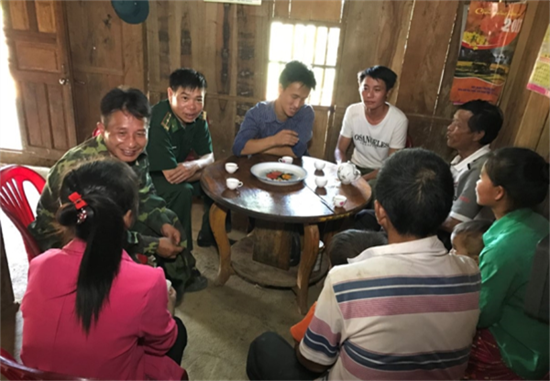 |
| Law dissemination and education conducted by cadres of Economic - Defence Unit 799 of Military Region 1 for citizens of Che Ly B village, Cao Bang province (photo: qdnd.vn) |
It is worth noting that delivering legal content has been combined with explaining and clarifying the rights, obligations, and legitimate interests of the People, thereby bringing the law into the daily life and activities of the People. The Military Region has effectively disseminated information to raise public awareness of problems of concern to the People, matters of opinion, and issues that could easily be exploited by hostile forces for distortion, such as major lines and strategic decisions of the Party and State that directly affect organisational structures, State management, and the lives of the People, the adoption of the two-tier local government system, the rearrangement of administrative units, adjustments to local military agencies, and the implementation of policies and lines on ethnicity and religion. These efforts have helped create unity in awareness in the process of implementation and enabled the People to distinguish right from wrong and truth from falsehood as the basis for proactively combating distortions and contributing to maintaining political and social stability in the locality.
Linking the implementation of Project 1371 with mass mobilisation and local area building
A notable feature of the execution of Project 1371 in Military Region 1 is that Project activities have always been placed within the overall framework of mass mobilisation and the tasks of building political bases, fostering socio-economic development, and maintaining political security and social order and safety. Practical experience shows that the effectiveness of dissemination and mobilisation depends on persuasive communication of legal content combined with the People’s trust. Therefore, agencies and units have always integrated law dissemination and education with mass mobilisation, citizen reception, legal assistance, and grass-roots mediation, coordinating with Party committees, authorities, the Vietnam Fatherland Front, political - social organisations, and forces in the locality to carry out these activities. In the first half of 2026, the armed forces of Military Region 1 organised 12 companies (501 cadres and soldiers) to participate in field marches for mass mobilisation; 8 units took part in the construction of multi-level boarding schools in border communes of Cao Bang province (859 cadres and soldiers), and organised activities under Phase 1 of Project 1371 in 2026 in 26 communes in Cao Bang, Lang Son, Thai Nguyen, and Bac Ninh provinces. Cadres and soldiers have always genuinely stayed close to the People, respected the People, listened to the People, and demonstrated a strong sense of responsibility for the People. As a result, dissemination and mobilisation activities have been highly persuasive and welcomed by the People, producing practical results.
When administrative and local military organisations underwent changes in boundaries, structures, and management methods, military agencies and units have promptly grasped the grass-roots situation, clearly identified newly arising issues, and maintained close links between the armed forces and local Party committees, authorities, and People. They have clearly recognised that implementing the Project is an important channel through which the armed forces could conduct propagation and mobilisation, maintain a close understanding of the People and the locality, and participate in resolving issues at grass-roots level simultaneously. In particular, in border areas, law dissemination and education have been closely linked with raising the People’s awareness and responsibility for managing and protecting national sovereignty and border security. This ensures that people living in border areas are both beneficiaries of policies and laws and a force in charge of maintaining security and order and protecting border lines and markers, thereby contributing to building strong all-people national defence, people’s security posture, and all-people border defence posture, consolidating the “posture of people’s hearts and minds”, creating a solid political and social foundation for the performance of military and defence tasks.
Improving the effectiveness of Project implementation in the new period
At present, more demanding requirements are being placed on law dissemination and education and the execution of Project 1371, particularly amid rapid changes in social life, state apparatus, and the People’s ways of accessing information. Building on the results achieved, Military Region 1 will focus on the following key areas.
First, continuing to enhance the leadership, direction, and responsibility of Party committees and key cadres at all levels for law dissemination and education and the implementation of Project 1371. Such content will be incorporated into regular work programmes and plans to ensure unified leadership, clarity in assigned personnel, tasks, responsibilities, authority, timelines, and results, as well as association with the political tasks of agencies and units and the requirements for building the armed forces of Military Region 1 in the new situation.
Second, improving proactivity and forecasting capacity in law dissemination and education, promptly identifying legal and social issues that may affect the People’s thoughts and lives and local stability. Importance will be attached to new issues arising from socio-economic development, adjustments to local organisations and management, and military and defence tasks. Dissemination, explanation, and awareness guidance will be proactively prepared to contribute to creating unity in the process.
Third, building a contingent of cadres engaged in law dissemination and education with political steadfastness, deep knowledge, and good skills in the new situation. Emphasis will be placed on training and fostering a pool of legal reporters, communicators, collaborators, and mediators, improving their capacity to explain, engage in dialogue, and address legal issues associated with practical realities, and promptly consolidating this force with adequate numbers and strong professional competence to meet their task requirements in each locality.
Fourth, stepping up the development, improvement, and replication of law dissemination and education models suited to each target group and locality, effectively harnessing information technology, digital transformation, and artificial intelligence. Due attention will be paid to developing flexible dissemination methods capable of reaching a wide audience, providing rapid feedback, increasing interaction, and enabling cadres, soldiers, and the People to proactively access, study, and comply with the law.
Fifth, strengthening inspections and assessments in a substantive manner, linking implementation results with the quality of the building of agencies and units and the task performance in each locality. Consideration will be given to promptly detecting shortcomings, their causes, and newly arising issues in order to adjust the content and methods. Besides, due regard will be paid to commending and replicating effective approaches, rectifying shortcomings, seriously carrying out reviews to draw lessons, and identifying tasks closely aligned with practical requirements to ensure that Project 1371 is executed regularly, substantively, and effectively, with strong and widespread positive impacts.
Maj. Gen. DUONG VAN QUANG
Deputy Political Commissar of Military Region 1