Fully aware of the importance of standardisation building and discipline management, the Party Committee and Command of Corps 34 have consistently focused their leadership and direction on this aspect by means of innovative and effective solutions, and achieved significant advancements, significantly improving the quality of building an all-strong, “model, exemplary” unit.
Corps 34 was founded basing on the merger between Corps 3 and Corps 4, marking a turning point in its force organisation, strategic deployment, functions and tasks.
However, difficulties in the initial process of merger and restructuring have posed substantial challenges. In this context, the Resolution of the Corps' first Party Congress (2025–2030 term) has identified standardisation building and discipline management as one of three breakthroughs aimed at achieving solid progress in making the Corps all strong, “model and exemplary”, successfully fulfilling all assigned tasks.
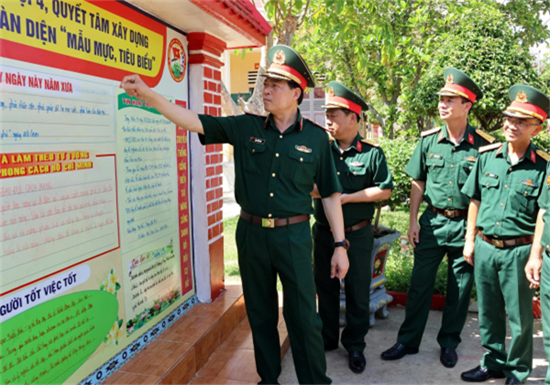 |
| Lt. Gen. Dao Tuan Anh checks the standadisation of units |
In the coming time, in order to meet the increasingly demanding mission requirements, the Corps' Party Committee and Command will continue to strengthen comprehensive leadership and direction across all aspects of work, especially breakthroughs in standardisation building and discipline management through the following key measures:
First, strengthen leadership and direction regarding the work of standardisation and discipline management. Party committees and organisations at all echelons should focus on leading and directing the thorough study and serious implementation of resolutions, directives, and conclusions on standardisation building, the observance of State laws and Military discipline, and safety regulations. The contents of standardisation building and discipline management must be thoroughly discussed and assessed, then incorporated into regular and thematic leadership resolutions, including specific objectives and measures tailored to the features and mission requirements of each agency and unit.
Leaders at all levels should proactively make specific implementation plans, clearly assign duties and responsibilities, direct the execution drastically, and resolutely rectify the shortcomings and deficiencies. Agencies at all levels should perform their functions and duties properly, coordinate smoothly, and provide accurate, pertinent, and timely advice to leaderships and commandants. They should also strengthen inspections, maintain close contact with grassroots units, and provide necessary guidance and support. The effectiveness of standardisation building and discipline enforcement should be taken as one of the key criteria for evaluating the annual task performance of party organisations, units, and each cadre and Party member.
At the same time, emphasis should be placed on effective education and dissemination to heighten the awareness of officers and soldiers regarding standardisation building and discipline management. Regular efforts are required to disseminate and educate servicemen on State laws, military regulations and statutes, and rules of the units, together with revolutionary ethical standards of officers and Party members, and the “Uncle Ho’s Soldier” standards in the new era. In addition, there is a need to promote the combined strength of organisations and forces to promptly identify, cultivate, and replicate exemplary cases, good models, and innovative methods, thereby creating a vibrant and widespread emulative atmosphere in standardisation building and discipline enforcement.
Secondly, improve working styles, methods, and professional conduct of the officers, particularly the leaders at all echelons. The Corps requires that officers at all levels innovate their working methods and conduct in a scientific, specific, meticulous, and practical direction. They are also required to thoroughly grasp and strictly implement the spirit of “7 Dares”, “2 Steadfast, 2 Intensifications, 2 Prevention”, and the guiding principles of “5 Solidities” and “6 Clear” to foster positive and robust changes in awareness and responsibility, alignment between words and actions, self-cultivation of ethical standards and a disciplined, cultured lifestyle, and strict compliance with State laws and Military discipline.
The Corps continues to uphold the exemplary role of leaders at all levels according to the motto: “Superiors act as the example for juniors, commanders for their units, and party members for the rank and file”. Accordingly, officers, especially the commanding ones of regiments, battalions, and companies, must practice the “four-together” principle with their troops. Commanders and agencies of regiment-level and above must regularly inspect and grasp the situation and activities of subordinate units. Commanders at the battalion level and below must closely follow all unit activities and participate in all operations of their troops. Attention must also be paid to cultivating the command and managerial knowledge, skills, and experience of officers at all levels. Emphasis should be placed on training a cadre of grassroots-level officers and young officers with strong character; a desire for dedication and commitment; a scientific and detail-oriented working style; and a compassion for troops.
Concurrently, the Corps imposes strict sanctions on presiding officers in cases serious disciplinary violations or safety incidents happen in their units as a result of subjective errors, to heighten the sense of responsibility among officers at all levels regarding the standardisation building and disciplinary enforcement.
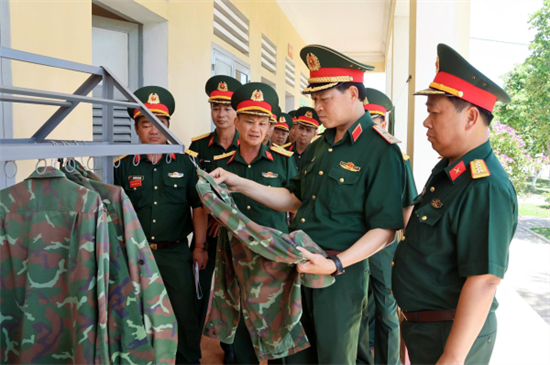 |
| Leader of Corps 34 checks one of the units |
Thirdly, strictly maintain standardised routine in all operations of units. This includes the building of a politically strong Corps and enhancing the quality and effectiveness of Party and political work across all missions; the improvement of leadership capacity and combat effectiveness among Party committees and organisations at all levels, and the making of all-pervasive leadership resolutions. Besides, it is to strengthen measures to improve the quality of Party activities, particularly those of the party cells; seriously adheres to the principles of democratic centralism and collective leadership combined with individual responsibility; promote democracy together with the spirit of criticism and self-criticism. Furthermore, it plans to enhance the quality of political and ideological education to build political mettle and the determination to accept and successfully complete all assigned missions.
Moreover, standardisation and discipline in training and combat readiness must be emphasised. The motto “fundamental, practical, and solid” must be translated into action through the standardisation and formalisation of everything from documentation systems, training grounds, and equipment to the methods of execution. Training principles and integrated approaches are to be applied flexibly, creatively, and effectively; training content and methods are to be actively innovated to align closely with specific missions, targeted trainees, operational areas, combat scenarios, and available weaponry and technical equipment. The quality of advisory work regarding training and combat operations is to be improved, and the management and direction of training is to be modernised. Additionally, established regulations and routines regarding command duty, operational duty, and combat readiness duty are to be strictly maintained.
Accelerate the application of information technology and digital transformation in training, exercises, and combat readiness; expedite the transmission of orders and situation reports while ensuring absolute safety and security. Strictly maintain standardised routines in daily life and operations; pay attention to fostering a disciplined cultural environment and creating green, clean, and beautiful barracks. Simultaneously, there should be breakthroughs in standardising logistics and technical operations, ensuring the full, timely, and compliant provision of supplies, weapons, and technical equipment for all missions, regardless of routine or unscheduled ones.
Finally, ensure close and effective coordination between “building” and “combating”, and between administrative measures and empathy for troops in the management and exercise of strict discipline. There is a need to focus on grasping and strictly implementing Directive No. 76/CT-BQP, dated 28 April 2026 issued by the Minister of National Defence regarding the strengthening of political education, ideological management, discipline maintenance, and safety assurance in the Vietnam People's Army. Alongside strictly maintaining the prescribed daily and weekly routines, agencies and units should enhance comprehensive management regarding personnel numbers, quality, ideology, awareness of legal and disciplinary compliance, health, family circumstances, personal concerns and aspirations, and interpersonal relationships; conduct frequent unannounced inspections, particularly during break times, weekends, holidays, and Tet, as well as at units performing dispersed or small-scale tasks.
Prioritise ideological management solutions and effectively execute the process of grasping, forecasting, managing, guiding, and addressing the troops' mindset. Rigorously assess and categorise personnel; assign officers to monitor and assist service members facing difficult circumstances, complex relationships, or signs of psychological instability. Proactively coordinate with families and local authorities to monitor, remind, and rectify the compliance with State laws, military discipline, and safety regulations among officers and soldiers. Accelerate the application of science, technology, and digital transformation in troop management, with a specific focus on managing service members' ideological expression on the internet and social media.
Develop a democratic, disciplined and orderly environment; effectively manage interpersonal relationships, particularly those between superiors and juniors, officers and soldiers,...enhancing the quality of activities such as “Political and Cultural-Spiritual Days”, “Legal Days”, democratic dialogues, and the operations of soldiers' councils and mass organisations... fostering solidarity and spreading a spirit of camaraderie and mutual affection among troops. Through these efforts, it is possible to proactively anticipate, promptly detect, and nip in the bud any abnormal psychological or ideological tendencies and potential violations, while strictly handling any infractions that do occur.
Establishing standardised order and discipline management is an ongoing process requiring the resolute and persistent involvement of all organisations, forces, and each officer and soldier. By implementing a synchronised and creative range of solutions, spanning from political-ideological work to administrative measures, and by closely combining the strict enforcement of military discipline with genuine camaraderie, these efforts will undoubtedly bring about a breakthrough and solid transformation. This will contribute to building an all-strong, “exemplary and typical” Corps 34, capable of excellently fulfilling all assigned missions.
Lieutenant General DAO TUAN ANH, Member of the Party Central Committee, Commander of the Corps