Cao Bang province resolutely implements the 500-day-and-night Campaign to accelerate the search, recovery, and identification of martyrs’ remains
Upholding its revolutionary tradition and strong sense of responsibility, and the moral principle of “remembering the source when drinking water”, Cao Bang province has been executing the “500-day-and-night Campaign to accelerate the search, recovery, and identification of martyrs’ remains” with high political resolve and a methodical, scientific approach, striving to achieve the best possible results, expressing its gratitude to fallen heroes and bringing them back to their comrades, families, and homeland.
Cao Bang is a land that is rich in revolutionary tradition; many special events in the struggle for national independence and Fatherland protection took place within the province. During the resistance wars, countless cadres, soldiers, and citizens fought and sacrificed themselves heroically on this sacred land. Thus, the search, recovery, and identification of martyrs’ remains is not only a particularly important political task, but also a sacred responsibility and an expression of gratitude and affection of Cao Bang’s party committees, authorities, armed forces, and people towards the fallen heroes and their relatives.
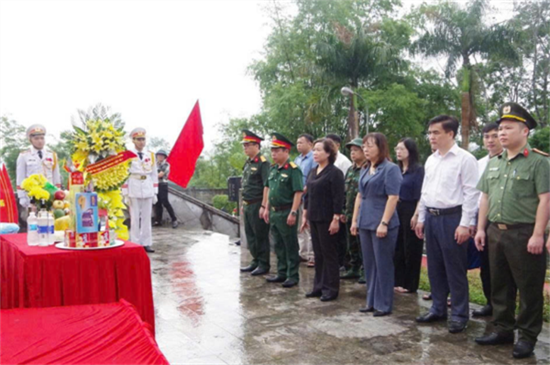 |
| Incense offering at the martyrs’ cemetery of Hoa An commune |
Grasping and realising the lines of the Party and State, especially Plan 1241/KH-QK, dated 11 May 2026, issued by Military Region 1’s Steering Board for the “500-day-and-night Campaign to accelerate the search, recovery, and identification of martyrs’ remains”, the province has regarded this as a particularly important political task requiring focused leadership and direction with the highest resolve, striving to recover approximately 18 sets of martyrs’ remains, complete the collection of remains samples at nine martyrs’ cemeteries, and develop a genetic database of relatives of martyrs whose information has yet to be identified, for the sake of comparison and identification. At the same time, it has stepped up bomb, mine, and unexploded ordnance clearance in key areas, core areas, and locations with available information about martyrs’ graves.
To successfully fulfil the assigned tasks, the Provincial Party Committee Standing Board issued Directive 11-CT/TU, dated 16 July 2026, on strengthening leadership and direction over the search, recovery, and identification of martyrs’ remains with missing information within the province. Based on that Directive, the Provincial Military Command (PMC) - the Standing Office of Provincial Steering Board 515 has given advice on consolidating the forces engaged in searching for martyrs’ remains and collecting biological samples, forming two additional teams, bringing the total number of DNA sampling teams to four, selecting the Martyrs’ Cemetery in Trung Khanh commune as a pilot site to draw experience and replicate the model.
With a high sense of responsibility, as of 24 August 2026, the province had identified 12 locations of martyrs’ graves and recovered three sets of martyrs’ remains; it had organised solemn memorial and reburial ceremonies under regulations. Besides, the teams had completed sampling at all nine cemeteries, handed over more than 200 samples to the Military Forensic Institute, and continued supplementing records and updating data for the identification of martyrs’ remains through DNA testing.
Within the province, there remain many areas contaminated with bombs, mines, and unexploded ordnance; terrain is fragmented and transport infrastructure is poor, thereby greatly affecting survey, search, and recovery efforts. Regarding bomb, mine, and unexploded ordnance clearance as a “dual task” that both ensures the safety of the search forces and facilitates the expansion of agricultural land, the province has proactively directed its forces to review and delineate areas, identify priority locations, and conduct clearance in a rolling manner. To date, more than 1,200 hectares have been cleared to facilitate the search and recovery of martyrs’ remains and serve socio-economic development.
These initial results affirm the responsible involvement of the party committees, authorities, armed forces, and people of Cao Bang province in the Campaign, demonstrating that the methods of leadership, direction, and execution are gradually becoming systematic and effective. However, the workload remains enormous; much of the information is incomplete; the search areas are complex; the identification of remains is extremely urgent. Hence, the province has determined to accelerate its efforts and bring into full play the responsibility of the entire political system, with a focus on the following solutions.
First, enhancing leadership and direction and creating a high degree of unity in awareness and action. The province will continue to grasp the Party and State’s lines on accelerating the search, recovery, and identification of martyrs’ remains and the directions of National Steering Committee 515, while intensifying information and communication to achieve unified awareness and a shared sense of responsibility throughout the political system and among the entire people for this special task. It will resolutely deal with the mindset that this is solely the duty of military agencies, or that efforts should be concentrated only during peak periods. To improve effectiveness, the Provincial Party Committee Standing Board will direct all-level party committees and authorities to include the search, recovery, and identification of martyrs’ remains in their resolutions and work plans, with specific goals, targets, requirements, areas, timelines, and forces. Importance will be attached to heightening the role and responsibility of heads of agencies and units in leadership, direction, and execution and linking the results of this work to the responsibility of each agency, unit, and locality.
Additionally, Provincial Steering Board 515 will focus on raising the effectiveness of staff work, direction, inspection, and guidance under the motto of “acting resolutely”, turning lines into specific tasks and targets, and progress schedules appropriate to each area. It will promptly assess results, draw experience, clearly identify what has been completed, what remains behind schedule and the reasons for the delays so as to determine appropriate measures, while striving to fulfil 100% of the targets assigned by the Military Region within 2026.
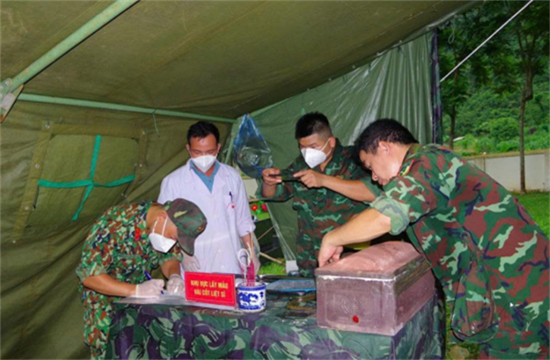 |
| Sampling work carried out by the province’s competent forces |
Second, promoting the pivotal role of the PMC in staff work, execution, and coordination. Building on the results and experience achieved, in the coming period, the PMC will continue to give proactive advice on developing plans and road maps for the Campaign. Emphasis will be placed on advising and directing agencies, units, and localities to grasp and strictly execute documents issued by Provincial Steering Board 515, particularly Plan 98/KH-BCĐ, dated 6 May 2026, by Military Region 1’s Steering Board, as well as regulations on the technical procedures for collecting, transporting, handing over, preserving, and storing samples of martyrs’ remains. Based on the actual situation, it will promptly adjust and supplement plans and clearly identify key areas, progress, forces, and methods to avoid a scattered approach and ensure “six clear” requirements. Great value will be attached to closely managing every source of information, every record, every surveyed location, and every biological sample to ensure proper procedures, safety, and accuracy. The PMC will continue to serve as a bridge between Provincial Steering Board 515 and Military Region 1’s Steering Board 515 and higher-level specialised agencies, maintain reporting and information-sharing regulations, and proactively propose solutions to arising issues beyond its authority. It will coordinate with press agencies to intensify information and education to enable cadres, soldiers, personnel directly engaged in the task, and the people to gain a profound understanding of the political and humanitarian significance of the Campaign, thereby mobilising additional sources of information, achieving consensus, and raising a sense of responsibility in the process.
Third, mobilising the combined strength of the entire political system and population to exploit and verify information sources for the search and recovery efforts. In order to create an important resource for supplementing and clarifying information about martyrs and martyrs’ graves, especially cases with information about the place of death or original burial location remaining incomplete or inconsistent, the province will continue to promote the combined strength of the entire political system and people, particularly the role of Veterans Associations, liaison boards of military units, historical witnesses, and martyrs’ relatives in mobilising and providing information. It will issue open letters to organisations and individuals, especially units that previously fought or operated in the area. It will diversify methods of receiving information, ranging from direct reception, hotlines, and email to QR codes, electronic forms, social media and mass media, and assign agencies and personnel to receive, classify, manage, and process information to ensure that no source of information is overlooked.
Based on their functions and assigned tasks, departments, sectors, mass organisations, and party committees and authorities at grass-roots level will closely coordinate with the PMC to establish an interconnected mechanism covering the process from receiving, reviewing, and cross-checking information to verification and field surveys. Significance will be attached to improving coordination between military, police, policy, medical, and specialised agencies in supplementing records, cross-checking data, verifying personal information and supporting DNA testing when necessary.
Fourth, improving the capabilities of the forces directly engaged in searching and recovering martyrs’ remains and collecting biological samples. The province will continue to closely follow the actual situation in order to consolidate the forces in charge of the task, ensure the availability of command forces, specialised forces, dedicated forces, and mobilised forces when necessary, clearly assign the responsibilities of each component, maintain sufficient personnel and close coordination, remain ready to reinforce and adjust forces according to each area and task, and avoid passivity and unexpected situations in the process. It will also intensify training and professional development, especially in survey, excavation, sample collection, preservation, and handover, and the completion of records. It will provide adequate vehicles, equipment, materials, information technology infrastructure and other necessary conditions. It will promptly encourage cadres and employees, particularly those regularly working in difficult areas far from headquarters to enable them to keep their mind on their work and maintain a strong sense of responsibility.
In the process, agencies, units, and localities will closely follow the characteristics of each area and each case, draw experience at every step, and promptly adjust inappropriate elements. In deep-lying, remote areas, rugged terrain, and complex weather conditions, due attention will be paid to deploying forces proactively and appropriately to ensure safety and resolutely avoid pursuing progress at the expense of quality, accuracy, and prudence.
With high political resolve, solidarity, consensus, and a profound sense of responsibility and gratitude towards the fallen heroes, Cao Bang province is determined to achieve the goals of the “500-day-and-night Campaign to accelerate the search, recovery, and identification of martyrs’ remains”, contributing to alleviating the pain and loss left by wars, meeting the earnest aspirations of people nationwide and martyrs’ relatives, and fulfilling its moral duty towards the fallen heroes who devoted their youth and blood to the Fatherland.
HA NHAT LE
Vice Chairman of the Provincial People’s Committee
Head of the Cao Bang Provincial Steering Board for the Search, Recovery, and Identification of Martyrs’ Remains