326th Economic-Defence Corps links economic development with strengthening national defence and security
Deeply understanding the Party's strategic policy on combining economic, cultural, and social development with strengthening national defence and security, and fulfilling its assigned functions and tasks, the 326th Economic-Defence Brigade has deployed a range of solutions to develop socio-economic conditions, improve people's lives, strengthen national defence and security, and build sustainable development project areas over the years.
The 326th Economic-Defence Corps under Military Region 2 is stationed and carries out its duties in 8 communes in 2 provinces of Son La and Dien Bien provinces within the Song Ma Economic-Defence Zone - an important area for national defence, security, and foreign relations of the country.
During the performance of its duties, the unit has encountered numerous difficulties due to the mountainous terrain, high valleys, and frequent flash floods, landslides, and mudslides. The area is characterised by an underdeveloped economy, with ethnic minorities accounting for over 80% of the population, uneven cultural levels, and many outdated customs. Moreover, it is prone to sabotage schemes of hostile forces, posing a potential risk of instability in political security, order, and social safety.
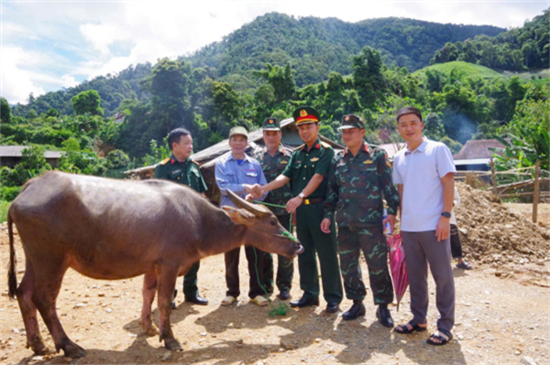 |
| Providing breeding buffalo to poor household in Muong Leo commune, Son La province |
In the face of this situation, over the past years, the Party Committee and command of the corps have focused on leading and directing its agencies, units, and production teams to accelerate the implementation of economic development projects and plans; social welfare programmes, poverty reduction, and improving the living conditions of the People, ensuring peace and security for the People, and building a “People's heart and mind posture”. At the same time, they have effectively carried out military and national defence tasks, building the all People’s national defence and an increasingly solid People's defence posture integrated with a People's security posture in the area.
From the performance of its tasks, the corps has drawn some lessons which are also key solutions for its task execution in the coming time as follow:
Firstly, focusing on improving the effectiveness of economic development and livelihood projects. The corps has thoroughly studied the resolutions, directives, and conclusions of the Party Central Committee, the Central Military Commission, the Ministry of National Defence, and the Military Region on economic, cultural, and social development linked to strengthening national defence and security in the Northwest region, especially the Song Ma Economic-Defence Zone. Based on that, it has developed specialised resolutions and established plans and programmes for effective implementation. Together with local Party committees and authorities, it has made coordination regulations; proactively strengthened the steering committee and project management units; clearly defined the tasks, responsibilities, and areas of operation for each force and unit.
Based on the overall project area plan and the local socio-economic development plans, it conducted surveys and assessments of the climate, soil conditions, needs, and production levels of the local people. Then, it made project plans and developed appropriate economic development models. During implementation, it closely coordinated with local Party committees and authorities to identify sound and suitable beneficiaries; actively promoted and encouraged People to commit to the projects by contributing matching funds to foster their proactiveness, initiative, and responsibility. Besides, it directed its agencies and production teams to develop training programmes and plans on livestock and crop cultivation techniques for ethnic minorities; closely monitor and accompany them throughout the entire production and consumption process, promptly resolving difficulties and obstacles, making them secure in implementing economic development models. Over the past years, the corps has provided the People with thousands of livestock, seedlings, and production supplies, gradually eliminating outdated farming practices and creating stable and sustainable livelihoods for the local people.
In addition, the corps has constructed and handed over 6 transportation projects and 3 clean water projects to the localities; concreted many inter-commune and inter-village roads, preventing the villages from being isolated during the rainy season and opening up commercial opportunities in the region; supported 11 villages in building new rural areas, and helped 63 poor households escape poverty according to multidimensional criteria. In particular, it directed its agencies and production teams to provide 18 schools with facilities and life skills training under the programme ‘Military officers and soldiers help children’s schooling’; mobilised human labour and material resources to participate in eliminating temporary and dilapidated houses in the area. What’s more, it also conducted free medical examinations, treatment, health consultations, and provided free medicine to thousands of people, worth hundreds of millions of VND. These efforts have contributed to improving the material and spiritual lives of the people in the project area, and the area has seen a significant decrease in poverty rate, as well as in illegal migration and drug trafficking. The political security, order, and social safety in the area have been maintained.
Secondly, innovating propaganda and public relations work; and participating in building a strong political base. The majority of the population in its project areas is ethnic minority groups, e.g. Thai, Hmong, and Kho Mu, whose cultural levels are uneven, making them prone to exploitation and incitement of hostile forces. Therefore, alongside economic development, the corps intensifies its propaganda and public relations work, considering this a key political task and a crucial foundation for building a solid people’s heart and mind posture. Implementing Project 1371 and Project 57, it has developed models such as: “Wings of Dreams”, “Military-civilian bookcase”, and “Building 3-together, 3-no villages”,... to educate and persuade local People to seriously abide by the Party's guidelines and policies, and the State's laws; to change outdated customs, prevent and counter social evils, and build a cultured way of life. On the other hand, it closely coordinates with friendly forces in the fight against and thwarting the schemes and tactics of incitement of hostile forces to demand autonomy and “separate states”, as well as illegal proselytisation and religious studies, free migration, and drug trafficking, etc.
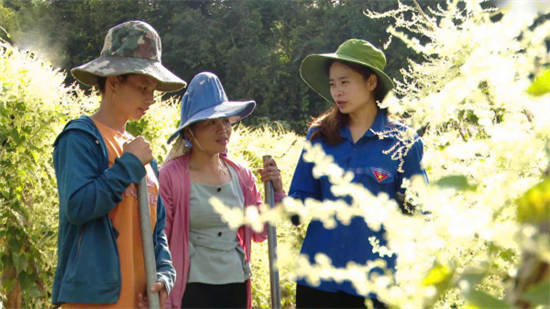 |
| Voluntary young intellectual instructs farming techniques for People in Sop Cop commune, Son La province |
Adhering to the motto “Each cadre and Party member is a propagandist and a soldier in mass mobilisation work, and a scout who thoroughly grasps the local situation”, the Corps has deployed its voluntary cadres, staff, and young intellectuals as part of inter-sectoral teams and groups stationing in villages and implementing the “3-stick, 4-together” motto to grasp the situation and conduct public work. In order to make this work effective, the Corps held training courses on mass mobilisation skills, especially ethnic language courses, enabling its cadres and staff to approach the people and carry out their tasks more easily. It has also directed its production teams to integrate other forms of propaganda, such as filming, internal radio, and cultural and sports exchanges, etc. In particular, it pays special attention to the role of village elders, leaders and key figures of the communities, and young ethnic intellectual volunteers in the project areas to tap into and promote the internal strengths of the ethnic minority people.
Its production teams have established fraternal ties with and supported the socio-political organisations in the area. Through direct participation in the activities of Party cells, they help Party cells implement Party principles and regulations, and create sources for developing new Party members. They guide socio-political organisations on how to mobilise and attract members to local activities. They also provide training in knowledge and skills to young volunteer intellectuals so that they may become possible candidates for vacancies in the grassroots political system. These actions contribute to strengthening trust and creating consensus among the people towards the local Party committee, government, and armed forces, enhancing military-civilian solidarity, and maintaining political security and social order in the area.
Thirdly, improving the quality of military and national defence work and maintaining border security. The Party Committee and Command of the Corps focus on leading and directing the building of strong, comprehensive, “exemplary and typical” agencies and units, taking political strength as the foundation for improving its overall quality and combat power. They regularly review and consolidate organisational structures with priorities being given to production teams in key areas and remote regions. They strictly adhere to and implement training and combat readiness orders from the Ministry of National Defence and the Military Region; conduct training with sound and sufficient contents and programmes for all personnel. As a result, 100% of the training results in 2025 meet the requirements, including 83.05% being rated good and excellent.
Its agencies and units have practiced combat readiness plans thoroughly; coordinated with functional forces to effectively handle situations related to national defence and security. They strictly maintain the duty regimes, especially during peak periods such as holidays, Tet, and important political events. In addition, it has directed its agencies and units to promote regularity building, disciplinary management, administrative reform, and digital transformation. To date, it has completed the deployment of a military computer network from its command to subordinate offices, through which all official documents are signed and transmitted.
Furthermore, the Corps also assists commune-level military commands in building and training militia and reserve forces, and completing combat readiness plans; coordinates closely with the police, border guards, and militia in the area to conduct patrols and protect national border security, maintain security and order, combat crime, and promptly and effectively resolve emerging incidents and issues, preventing them from becoming hotspots.
The above-mentioned achievements clearly demonstrate the responsibility and perseverance of the officers and soldiers of the 326th Economic-Defence Corps, affirming their determination to make the villages and hamlets in the project areas become solid "protective barriers" on the Northwest border of the Fatherland.
Senior Colonel DOAN MINH KHUE, Commander of the Corps