VPA promotes core role in the “500-Day Campaign to accelerate the search, recovery, and identification of martyrs’ remains”
On 2 April 2026, at the Quang Tri Ancient Citadel National Special Relic Site, the National steering committee for the search, recovery, and identification of martyrs’ remains officially launched the “500-Day campaign to accelerate the search, recovery, and identification of martyrs’ remains.” The Campaign reflects the political determination, profound gratitude, and deep sense of responsibility of the Party, the people, and the armed forces towards the heroic martyrs who sacrificed their lives for the Fatherland. Fully recognising the profound significance of this exceptionally sacred and noble political mission, cadres and soldiers throughout the Vietnam People's Army have demonstrated unwavering determination to fulfil their core role. With dedication, perseverance, and a strong sense of duty, they are working closely with the entire political system to implement synchronised policies and measures, striving to successfully accomplish the objectives and targets set forth by the Campaign.
The search, recovery, and identification of the remains of martyrs have consistently been regarded by the Party, the State, the People, and the entire political system as a task of exceptional political importance. It is a sacred responsibility and solemn obligation, embodying the nation’s enduring traditions and moral values of “Remembering those who made the well possible” and “Repaying the debt of gratitude”. At the same time, this work serves as a profound expression of gratitude for the immense sacrifices made by the heroic martyrs - the nation’s finest sons and daughters, who devoted their entire lives to the cause of the Fatherland. It also responds to the heartfelt aspirations of the martyrs’ families, as well as of compatriots and service personnel throughout the country.
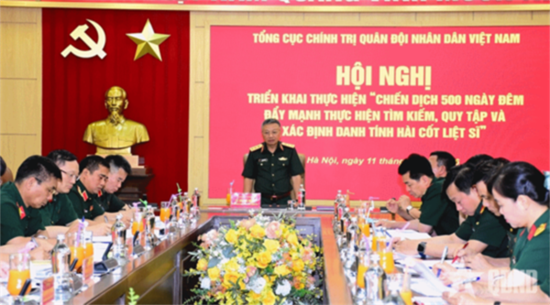 |
| Sr. Lt. Gen. Le Quang Minh speaks at the launch of the implementatin of the 500-Day Campaign. (Photo: qdnd.vn) |
Over the past years, particularly during the 2021-2025 period, the Central Military Commission, the Ministry of National Defence, the General Department of Politics, and commanders at all levels throughout the Military have continued to provide strong leadership and direction in thoroughly implementing the Party’s resolutions and directives, the State’s policies and legislation, and the programmes and plans of the National steering committee for the search, recovery, and identification of martyrs’ remains (hereinafter referred to as the National Steering Committee). Particular emphasis has been placed on implementing Politburo (11th tenure) Directive No.24-CT/TW dated 15 May 2013 on further accelerating the search and recovery of martyrs’ remains through 2020 and beyond, and Prime Minister’s Decision No.1515/QĐ-TTg dated 14 September 2021, promulgating the Plan for the search, recovery, and identification of martyrs’ remains lacking information through 2030 and beyond. Military agencies and units have consistently fulfilled their role as the core force, working proactively and in close coordination with local Party committees and authorities to implement comprehensive, synchronised, and resolute measures for the search, recovery, and identification of the remains of martyrs whose identities remain unknown or incomplete. These sustained efforts have yielded highly significant results, earning widespread recognition and high appreciation from the Party, the State, and the People.
However, the task of searching for, recovering, and identifying the remains of martyrs whose identities remain unknown continues to be an immense challenge. At present, the remains of approximately 175,000 martyrs have yet to be located, while more than 300,000 martyrs’ graves remain unidentified. At the same time, the conditions for carrying out this work are becoming increasingly difficult. Without urgent, resolute action, underpinned by scientific approaches and close coordination among ministries, sectors, local authorities, specialised forces, and the People, the opportunity to recover the remains of many martyrs will continue to diminish.
Accordingly, in 2026 - the inaugural year of the nation’s new era of development - the National Steering Committee launched the “500-Day Campaign to accelerate the search, recovery, and identification of martyrs’ remains” (hereinafter referred to as the Campaign) in order to further implement the Party’s guidelines and policies, the State’s laws and regulations, and, in particular, the directions of General Secretary To Lam concerning policies for people who have rendered meritorious service to the revolution, as well as the search, recovery, and identification of the remains of martyrs lacking identifying information. The Campaign aims to mobilise the fullest possible combined strength of the Party, the People, the armed forces, and the entire political system in carrying out the search, recovery, and identification of martyrs’ remains. It is intended not only to honour and commemorate the immense sacrifices of the Heroic Martyrs, who devoted their lives for the independence and freedom of the Fatherland and the happiness of the People, but also to foster the nation’s enduring traditions and moral values of “remembering those who made the well possible” and “repaying the debt of gratitude”, as the country moves towards the 80th Anniversary of War Invalids and Martyrs’ Day (27 July 1947 - 27 July 2027).
Building upon the achievements already attained and the experience accumulated over previous years, military agencies and units throughout the armed forces, immediately following the launch of the Campaign, have rigorously implemented the directives of the National Steering Committee, particularly the guidance issued by the leadership of the Ministry of National Defence and the General Department of Politics. Closely aligned with practical conditions, they have proactively, flexibly, and creatively implemented a comprehensive range of measures, achieving a number of important initial results. These include the timely formulation and promulgation of detailed guidance on the procedures for establishing sampling teams, providing a basis for local authorities to study and adapt to their specific circumstances. Nationwide training programmes have also been held for personnel directly engaged in the mission, particularly military medical and information technology specialists, together with decentralised training at subordinate levels. In addition, appropriate sampling teams have been established in accordance with local conditions, while efforts have been intensified to review and consolidate archival records and organise verification workshops to authenticate and conclude information relating to martyrs and martyrs’ graves, with particular attention given to collective burial sites.
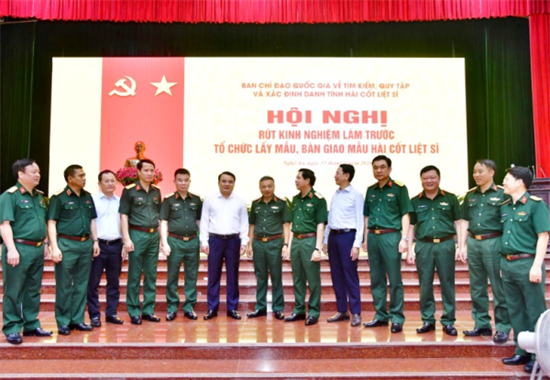 |
| Sr. Lt. Gen. Le Quang Minh discusses with delegates attending the review on the pilot implementation of the 500-Day Campaign in Nghe An province |
Nevertheless, the Campaign encompasses numerous new and exceptionally demanding tasks. The volume of work is substantial, its scope is extensive, and implementation requires both urgency and meticulous precision. It also demands a high degree of scientific rigour and specialised professional expertise. At the same time, many military units and localities continue to face shortages of personnel, equipment, and infrastructure, while operations conducted overseas are complicated by a range of additional challenges. These factors have inevitably posed significant obstacles to the effective implementation of the Campaign.
To accomplish the Campaign’s assigned tasks, objectives, and targets, ministries, sectors, local authorities, and particularly military agencies and units serving as the core force, must continue to coordinate closely in implementing comprehensive and synchronised measures. This requires mobilising all available resources and harnessing the combined strength of the entire political system and society to successfully fulfil this exceptionally important mission of profound national gratitude. To this end, priority should be given to effectively implementing the following key tasks and measures:
Firstly, to strengthen the leadership and direction of Party committees and commanders at all levels in implementing the Campaign. Party Committees of the Military Regions, local military Party organisations, and Party committees and commanders at all levels must continue to thoroughly grasp and rigorously implement the Party’s guidelines and policies, the State’s laws and regulations, and the directives and guidance issued by the National Steering Committee, the Ministry of National Defence, and the General Department of Politics concerning policies for people who have rendered meritorious service to the revolution, with particular emphasis on the search, recovery, and identification of martyrs’ remains. On that basis, they should formulate scientific, practical, and effective leadership measures and implementation plans. Particular attention should be paid to directing and coordinating the development of comprehensive programmes and action plans to ensure the strict and effective implementation of the responsibilities assigned under Ministry of National Defence Plan No.2630/KH-CT dated 22 April 2026 on the implementation of the Campaign, together with other relevant directives and documents. These plans should clearly define tasks, milestones, and deliverables on a weekly, monthly, quarterly, phased, and campaign-wide basis, accompanied by specific and feasible implementation measures suited to the functions, operational requirements, and conditions of each agency, unit, and locality.
Party committees and commanders at all levels, particularly principal leaders and specialised agencies, must personally direct and oversee implementation and bear full responsibility for the results achieved. All assigned tasks should be translated into concrete actions with clearly defined responsibilities for each agency, unit, and individual in accordance with the principle of the “Six-clear”: clear personnel, clear tasks, clear timelines, clear responsibilities, clear authority, and clear deliverables. Each task should be assigned to a single lead agency to avoid overlapping responsibilities, duplication of functions, or the shifting of accountability that could delay the Campaign’s progress. The results of Campaign implementation should also constitute an important criterion in assessing the performance of Party committees, Party organisations, agencies, units, and commanding officers at all levels.
Secondly, to intensify communication and propagation efforts to promote the profound humanitarian significance of the Campaign through diverse and innovative approaches. Military agencies and units throughout the Army should organise a broad-based political education campaign. Military media organisations should continue to work closely with central and local press agencies by establishing dedicated columns and special features, increasing broadcast airtime, and expanding news coverage to disseminate the Party’s and the State’s policies on the search, recovery, and identification of martyrs’ remains, promote the objectives and activities of the Campaign, and highlight initiatives under the “Repaying the Debt of Gratitude” movement in anticipation of the 80th Anniversary of War Invalids and Martyrs’ Day.
At the same time, proactive efforts should be made to strengthen communication, advocacy, and public engagement in order to encourage organisations and individuals both within and outside the country, military units stationed in localities, and local communities - particularly veterans and historical witnesses - to provide information on martyrs and martyrs’ graves and to participate in search and recovery activities. Priority should be given to key operational areas, remote and isolated regions, ethnic minority communities, former revolutionary bases, and other areas where information is limited. Comprehensive investigations, reviews, verification, and integration of available information should be carried out to accurately identify priority locations for search and recovery operations. Public communication should also contribute to maintaining political and social stability at the grassroots level. Information management must be conducted rigorously, accompanied by timely guidance of public opinion and prompt handling of emerging issues, thereby preventing hostile elements from exploiting or distorting the Party’s guidelines, the State’s policies and legislation, or the objectives, significance, and humanitarian values of the Campaign.
Communication and propagation activities should be conducted continuously before, during, and after the completion of the Campaign. Methods and formats should be constantly renewed to ensure they remain engaging, practical, and effective. Full use should be made of all communication channels - including print and online newspapers, radio, television, digital platforms, and social media - while combining them with visual publicity, cultural and artistic activities, traditional exchanges, meetings with historical witnesses, and commemorative events honouring the families of martyrs. Through these integrated efforts, the profound political, social, and humanitarian significance of the Campaign will be widely disseminated, fostering broad consensus and strong public support among military personnel, the People, and society as a whole.
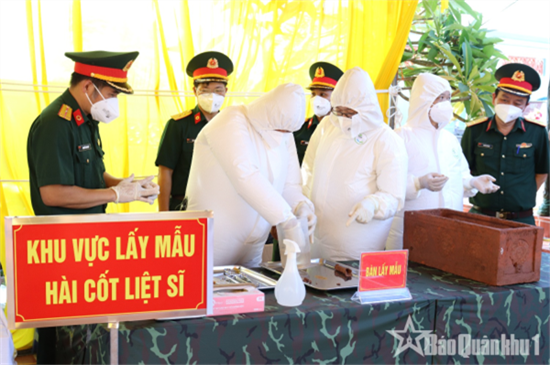 |
| Armed forces of Military Region 1 collect biological samples of unidentified martyr remains for DNA testing (Photo: baoquankhu1.vn) |
Thirdly, to remain responsive to practical developments and proactively implement the search, recovery, and identification of martyrs’ remains in a flexible, innovative, and effective manner. Based on evolving circumstances and the Campaign’s assigned tasks and targets, military agencies, units, and local authorities should regularly review implementation progress, report emerging issues, and propose necessary adjustments to programmes, plans, organisational structures, and force composition. Adequate facilities, equipment, logistics, and operational resources must be ensured, with the highest priority accorded to the search, recovery, and identification of martyrs’ remains, in accordance with the characteristics of each operational area. Greater application of science and technology and digital transformation should be promoted, particularly in verifying information, confirming search areas, developing search-and-recovery maps, and improving the documentation, archival records, and mapping products related to martyrs’ remains. On this basis, leadership and direction should focus on intensifying search and recovery operations both domestically and overseas, with priority given to operations within Vietnam, especially in areas where information on martyrs’ graves remains abundant and in locations believed to contain collective burial sites. In addition to maintaining and enhancing the effectiveness of existing search and recovery teams, the Steering Committees of the Military Regions should promptly direct relevant agencies to review and propose the consolidation or establishment of additional task forces, sampling teams, specialised units, and temporary search and recovery teams in order to accelerate implementation and achieve the Campaign’s objectives and targets.
At present, a number of areas containing the remains of martyrs have yet to be recovered because they remain contaminated by landmines and unexploded ordnance. Local military agencies, units, and authorities should work proactively with relevant authorities to delineate and secure these areas, with the objective of completing mine and explosive ordnance clearance by the end of 2026 in priority locations and core operational areas, including Vi Xuyen of Tuyen Quang Province, and the provinces of Lao Cai and Lang Son. Clearance operations should follow the principle of “handover upon clearance”, enabling search and recovery teams to recover approximately 700 sets of martyrs’ remains. Launching ceremonies, receptions, memorial services, and burial ceremonies for recovered remains should be held with solemnity, meticulous preparation, dignity, and absolute safety.
The identification of martyrs’ remains represents a new and particularly important mission, one that requires the highest standards of scientific accuracy and professional competence. Building on the initial success of sample collection and transfer at Nghi Loc Martyrs’ Cemetery (Dong Loc Commune, Nghe An Province), military agencies, units, and local authorities should prioritise leadership, direction, and resource allocation for the collection and transfer of biological samples from martyrs’ remains. These activities must strictly comply with established procedures and ensure scientific rigour, accuracy, safety, and efficiency. The armed forces should strive to complete this task by May 2027, thereby achieving the target two months ahead of the Campaign’s overall schedule.
To ensure substantive results, military agencies and units should continue to effectively implement Party building and political work in accordance with General Department of Politics Directive No.1814/CT-VP dated 26 May 2026 on the implementation of the Campaign. Close coordination should be maintained with local departments, agencies, and relevant organisations in conducting DNA analysis and identification, while greater emphasis should be placed on mass mobilisation, monitoring public opinion, and understanding local concerns in order to build broad social consensus and maintain political stability, public security, and social order throughout the Campaign.
Fourthly, to continue to strengthen international cooperation in the search, recovery, and identification of martyrs’ remains. In accordance with the tasks, targets, and responsibilities assigned under the Campaign, the competent agencies of the Ministry of National Defence should proactively coordinate with relevant central ministries and agencies in advising the Central Military Commission, the Ministry of National Defence, and the General Department of Politics on measures to expand international cooperation. This includes strengthening collaboration with political and social organisations in the United States, Australia, and other relevant countries in order to obtain technical and technological assistance, exchange professional experience, and acquire documents, archival records, artefacts, and personal effects relating to Vietnamese servicemen who were killed, went missing, or whose fate remains unknown during the war. The Ministry should also coordinate the establishment of working delegations under the National Steering Committee to conduct archival research and information collection in selected countries, while proactively receiving and utilising documents and information provided by foreign partners to support the search, recovery, and identification of martyrs whose identities remain unknown.
Close cooperation should also continue with the Lao Government’s special task Committee and the Cambodian Government’s specialised Committee in accelerating the search, recovery, and repatriation of the remains of Vietnamese volunteer soldiers and military experts who laid down their lives in Laos and Cambodia during successive periods of war. These efforts should continue until no further information concerning burial locations remains, and should be carried out in a spirit of initiative, determination, urgency, and the highest sense of responsibility.
Finally, to strengthen inspection, supervision, periodic review, and lessons-learned activities throughout the implementation of the Campaign. The competent agencies of the Ministry of National Defence should proactively coordinate with relevant central ministries and agencies to conduct regular inspections and supervision, closely monitor the progress of Campaign implementation by military agencies, units, and local authorities, and ensure that assigned tasks are carried out effectively. Particular attention should be given to monitoring the implementation of policies and entitlements, as well as the provision of equipment, vehicles, and logistical support for organisations and personnel engaged in the search, recovery, sampling, transportation, management, preservation, and identification of martyrs’ remains. Inspection teams should also be established to oversee the operations of search and recovery teams working in Laos and Cambodia. Difficulties, shortcomings, and emerging issues encountered during implementation should be identified promptly, with appropriate remedial measures proposed and implemented in accordance with established reporting procedures. Comprehensive mid-term and final reviews of the Campaign should be conducted to draw practical lessons, evaluate implementation outcomes, and make timely adjustments to leadership measures, operational plans, and implementation mechanisms in order to ensure the successful achievement of the Campaign’s objectives and targets. The Campaign’s tasks and performance indicators should be closely integrated with the Patriotic Emulation Movement, the Determination-to-Win Emulation Movement, peak emulation campaigns, and the “Repaying the Debt of Gratitude” movement. Outstanding collectives and individuals should be recognised and commended in a timely manner, thereby promoting exemplary models of dedication, responsibility, professionalism, and humanitarian commitment, and inspiring their wider replication throughout the armed forces and society.
The search, recovery, and identification of martyrs’ remains constitute a sacred political mission and a profound moral responsibility of the Party, the State, the People, and the Army towards the Heroic Martyrs who sacrificed their lives for the nation. Military agencies, units, and local authorities should continue to uphold the nation’s enduring tradition of “Remembering those who made the well possible”, demonstrate the highest sense of responsibility, strengthen solidarity, proactively overcome difficulties, and carry out their duties with flexibility, determination, and innovation. Through these concerted efforts, they should strive to successfully accomplish all objectives of the Campaign while fostering a vibrant and meaningful spirit of emulation in celebration of the 80th Anniversary of War Invalids and Martyrs’ Day (27 July 1947 - 27 July 2027).
Senior Lieutenant General LE QUANG MINH, Deputy Chief of the General Department of Politics of the Vietnam People’s Army, Member of the National Steering Committee for the search, recovery, and identification of martyrs’ remains