Vietnam Military Medical University concentrates on enhancing the quality of training, scientific research, and medical treatment
Building on the achieved results, the Vietnam Military Medical University (VMMU) has been implementing comprehensive solutions to enhance the quality of training, scientific research, and medical treatment, thereby meeting the increasing requirements of the task of building the Military and protecting and caring for the health of troops and the People in the new situation.
The Vietnam Military Medical University has received close attention, investment, and development support from the Party, the State, the Central Military Commission, and the Ministry of National Defence, and is being built and developed in the direction of a research-oriented university and a national key university. Its mission is to develop high-quality healthcare professionals; to conduct scientific research and technology transfer in medicine and military medicine; and to deliver professional, standardised medical examination, treatment, and health care, meeting the needs of protecting and improving the health of soldiers and the People.
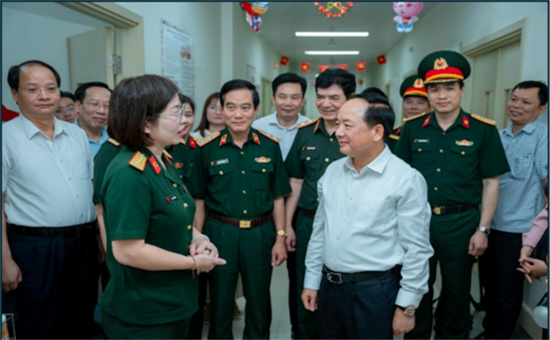 |
| General Trinh Van Quyet, Head of the Central Propaganda and Mass Mobilisation Commission visits Military Hospital 103 |
Deeply aware of the position, role, and assigned missions, the University’s Party Committee and Board of Directors have concentrated on leading, directing, and resolutely and synchronously deploying solutions, generating comprehensive and solid transformation across all areas of work. Thoroughly grasping the guiding principle that “The school’s training quality represents the unit’s combat readiness”, the University has synchronously and effectively implemented solutions spanning admissions work, the development of training programmes, the building of the lecturer contingent, the renewal of teaching methods, and cooperation in education and training. Its scientific research activities remain highly practical, concentrating on addressing issues arising from military and defence tasks as well as medical development requirements, and yielding numerous research projects and products with high practical application value. The quality of medical examination and treatment has been steadily elevated, with the mastery of many advanced and specialised techniques, serving as an important practical environment for training, scientific research, and the protection and healthcare of both soldiers and the People.
Currently, facing the requirement of building a modern Military and the rapid development of science and technology - particularly biomedical technology, artificial intelligence, and advanced medical techniques - together with the increasingly high demands of protecting and caring for the health of soldiers and the People, the University is presented with new requirements in training, scientific research, and treatment, with favourable opportunities and challenges intertwined. To successfully fulfill its assigned tasks and affirm the prestige and position of a leading centre in training, research, and medical treatment of the Military and the nation, the University has resolved to continue renewing its mindset and to concentrate on generating solid transformation in the quality of training, scientific research, and treatment, through the following key solutions:
Firstly, strengthen the leadership and direction of Party committees and commanders at all levels over the tasks of training, scientific research, and treatment. The University continues to research, study, and thoroughly grasp the resolutions, directives, and conclusions of the Party Central Committee, the Central Military Commission, and the Ministry of National Defence concerning education and training, breakthroughs in science and technology development, and healthcare for soldiers and the People. On this basis, the University concretises these into plans and action programmes, clearly identifying priorities, breakthrough stages, objectives, targets, timelines, and implementation responsibilities, thereby ensuring concentrated and unified leadership over all tasks.
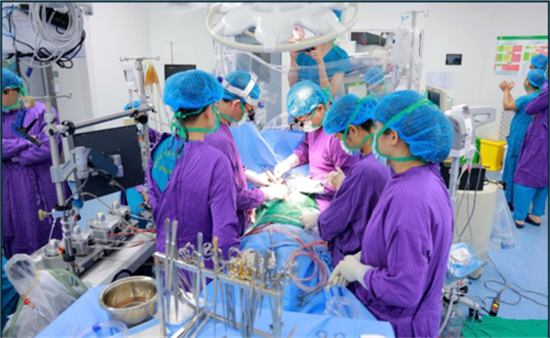 |
| Doctors of Military Hospital 103 conduct organ transplantation |
Along with this, the University continues to innovate its leadership style, working methods, and working procedures in the direction of being “focused, deeply engaged, resolute, and effective”; and to promote the exemplary role of the contingent of cadres and Party members, above all the key leading cadres. It regularly reviews and perfects working regulations and leadership regulations for key areas of work; implements decentralisation and empowerment in conjunction with the assignment of duties and responsibilities, aligning with the functions, authority, and task requirements; ensures clear authority, clear responsibility, and clear coordination mechanisms, without either performing work on others’ behalf or slackening the leadership role of Party committees and organisations. The University takes training quality, the results and applied value of scientific research, and the quality and effectiveness of medical treatment as the criteria for evaluating the leadership capacity and task completion levels of cadres at all levels, agencies, and units annually; overcomes the mindset of task-based and formal management, valuing substantive results and contributions to the University’s common mission.
The University strengthens inspection and supervision, linking inspection with urging and guiding implementation to promptly detect and rectify limitations and shortcomings; and resolutely overcomes the tendency toward evading and shifting of responsibility, fear of making mistakes, “words not matching deeds”, lack of resolution in implementation, and insufficient quality and effectiveness. Emphasis is placed on inspecting difficult stages, new tasks, and missions and fields requiring the mobilisation of substantial resources, as well as the coordination among training, scientific research, and treatment. Organise preliminary and final reviews to draw lessons, promptly supplement and perfect leadership guidelines and measures, and create alignment between leadership, guidance, and implementation, ensuring that resolutions, plans, and programmes are executed seriously and effectively.
Secondly, make a breakthrough in enhancing the quality of education and training. The University concentrates its breakthrough efforts on education and training in the direction of standardisation and modernisation, attaching importance to the close combination of equipping learners with specialised knowledge and training them in professional skills with fostering political stance, moral qualities, organisational discipline, and operational capacity in the military environment.
First and foremost, it concentrates on building a contingent of lecturers and educational managers of sufficient quality, capability, and prestige, with a rational quantity and structure; and attaches importance to developing leading experts in the spearhead fields of military medicine and pharmacy. Cadre building is linked to the standardisation of professional titles and to the enhancement of specialised expertise, pedagogical capacity, and scientific research capability, along with the capacity to update and transfer modern medical knowledge. Concurrently, mobilise resources, accelerate investment, and upgrade infrastructure, facilities, equipment, and teaching aids in a synchronous and modern manner, with unity among training, scientific research, and medical examination and treatment, meeting the requirements for training high-quality military medical human resources. The University continues to review and perfect its training programmes and content in an interlinked, integrated, and modern direction, closely aligning with the development of medical science, biomedical technology, and the requirements of military and defence tasks; ensuring a balance between specialised knowledge and military and defence knowledge, between theory and practice, and between clinical medicine and modern military medicine, while decisively shifting from content-based training to training based on output standards and task-performance capability.
The University strongly innovates teaching-learning methods and organisational forms, under the guiding principle of “substantive teaching, substantive learning, and substantive evaluation of learners’ competence”. It flexibly combines traditional methods with modern teaching approaches, strengthens hands-on practice, and values the method of “step-by-step” instruction for essential professional skills. In particular, it closely integrates teaching with clinical practice, internships at hospitals and military units, and final-course field exercises to enhance the practical competence of learners. Strengthen strict management and inspection, and ensure objective and accurate evaluation of education and training quality based on output standards. In the short term, make thorough and comprehensive preparations for the professional competency examination for medical practice by the National Medical Council, which will be implemented from 2027. The University strives to fundamentally meet the criteria of a research-oriented university by 2030 and to be ranked among the leading institutions nationally and regionally in the health sciences sector.
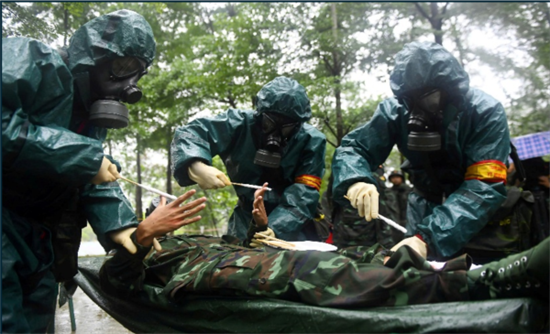 |
| Conducting course-end military medical exercise |
Thirdly, promote scientific research, application of science and technology, and innovation - an important driving force for enhancing the quality of training, research, and treatment. The University continues to boldly renew its thinking and methods of conducting scientific and technological activities; it prioritises the development of spearhead research directions in military medicine and pharmacy, capable of yielding products, techniques, and solutions of high applied value. Specifically, research efforts will centre on specialised and high-priority areas of military medicine and pharmacy, such as: tropical diseases, disaster medicine, toxic and radiation countermeasures, field surgery, developing pharmaceutical formulations for soldiers in extreme environments, ensuring health readiness for special operations forces, and sustaining military medical support in high-technology warfare. At the same time, it proactively approaches, researches, and applies the new achievements of modern medicine, biomedical technology, artificial intelligence, Big Data, digital technology, and advanced diagnostic and therapeutic techniques, tailored to its functions, missions, and practical conditions.
Link basic research with applied research and clinical practice; focus on researching foundational and core technologies, as well as strategic products of military medicine and pharmacy, gradually establishing strong and specialised research groups; enhance the University’s autonomy in science and technology while also giving priority to expanding the application of new material technologies, biotechnology, and advanced techniques in diagnosis and treatment. Concurrently, build a synchronous scientific and technological potential, ranging from infrastructure, laboratories, and applied research centres to a contingent of experts and scientists with leadership capabilities. Continue to expand cooperation with prestigious, modern medical centres both domestically and internationally, while strengthening the acquisition, development, and transfer of technology to generate highly practical scientific products.
Along with this, the University accelerates digital transformation and innovation, promotes initiatives and technical improvements, builds a “smart university”, and leverages its digital library and digital platforms. Additionally, it strengthens the application of artificial intelligence and the exploitation of Big Data in management, training administration, and learner competency assessment, as well as in hospital management, medical examination, treatment, and patient care. Consequently, this will gradually upgrade the University’s research capacity, mastery, and application of science and technology, generating practical products, techniques, and solutions to serve both soldiers and the People.
Fourthly, raising the quality of medical examination, treatment and healthcare protection for soldiers and the People. Medical examination and treatment constitute both a central mission and a practical environment for honing and testing the University’s professional expertise level, practical capability, and scientific research results. Therefore, raising the quality of medical examination and treatment not only better meets the health care needs of soldiers and the People, but also lays the foundation for improving training quality, promoting scientific research, and developing new techniques. Accordingly, the University concentrates on developing Military Hospital 103, the Le Huu Trac National Institute of Burns, and the Military Institute of Clinical Embryology and Histology in a highly specialised and modern direction - with high medical capabilities linked with training and scientific research, gradually perfecting the “university hospital” model.
Continuing the execution of the “Professional and Technical Development Plan to 2025, with a Vision to 2030”, the University concentrates on developing its spearhead specialties, mastering advanced specialised techniques, while enhancing capabilities in diagnosis, emergency care, and the treatment of complex and critical illnesses. At the same time, it proactively updates and applies the new achievements of modern medicine and medical technology, progressively enhancing its mastery of technique. The University will standardise professional procedures; strengthen infection control, quality management, and patient safety; and effectively perform medical direction for lower-level healthcare facilities, technology transfer, and patient counseling, management, and care, ensuring safety and efficiency in treatment.
Along with that, the University focuses on investing in the modernisation of infrastructure, equipment, medicines, and medical supplies, ensuring synchronisation and alignment with the orientation for professional and technical development; and on building a contingent of physicians, nurses, and technicians with solid expertise, high medical ethics, compassion, and dedication, wholeheartedly serving the cause of protecting and caring for the health of soldiers and the People. Emphasis is placed on building a civilised and professional medical environment and on accelerating the application of digital technology in management, examination, treatment, and patient care. In particular, the University closely links medical examination and treatment capabilities with military medical logistics requirements and combat readiness tasks; organises, trains, and builds mobile military medical forces capable of effectively handling emergencies, epidemics, disasters, and unexpected tasks. Consequently, this will not only enhance the quality of protecting and caring for the health of soldiers and the People, but also build potential and military medical logistics capabilities to meet the requirements of building a modern military and protecting the Fatherland.
With high political determination, innovative thinking, methodical execution, and firm, scientific steps, the Vietnam Military Medical University continues to promote its bravery and intellect, further raising the quality of education, training, scientific research, and treatment, and ever better meeting the requirements of building a modern Military, as well as protecting and caring for the health of soldiers and the People. Consequently, the University continues to affirm its prestige and standing as a leading centre of training, research, and treatment of the Military, the nation, and the region.
Lieutenant General, Prof., Dr. TRAN VIET TIEN, Director of the University