Promoting the combined strength for the “500-day-and-night Campaign to accelerate the search, recovery, and identification of martyrs’ remains”
Deeply aware of the particularly sacred and profoundly humanitarian significance of the “500-day-and-night Campaign to accelerate the search, recovery, and identification of martyrs’ remains”, agencies, units, and localities are resolutely and synchronously implementing various solutions to bring into full play the combined strength, determined to successfully fulfil all the tasks and objectives set out by the Campaign.
Continuing to thoroughly grasp and concretise the Party’s lines and the State’s policies and laws, particularly Notice 466-TB/VPTW, dated 19 December 2025, issued by the Office of the Party Central Committee on the conclusions of the General Secretary at his working session with the Party Committee of the Ministry of Home Affairs and central-level committees, ministries, and sectors on policies for people with meritorious services to the revolution, as well as on the search, recovery, and identification of martyrs’ remains, the National Steering Committee for the Search, Recovery, and Identification of Martyrs’ Remains (hereinafter referred to as the National Steering Committee - NSC) launched the “500-day-and-night Campaign to accelerate the search, recovery, and identification of martyrs’ remains” (hereinafter referred to as the Campaign), from 15 March 2026 to 27 July 2027.
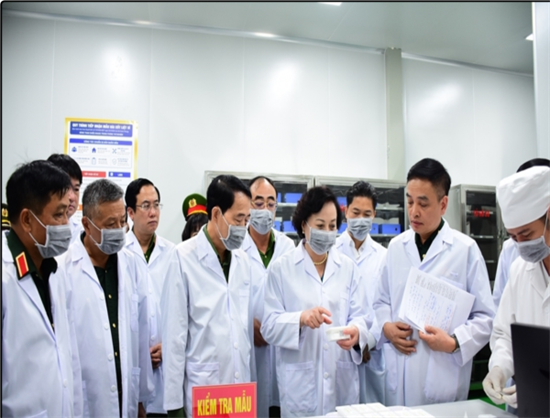 |
| Deputy Prime Minister Pham Thi Thanh Tra inspects the work of receiving, managing, and preserving samples of martyrs’ remains |
Under the Campaign, the Vietnam People’s Army (VPA) is assigned three tasks, namely searching and recovering martyrs’ remains, collecting samples from martyrs’ remains in graves whose information has not yet been identified in martyrs’ cemeteries, as well as from martyrs’ remains found and recovered through searches, and conducting bomb, mine, and explosive ordnance clearance in key areas and core zones, such as Vi Xuyen (Tuyen Quang province), Lao Cai province, Lang Son province, and areas where information on martyrs’ graves is available, in order to facilitate the search and recovery of martyrs’ remains.
Immediately after the Campaign was launched, agencies and units across the VPA have thoroughly grasped and strictly implemented the directions of the NSC and leaders of the Ministry of National Defence and the General Department of Politics, kept a close eye on realities, and adopted synchronous, flexible, creative solutions, thereby initially achieving important results. Competent agencies have proactively given advice and promulgated detailed guidance on procedures and methods for establishing sampling teams and groups as the basis for localities to study and apply. Many tasks have been carried out, including: organising training nationwide and at different levels for forces directly performing the tasks, establishing sampling teams and groups, stepping up the review and compilation of dossiers, holding workshops, verifying and drawing conclusions on information about martyrs and martyrs’ graves, particularly mass graves of martyrs, and maintaining 32 search and recovery teams, with a strength of more than 1,600 personnel. The search and recovery of martyrs’ remains has been intensified, with a focus on domestic areas, particularly areas where much information about martyrs’ graves remains available, and areas where information about mass graves of martyrs is available. Steering Boards of Military Regions have promptly proposed the establishment of new working groups and sampling teams for martyrs’ remains and martyrs’ relatives, specialised teams, and temporary search and recovery teams to accelerate progress and achieve the targets and objectives set out by the Campaign. Troop deployment activities and memorial and burial ceremonies for martyrs’ remains have been carefully, thoroughly, and solemnly organised by localities, with absolute safety.
However, the progress of the Campaign in some localities and units remains slow; meanwhile, the tasks to be accomplished during the remaining period of the Campaign are substantial, involving numerous difficulties and challenges. A large number of martyrs’ remains have yet to be searched and recovered; information is limited; dossiers and grave-location maps under management and storage are incomplete and inconsistent; terrain, physical features, and administrative boundaries have undergone many changes, making it difficult to collect, survey, verify, and draw conclusions on information and to search and recover martyrs’ remains. These difficulties and challenges are even greater in the search and repatriation of martyrs’ remains abroad, because the areas are extensive, the terrain is complex, the sites are far from population centres, and there are differences in language, culture, and so forth.
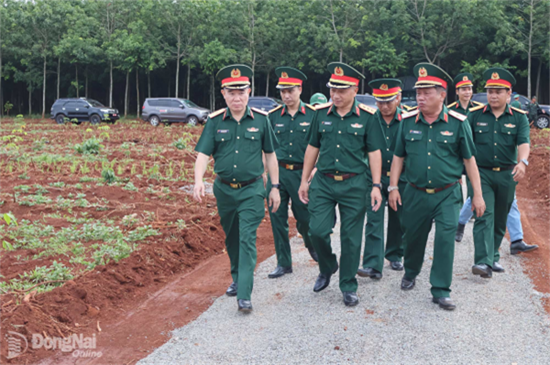 |
| General Department of Politics delegation inspects the search and recovery of martyrs’ remains in Minh Duc commune, Dong Nai province (photo: baodongnai.com.vn) |
To accelerate progress and successfully accomplish the tasks, objectives, and targets set out by the Campaign, military agencies and units need to maintain close coordination in synchronously implementing solutions and bringing into full play the combined strength to successfully fulfil this particularly sacred, deeply meaningful political mission. To that end, emphasis should be placed on the following key solutions.
First, continuing to step up education and communication to raise awareness and a sense of responsibility towards the Campaign among cadres and soldiers. It is necessary to strengthen education and dissemination of the Party’s lines, the State’s policies and laws, and resolutions, directives, plans, and guidance on the search, recovery, and identification of martyrs’ remains. Emphasis should be placed on clarifying the position, significance, requirements, objectives, and key tasks of the Campaign, associating this mission with promoting the revolutionary tradition, qualities, and cultural values of “Uncle Ho’s Soldiers”, the VPA’s political responsibility, and the requirements for building all-people national defence in the new situation. Due attention should be paid to bringing into full play the role of organisations and forces, with the Campaign’s specialised communications team serving as the core force in education and propagation. It is important to actively renew the content and forms of education and communication towards approaches that are visual, lively, diverse, and appropriate to each target group. Information technology, digital platforms, internal broadcasting systems, web portals, social media, and multimedia should be further applied to disseminate results and effective models in the Campaign. Importance should be attached to producing documentaries, articles, short videos, eyewitness accounts, and historical materials on the process of fighting and sacrifice of martyrs, on the search and recovery of martyrs’ remains, as well as on collectives and individuals who have demonstrated a strong sense of responsibility, dedication, and creativity in performing their tasks. Doing so will help create a broad ripple effect and inspire pride, sentiment, and a sense of responsibility among cadres and soldiers towards this mission.
Second, strengthening the leadership and direction of party committees and commands at all levels in executing the Campaign. Thoroughly grasping and strictly implementing Directive 1814/CT-VP, dated 26 May 2026, issued by the General Department of Politics on party and political work in the “500-day-and-night Campaign to accelerate the search, recovery, and identification of martyrs’ remains”, all-level party committees and party organisations should regularly conduct inspection and assess the situation to promptly promulgate guidelines and measures of leadership and direction appropriate to the characteristics of the areas and assigned tasks. The leadership role of party committees and the responsibility of commanders and heads of agencies and units should be promoted; commanders must directly ensure clarity as to the person responsible, task, authority, responsibility, timeframe, and expected outcome. In key or complex areas, or areas where much information related to the burial locations of martyrs is available, it is necessary to reinforce cadres in charge of direction, specialised forces, and equipment in order to proactively resolve difficulties right at grass-roots level. The responsibility of heads in inspecting progress and quality and addressing arising problems should be heightened. Party committees and commands at all levels should shift from a leadership and direction method primarily based on documents to a close combination of direction, inspection, guidance, and direct grasp of the situation in the areas. They should maintain regular briefing, reporting, and progress-inspection regimes at each stage, establish a mechanism for regularly updating data on information sources, surveyed areas, graves searched, remains recovered, and identification results, in association with the assigned targets for searching and recovering martyrs’ remains by agencies, units, and localities. On the basis of actual data, they should promptly adjust search forces, equipment, and methods to avoid scattered, unfocused approaches or delays in dealing with valuable information sources.
Party committees and commands at all levels should lead and direct the provision of adequate necessary conditions for the Campaign, proactively balance and ensure personnel, funding, equipment, means, and logistics and technical support, with priority given to key areas, areas where relatively clear information sources are available, and urgent tasks. Great value should be attached to providing training and guidance to forces directly performing the tasks, particularly skills in conducting surveys, processing information, using technical equipment, and applying scientific and technological achievements. Ensuring conditions for task performance must be associated with guaranteeing the living conditions, health, safety, and policies for forces directly implementing the Campaign.
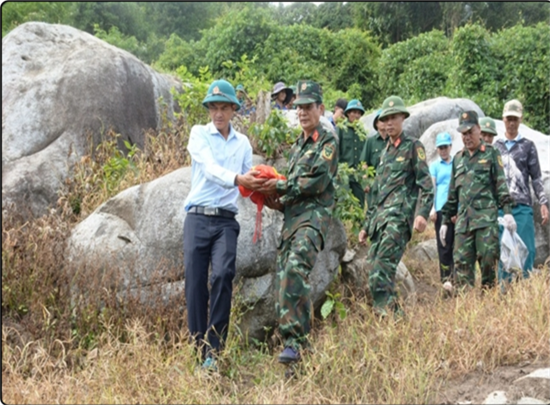 |
| K51 Team under the Provincial Military Command of Dak Lak coordinates with Cu Pui commune authority to search and recover martyrs’ remains in the area |
Third, closely coordinating with organisations and forces, mobilising all resources, proactively executing the Campaign in a flexible, creative, and effective manner. Inter-agency and inter-force coordination mechanisms to ensure unity in leadership, direction, management, and implementation should be strengthened. Information exchange, inspection, and assessment should be regularly maintained to promptly resolve difficulties and arising issues. The role of military agencies, local authorities, police forces, home affairs agencies, health agencies, science and technology forces, and other relevant agencies should be brought into play to formulate a unified coordination mechanism from the collection of information, field survey, search, excavation, and recovery to the forensic examination and identification of martyrs’ remains. Emphasis should be placed on reviewing and assessing demands for personnel, means, equipment, funding, databases, and professional capabilities in order to develop appropriate allocation plans suited to the characteristics of each area; priority should be given to areas with substantial information on martyrs, key areas, areas with harsh terrain, or areas at risk of changes due to socio-economic development and natural impacts.
Furthermore, social resources should be leveraged by encouraging organisations, enterprises, scientists, war veterans, historical witnesses, and the People to provide information, means, technological capacity, and funding under regulations. Resource mobilisation must go hand in hand with strict, public, and transparent management to ensure that resources are used for the right purposes and avoid dispersion and waste. It is necessary to diversify forms of information reception, carry out systematic review, cross-checking, and verification of information provided by war veterans, martyrs’ relatives, historical witnesses, local people, and social organisations. The application of science, technology, and modern search methods should be intensified, while technology should be combined with the practical experience of forces directly performing the tasks. Technology, particularly digital maps, geographic information systems (GIS), remote sensing imagery, terrain data, and appropriate technical equipment, should be applied in a synchronous, focalised fashion to identify locations where martyrs’ remains may be found. Besides, solutions capable of reducing the time required, improving accuracy, and reducing costs should be prioritised.
Fourth, seriously conducting inspection and supervision and promptly drawing lessons to improve the quality and effectiveness of the Campaign and accelerate its progress. The content of inspection must be specifically defined, with a focus on key stages, such as: development and dissemination of plans; review, collection, verification, and management of information on martyrs and martyrs’ graves; organisation of survey, search, and recovery; preparation of dossiers, preservation and handover of remains; collection of biological samples and coordination in DNA testing; management and use of funding, means, and equipment; implementation of reporting regimes and coordination among forces. The results achieved should be substantively assessed, while shortcomings, causes, and responsibilities of relevant organisations and individuals should be clearly identified to avoid formalistic inspections or inspections that focus solely on the number of martyrs’ remains searched and recovered.
Agencies, units, and localities need to establish mechanisms for monitoring progress and providing early warnings for tasks at risk of delay or failure to achieve their objectives; they should develop systems of monitoring indicators appropriate to each stage of the Campaign. These mechanisms and systems should clearly define the progress of information collection and verification, the number of areas surveyed and searched, the results of recovery, the number of biological samples collected and sent for testing, the proportion of dossiers meeting the necessary conditions, and the results of identification of martyrs’ remains. It is essential to regularly provide updates, conduct analyses, and compare planned targets with actual results in order to promptly detect weaknesses, difficult areas, or tasks at risk of delay, and proactively adjust forces, means, methods, and timelines.
Significance should be attached to applying information technology and digital databases in inspection, supervision, and management of results, associated with data standardisation, access rights allocation, information security, and quality control of input data for the Campaign. Emphasis should be placed on digitalising information on martyrs, potential areas, and the results of survey, search, recovery, and identification, etc., thereby facilitating progress monitoring, data cross-checking, and detection of issues to be resolved. On the basis of uniformly updated data, authorities at all levels should produce real-time reports and analyse results by area, stage, and task group, while strengthening information sharing among relevant agencies and units.
Building on the results achieved, with political responsibility before the Party, State, and People and profound gratitude to the heroic martyrs who sacrificed their lives for national liberation, Fatherland protection, and noble international missions, agencies, units, localities, and forces will continue to bring into full play the combined strength and remain determined to successfully fulfil all the objectives and tasks set out by the Campaign, thereby deserving the trust of the Party, State, and People and meeting the expectations of the relatives and families of the fallen heroes.
Maj. Gen. DOAN QUANG HOA
Director of the Department of Policy and Social Affairs
Chief of the Office of the NSC