Gender equality in Vietnam: A human value and vivid proof of the good nature of the socialist regime
Gender equality is a progressive, humanistic value linked to the goal of human liberation. It is clearly reflected in the Party's leadership guidelines, institutionalised through policies and laws, and realised through practical achievements. These foundations affirm the good nature and superiority of the socialist regime while refuting one-sided, non-objective, and distorted claims regarding the reality of gender equality in Vietnam.
In recent years, the issue of gender equality in Vietnam has frequently been exploited by hostile forces and political opportunists to spread distortions and misrepresentations, thereby advancing biased views on the nature and superiority of the socialist system. Furthermore, an incomplete understanding of gender equality, particularly the failure to distinguish between equality of rights and opportunities versus equality of outcomes, can easily lead to non-objective perspectives or even the inadvertent abetting of erroneous narratives. To accurately grasp the essence of the issue and effectively refute distorted claims, it is essential to examine the matter through theoretical, legal, and practical lenses.
The political foundation of gender equality in Vietnam
Gender equality in Vietnam is rooted in the very first goals of the revolution. From its inception, the Communist Party of Vietnam linked the issue of women's liberation inextricably to national, class, and human liberation. This perspective is fundamental, as it situates the status of women within the process of transforming the old society and building a new one. Drawing on historical realities, President Ho Chi Minh clearly recognised the role of women, both globally and in Vietnam, and affirmed: “Women make up half of our population. To build socialism, it is a must to truly liberate women and respect their rights”.
His vision has been realised throughout the country's development, most notably in the changing social status of Vietnamese women. In the old society, women were constrained by feudal customs and mindsets, as well as by inequalities regarding political, economic, and social rights. The revolution marked a historic turning point, transforming women into citizens with political rights and the rights to work, study, participate in social management, and contribute to the nation. During the struggle for national independence, women were deeply involved in every facet of the revolution, engaging in direct combat, acting as liaisons, sheltering cadres, ensuring logistics and production, caring for the wounded, maintaining revolutionary bases, and more. In the process of national construction, women participate in production, education, healthcare, science, culture, state administration, and social activities. During the Renewal process, women continue to demonstrate their capabilities in economics, science and technology, management, foreign affairs, national defence, security, and various emerging fields. This reflects the human nature of the socialist system, where development goals are centred on people, and legitimate human rights and interests are upheld throughout the development process. Conditions are created for women to fully realise their potential and contribute to both their communities and the nation.
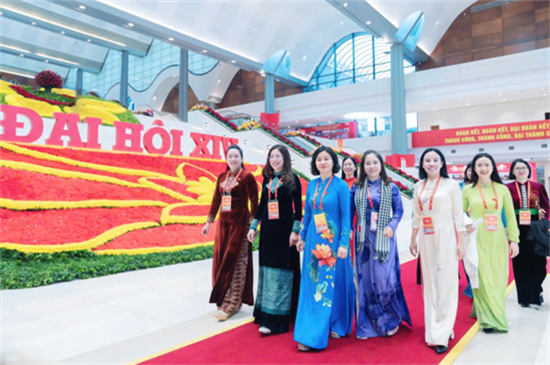 |
| Female delegates at the 14th National Party Congress |
Institutional frameworks establishing a solid foundation for gender equality
Gender equality in Vietnam is grounded in the consistent policy of the Party and institutionalised through an increasingly comprehensive legal system. Article 9 of the 1946 Constitution stated: “Women shall have equal rights with men in all respects”. The 2006 Law on Gender Equality stipulates principles for gender equality across social and family life, measures to ensure such equality, and the responsibilities of agencies, organisations, families, and individuals in its implementation. It defines the objectives of eliminating gender-based discrimination, creating equal opportunities for men and women in socio-economic and human resource development, striving for substantive gender equality, and establishing and strengthening cooperative and supportive relationships between men and women in all spheres of social and family life.
Resolution No. 11-NQ/TW, dated 27 April 2007, of the Politburo (10th Tenure) regarding women's affairs during the period of accelerated national industrialisation and modernisation, affirms: “Promoting the role and immense potential of women in the cause of industrialisation, modernisation, and national construction and defence, as well as elevating women's status and realising gender equality across political, economic, cultural, and social spheres, constitutes one of the key tasks and objectives of the Vietnamese revolution in the new era”. This perspective is further concretised in Article 26 of the 2013 Constitution: “1. Male and female citizens are equal in all aspects. The State shall adopt policies to guarantee gender equality regarding rights and opportunities. 2. The State, society, and the family shall create conditions for women to develop comprehensively and to fully exercise their roles in society. 3. Gender-based discrimination is strictly prohibited”. The 2014 Law on Marriage and Family establishes the following principles: “Marriage shall be voluntary, progressive, monogamous, and based on equality between husband and wife... without discrimination among children”.
The National Strategy on Gender Equality for the 2021–2030 period, promulgated by the Government in Resolution No. 28/NQ-CP dated 3 March 2021, sets out the overarching goal of continuing to narrow the gender gap and creating conditions and opportunities for both women and men to participate in and equally benefit from all spheres of social life, thereby contributing to the country's sustainable development. The relevant legal framework continues to be refined to establish a legal basis for protecting the legitimate rights and interests of women, encompassing instruments such as the Labour Code, the Law on Social Insurance, the Law on Prevention and Control of Domestic Violence, and various other legal documents.
The recognition of gender equality within the Constitution and a comprehensive legal system clearly demonstrates that the right to equality is enshrined in the State's highest legal foundation, serving as both a component of citizenship rights and a requirement of national governance. This institutional framework effectively refutes any claims suggesting that gender equality in Vietnam is merely a slogan.
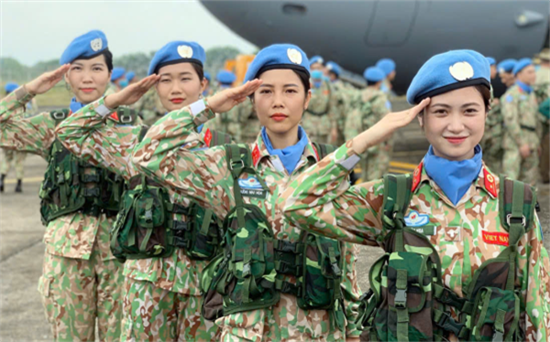 |
| VPA's servicewomen participate in UN peacekeeping operations |
Concrete achievements affirming the rising status of Vietnamese women
Real-world experience provides the most compelling, undeniable evidence of the progress made in gender equality in Vietnam. It also demonstrates how Vietnamese women are increasingly asserting their standing, roles, and capabilities across various sectors.
In the political sphere, the 16th National Assembly (2026–2031 term) includes 150 female deputies out of a total of 500, accounting for 30% of the body. This result reflects the ongoing processes of talent sourcing, training, succession planning, and the strategic placement and utilisation of female officials within the political system. It also clearly illustrates women's increasingly deep and extensive participation in policymaking, decision-making on critical national issues, and the exercise of their citizen rights. Consequently, women's political rights are being translated into a tangible capacity to participate in national governance.
Regarding the labour sector, women constitute a significant proportion of the workforce. As of 31 December 2025, the public and non-business sector recorded a total of 1,645,665 female workers, representing 70.1% of the sector's total workforce. These figures reflect the extensive involvement of women in production, service, and economic development. Vietnamese women also make substantial contributions to production, business operations, and entrepreneurship. Many women hold leadership positions in enterprises and organisations, own production and business establishments, and create jobs for their communities. Women's economic capacity is becoming an increasingly important component of the nation's overall development potential.
In the realm of education, the World Economic Forum’s Global Gender Gap Report 2025 noted that Vietnam has narrowed 97.2% of the gender gap. This serves as a crucial foundation for women to enhance their qualifications, access quality employment, and participate in skill-intensive fields. The report also ranks Vietnam 74th out of 148 countries, an improvement of nine places compared to 2022. These indicators provide objective evidence for assessing Vietnam's progress in implementing gender equality. Vietnam currently serves on the Executive Board of UN Women for the 2025–2027 term, a recognition by the international community of the country's efforts to promote gender equality and international cooperation.
Such contributions underpin the substantive value of gender equality. Gender equality empowers women to fully realise their potential, while women's advancement generates additional resources for national development. These two processes reciprocate, and together they drive the goals of human and social development.
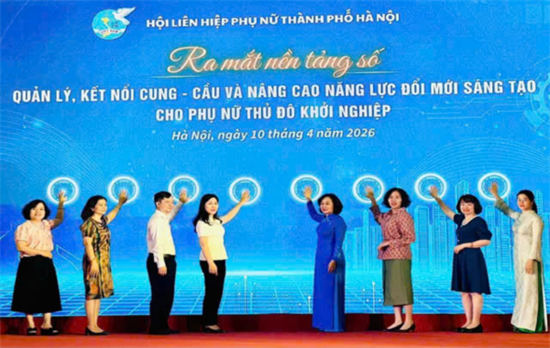 |
| The launch of digital platform for capital women's start-up (Photo: chinhphu.vn) |
Military women: A vivid manifestation of equal rights and the responsibility to serve
Military women play a vital role in the cause of national construction and defence. From the years of war to the era of peacetime national development, generations of military women have consistently upheld their character, mettle, determination, and sense of responsibility, serving across diverse fields. Many female officers have matured through roles in staff work, political affairs, logistics, technical support, military medicine, scientific research, education and training, defence diplomacy, and mass work with increasingly high positions of leadership, command, and management. Many servicewomen have successfully fulfilled their duties in challenging and arduous environments, including remote, isolated, border, and island regions. Notably, military women have made practical contributions to United Nations peacekeeping operations. The image of Vietnamese female service members in international missions helps spread the noble qualities of “Uncle Ho’s Soldiers” and showcases a peace-loving Vietnam, its people and its Army, as a responsible member of the international community.
The professional growth and contributions of military women clearly demonstrate the policy of assigning and utilising personnel based on character, competence, and performance. The Military environment has created conditions for servicewomen to continuously hone their skills, strive for excellence, and grow professionally. Each of their achievements further affirms the crucial role of women in Military building, defence consolidation, and Fatherland defence. This also serves as a concrete illustration of a key aspect of gender equality: that equal rights are inextricably linked to responsibility. When women are empowered to contribute, they will translate those opportunities into tangible results. Thus, the value of gender equality is demonstrated through each individual's competence, sense of responsibility, and practical contributions.
The achievements in gender equality in Vietnam serve as vivid proof of the human nature and superiority of the socialist system that can’t be denied. They also act as a vital driving force for the Party and the State to further enhance the role of women in the cause of national construction and defence in the new era.
Senior Colonel PHAN AI XUAN, Acting Head of the Military Women's Affairs Board