“Two Accelerations” – a strategic orientation for building the Army in the new situation
General Secretary (now General Secretary and State President) To Lam’s directive on the “two steadfast commitments, two accelerations, and two preventive measures”, delivered at the 12th Congress of the Party Organisation of the Vietnam People's Army, represents a new development in the Party’s thinking on Army building and the protection of the Fatherland. Of these, the “two accelerations” constitute a consistent strategic orientation aimed at closely integrating the building of the Vietnam People's Army into a revolutionary, regular, elite, and modern force with the promotion of international integration and defence diplomacy, thereby enhancing the overall strength and capability to safeguard the Fatherland firmly from early and afar.
The concept of the “two accelerations” is grounded in the theoretical foundations of Marxism–Leninism, Ho Chi Minh Thought, and the Party’s line on national defence and military affairs. It is the product of the inheritance and development of the Party’s strategic thinking on building and defending the Fatherland, distilled from the practical experience of the Vietnamese revolution and the requirements of the new situation. It reflects the Party’s creative application and further development of the all-people national defence and people’s war strategy under new conditions, while ensuring consistency between steadfast adherence to strategic objectives and innovation in strategic thinking, as well as in the methods of organising and implementing military and defence tasks.
Today, alongside the country’s continued development and the increasingly rapid and complex changes in the regional and international defence and security environment, there is an imperative to further renew strategic thinking on building and defending the Fatherland. Strategic competition among major powers, high-technology warfare, multi-domain operations, together with the rapid advancement of artificial intelligence, cyberspace, outer space, and the electromagnetic spectrum, as well as both traditional and non-traditional security challenges, are fundamentally reshaping the strategic environment and the conduct of warfare. Against this backdrop, the formulation of the “two accelerations” represents a significant advancement in the Party’s military and defence thinking. It seeks to closely combine the development of national defence capabilities with the creation of a favourable strategic posture, strengthen strategic self-reliance in national defence, and firmly safeguard the Fatherland in the new situation.
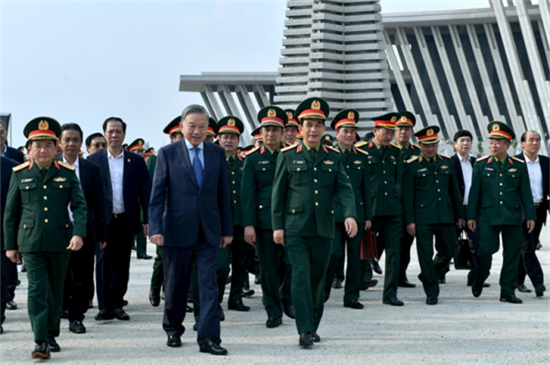 |
| General Secretary and State President To Lam visits the Vietnam Military History Museum (Photo: qdnd.vn) |
Accelerating the building of the Vietnam People's Army into a revolutionary, regular, elite, and modern force constitutes the central pillar of the “two accelerations”, aimed at strengthening national defence capabilities and establishing a solid foundation for enhancing the Army’s overall strength and combat readiness. This strategic orientation encompasses a wide range of tasks related to the Army’s development, with particular emphasis on building a modern Army in a comprehensive and synchronised manner across all dimensions, including force organisation; weapons and equipment; strategic thinking; military art; leadership, command and control; training; logistical and technical support; governance; and operational capabilities in both traditional and non-traditional domains. Priority is given to building a politically strong Army as the foundation, while making breakthroughs in science and technology, innovation, digital transformation, and the defence industry in order to enhance multi-domain operational capabilities, improve strategic forecasting and deterrence, and effectively respond to defence and security contingencies. The overarching objective is to achieve comprehensive improvements in the Army’s overall quality, combat strength, and level of modernisation.
Accelerating international integration and defence diplomacy constitutes a strategic orientation aimed at proactively fostering a favourable environment for the cause of national construction and defence. Priority is given to implementing defence diplomacy comprehensively and effectively in accordance with Viet Nam’s foreign policy of independence, self-reliance, peace, cooperation, and development; the diversification and multilateralisation of external relations; steadfast adherence to the “Four No’s” defence policy; and active participation in bilateral and multilateral defence cooperation mechanisms. Through these efforts, Viet Nam seeks to strengthen strategic trust, expand cooperation, and deepen shared interests with its partners, thereby contributing to conflict prevention, the peaceful settlement of differences, and the safeguarding of the Fatherland from an early stage and from afar. At the same time, it aims to leverage international knowledge, science and technology, modern defence governance experience, and external resources to enhance strategic autonomy in national defence, build the Vietnam People's Army into a revolutionary, regular, elite, and modern force, and further elevate the country's and the Army’s standing and prestige in the international arena.
The “two accelerations” are not independent of one another but are intrinsically interconnected, mutually reinforcing, and complementary, forming an integrated strategic whole. Specifically, accelerating the building of a revolutionary, regular, elite, and modern Army strengthens national defence capabilities, while accelerating international integration and defence diplomacy helps create a favourable strategic posture, strengthen overall national power, and generate conditions conducive to fully leveraging those capabilities. The close integration of endogenous strength with external resources, military power with political and diplomatic strength, and national strength with the strength of the times contributes to maximising the overall strength of the all-people national defence, enhancing national defence potential, maintaining a peaceful and stable environment, and firmly safeguarding the Fatherland from an early stage and from afar.
The strategic directive on the “two accelerations” ensures coherence between the objectives, methods, and resources required for fulfilling military and defence tasks. It provides an overarching orientation for renewing strategic thinking, leadership, direction, and implementation, while closely integrating the Army’s building with the expansion of international integration and defence diplomacy, and harnessing the combined strengths of all forces, sectors, and resources. At the same time, it creates favourable conditions for enhancing strategic forecasting capabilities, strengthening proactive responses to emerging security challenges, and fostering the spirit of self-reliance, self-strengthening, and innovation throughout the Army. In doing so, it contributes to the successful realisation of the goal of building the Vietnam People's Army into a revolutionary, regular, elite, and modern force and firmly safeguarding the Socialist Republic of Viet Nam.
The implementation of the “two accelerations” in recent years has brought about tangible progress in three key areas: awareness, the Army’s development, and international integration and defence diplomacy, thereby gradually realising the objective of building a modern Army while enhancing strategic autonomy in national defence. The policy of building the Vietnam People's Army into a revolutionary, regular, elite, and modern force in tandem with accelerating international integration and defence diplomacy has been consistently internalised and translated into programmes, plans, and measures tailored to the functions and responsibilities of each agency and unit. The Army’s overall quality, combat strength, level of readiness, operational capabilities, and capacity to accomplish assigned tasks have continued to improve. Meanwhile, force organisation has been restructured towards an elite, compact, and strong posture, in line with the requirements of modern warfare.
Education and training, military training, and scientific research have undergone significant innovation. Greater attention has been devoted to developing high-quality human resources, while the defence industry, science and technology, innovation, and digital transformation have achieved encouraging results, contributing to improvements in command and control, training, logistics and technical support, and force development. The movement promoting scientific research, initiatives, and technical innovation has expanded extensively, generating numerous products with substantial practical value. “International integration and defence diplomacy have been implemented proactively, actively, flexibly, and effectively, serving as one of the key pillars of the Party’s external relations, State diplomacy, and people-to-people diplomacy, and making an important contribution to maintaining a peaceful and stable environment for national development and safeguarding the Fatherland from an early stage and from afar.”
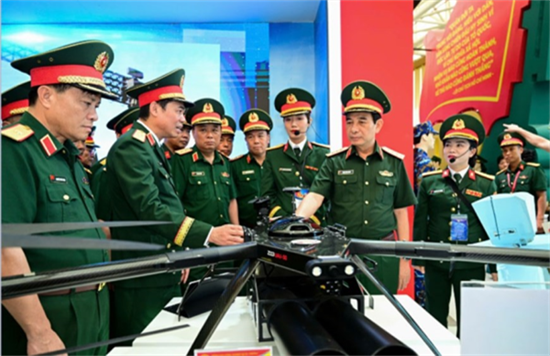 |
| General Phan Van Giang, Minister of National Defence, studies one achievement of Vietnam defence industry (Photo: qdnd.vn) |
These achievements demonstrate that the strategic directive on the “two accelerations” has gradually been translated into practice, bringing about coordinated progress in both the Army’s development and the promotion of international integration and defence diplomacy. Nevertheless, the requirements of building the Army and safeguarding the Fatherland in the new era demand that the implementation of this strategic directive be carried out in a more comprehensive, resolute, and effective manner. To that end, priority should be given to the following fundamental measures:
First, enhance leadership, direction, and political resolve in implementing the “two accelerations”. Party committees, Party organisations, and commanders at all levels should thoroughly grasp and concretise the strategic directive on the “two accelerations” in their resolutions, programmes, and work plans, while providing unified leadership and direction to ensure the close integration of building the Vietnam People's Army into a revolutionary, regular, elite, and modern force with the promotion of international integration and defence diplomacy. Greater responsibility should be placed on Party committees, commanders, and key leaders, particularly heads of agencies and units. Inspection and supervision should be strengthened to promptly resolve difficulties and shortcomings, while overcoming manifestations of insufficient determination, reluctance to innovate, formalistic implementation, and inadequate awareness in the execution of assigned tasks. Political and ideological education, information dissemination, and public communication should also be reinforced, alongside proactive efforts to refute erroneous and distorted views concerning the policy of building a modern Army and promoting international integration and defence diplomacy. These efforts will help foster a high degree of unity in awareness, determination, and action, thereby ensuring the effective implementation of the strategic directive on the “two accelerations.”
Second, continue improving institutions and mechanisms while enhancing the effectiveness of implementing the “two accelerations”. Functional agencies, together with Party committees and commanders at all levels, should review, supplement, and refine the system of legal normative documents, mechanisms, policies, master plans, implementation plans, and relevant regulations in line with the Party’s guidelines and viewpoints, ensuring consistency between the Army’s development and the promotion of international integration and defence diplomacy. Management and administration should be modernised through scientific approaches, while further decentralisation and empowerment should be accompanied by clearly defined responsibilities and effective coordination mechanisms for each agency and unit. At the same time, military administrative reform, digital transformation, and the application of science and technology should be accelerated in order to improve the quality of strategic advice, command and control, management, and administration. In addition, mechanisms for monitoring, evaluation, preliminary review, and comprehensive review should be further refined to promptly address shortcomings, adjust inappropriate provisions, and ensure that the strategic directive on the “two accelerations” is implemented in a comprehensive, coherent, and effective manner.
Third, make breakthroughs in developing high-quality human resources, renewing military training, and accelerating the application of science and technology in building the Army. Priority should be given to building a contingent of officers with firm political resolve, sound moral qualities, and high professional competence, capable of mastering modern weapons and technical equipment. Particular attention should be paid to educating and training high-quality personnel in such key fields as digital technology, artificial intelligence, cybersecurity, the defence industry, and other advanced engineering disciplines. Education, training, and military training should continue to be renewed in a standardised, modern, and mission-oriented manner, closely aligned with operational requirements, target groups, and the evolving operational environment. Efforts should also focus on enhancing joint-service operational capabilities, multi-domain operations, and the effective employment of new weapons and technical equipment. At the same time, science and technology, innovation, digital transformation, and the defence industry should be advanced towards greater self-reliance, self-sufficiency, dual-use capability, and modernisation, with the gradual mastery of strategic and core technologies. Greater application of scientific and technological achievements to command and control, training, logistical and technical support will provide a strong impetus for improving the Army’s overall quality and combat strength.
Fourth, renew and enhance the quality and effectiveness of international integration and defence diplomacy. Strategic thinking, content, and methods of defence diplomacy should continue to be renewed in a proactive, strategic, substantive, and effective manner. At the same time, Viet Nam should consistently adhere to its “Four No’s” defence policy, thereby contributing to the maintenance of a peaceful and stable environment while further enhancing the country's international standing and prestige. Greater emphasis should be placed on strategic research and forecasting to provide timely policy advice and effectively address emerging defence and security issues. Priority should also be given to developing and implementing major defence cooperation programmes tailored to individual partners and specific areas of cooperation. Defence diplomacy activities should be further expanded, particularly border defence friendship exchanges, high-level delegation exchanges, cooperation among military services and arms, participation in United Nations peacekeeping operations, search and rescue missions, and humanitarian assistance. Simultaneously, cooperation should be broadened in education and training, human resource development, science and technology, the defence industry, post-war recovery, and bilateral and multilateral defence and security cooperation mechanisms. Through these efforts, Viet Nam will strengthen strategic trust, prevent conflicts, resolve differences through peaceful means, and effectively harness international knowledge, technology, experience, and resources to support the building of the Vietnam People's Army into a revolutionary, regular, elite, and modern force and to safeguard the Fatherland from an early stage and from afar.
Fifth, harness the combined strength of the entire political system and the People in building the Army in the new era. Resources from across the political system and society as a whole should be mobilised effectively to ensure the comprehensive implementation of the “two accelerations”, closely integrating the building of the Vietnam People's Army into a revolutionary, regular, elite, and modern force with the strengthening of the all-people national defence. Greater efforts should be made to combine national defence and security with economic, cultural, social, scientific, technological, external relations, and digital transformation initiatives. The roles of ministries, sectors, localities, enterprises, and the People should be fully leveraged in developing defence potential, armed forces, the all-people national defence posture, and a self-reliant, dual-use, and modern defence industry. Continued efforts should be devoted to consolidating the all-people national defence, the all-people national defence posture in close association with the people's security posture and the solid “people's hearts and minds posture”. At the same time, greater attention should be paid to improving the mobilisation, coordination, and effective utilisation of resources in support of military and defence tasks under all circumstances. It is also essential to thoroughly grasp and effectively implement the Party’s policy of “closely and effectively integrating national defence and security with economic, cultural, social, and external relations development in order to promote Viet Nam’s soft power and create new strategic strength and potential for the country”. This will generate the combined national strength required to successfully realise the strategic directive on the “two accelerations”, build the Vietnam People's Army into a revolutionary, regular, elite, and modern force, and firmly safeguard the Fatherland in the new situation.
Against the backdrop of increasingly rapid and complex developments in the regional and international environment, thoroughly grasping and effectively implementing the strategic directive on the “two accelerations” has become both an objective requirement and an urgent imperative. It provides an important foundation for building the Vietnam People's Army into a revolutionary, regular, elite, and modern force, enhancing strategic autonomy in national defence, and firmly safeguarding the Socialist Republic of Viet Nam under all circumstances.
Lieutenant General, Associate Professor, PhD. LE VAN HAI, Deputy Political Commissar of the National Defence Academy