Ministry of Agriculture and Environment effectively performs defence and military work
Defence and military work is an important area of operations of ministries and sectors, aimed at realising the Party’s lines and the State’s policies and laws on national defence, contributing to building strong, modern all-people national defence and firmly safeguarding the Fatherland. Fully aware of this, the Ministry of Agriculture and Environment (MAE) has been stepping up the performance of this important work via practical and effective solutions.
The MAE was established on the basis of merging the Ministry of Agriculture and Rural Development and the Ministry of Natural Resources and Environment; it performs the function of State management over the fields of strategic importance to national development and defence, such as agriculture, forestry, salt production, fisheries, irrigation, natural disaster response, rural development, land, water resources, mineral resources, geology, and environment, etc.
The merger marked an important step forward in reforming the apparatus and improving the effectiveness and efficiency of State management, facilitating the unified management of strategic resources relating to land, natural resources, environment, and national development space, enabling an effective combination of socio-economic development and defence and security consolidation, laying a foundation for mobilising and utilising resources for defence and security tasks.
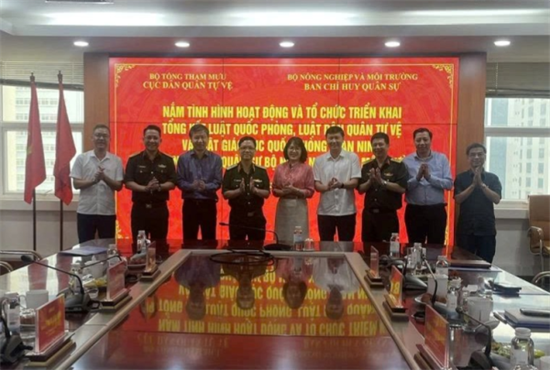 |
| A working session between Militia and Self-Defence Force Department and MAE Military Command |
Hence, the MAE’s Party Committee and leadership have consistently grasped the Party’s military and defence lines; based on their functions and assigned tasks, they have focused their leadership and direction on defence and military work via numerous resolute and coordinated solutions, achieving positive results. Due attention has been paid to widely disseminating and seriously executing resolutions, directives, and conclusions by the Party, the State, the Central Military Commission (CMC), and the Ministry of National Defence (MND) on defence and military tasks. Military commands at all levels have been consolidated and reorganised in line with the MAE’s restructuring, while their role in giving advice on performing defence and military work has been promoted. Due regard has been paid to building a strong self-defence force, with a proper structure and great capacity to handle defence and security situations at grass-roots level, thus greatly contributing to raising the effectiveness of the MAE’s State management-related functions and tasks.
At present, the situation on global and regional scales is developing rapidly, becoming increasingly complex and unpredictable. Together with armed conflicts and territorial disputes, non-traditional security challenges are on the increase, such as food security, water resources, and energy security; more seriously, climate change, natural disasters, resource degradation, and environmental pollution are creating increasingly intense pressure and imposing new, higher, more comprehensive requirements for Fatherland protection. As the agency responsible for managing the country’s key resources, closely associated with both defence and security potential and the country’s sustainable development, the MAE determines that successfully carrying out defence and military work is not only a strategic task but also a core foundation for building strong, modern all-people national defence and firmly protecting the Fatherland in the new situation.
First, strengthening the leadership and direction of party committees and heads of agencies and units in performing defence and military tasks. The MAE will continue directing its agencies and units to thoroughly grasp and concretise resolutions, directives, and guidance by the Party, State, CMC, and MND on military, defence, and Fatherland protection tasks in the new situation, in accordance with their functions and assigned tasks. The core role of military commands at all levels in giving advice on formulating scientific, effective resolutions and action programmes for defence and military work will be promoted. Operational regulations of these military commands will continue to be reviewed and supplemented; regulations and programmes for coordination with relevant ministries, sectors, and localities in defence and military tasks will be signed, in accordance with the particularities of the areas under their management.
Besides, the MAE will direct its units and agencies to step up education and communication to render cadres, party members, civil servants, public employees, and workers fully aware of the position, role, and importance of defence and military work as a key and routine task, thereby raising their awareness and sense of responsibility in the process of implementation, resolutely combating signs of perceptive deviation and underestimation in defence tasks. Measures for leadership and direction will be strengthened, particularly in giving advice and direction on managing resources, formulating master plans and projects for development, stepping up digital transformation, completing databases, enhancing forecasting and early-warning capabilities, organising civil defence, preventing and controlling natural disasters, responding to climate change, and protecting natural resources and the environment, thereby contributing to improving the capacity to ensure national defence in all situations. The results of defence work will continue to be used as one of the criteria for annual commendation. The effectiveness and efficiency of inspections of the performance of defence tasks in agencies and units will be enhanced, while collectives and individuals with brilliant results in defence and military work will be commended.
Second, closely appraising and managing master plans and projects to guarantee a combination of socio-economic development and defence and security consolidation. The MAE Military Command will closely work with relevant agencies to review and appraise socio-economic development projects in the fields managed by the MAE as the basis for giving advice to the MAE’s leadership on directing the combination of socio-economic development and defence and security. Close coordination will be maintained with functional agencies of the MND and localities in developing forestry projects in border areas and areas of key importance to national defence. Communication efforts will be promoted to prevent and combat illegal exploitation, trade, and transport of forest products; solutions will be adopted to have the European Commission’s illegal, unreported, and unregulated (IUU) fishing “yellow card” removed, thus contributing to consolidating the posture of all-people national defence.
Together with the MND and the Ministry of Public Security, the MAE will review and supplement defence and security criteria set for communes meeting new-style rural area standards, advanced new-style rural area standards, and exemplary new-style rural area standards, in accordance with defence and security postures in remote, isolated, and border areas; it will review dossiers and documents concerning the master plan on defence land use for the 2021 - 2030 period, with a vision to 2050. It will properly perform its State management functions over land and water resources, in tandem with defence and military tasks in the master plan on defence land use.
Third, improving the effectiveness of military commands at all levels and building a strong, extensive self-defence force. Military commands from ministerial to grass-roots levels operate on a concurrent-duty basis; following the merger, some new military command cadres have limited experience and advisory capabilities. Therefore, in the coming period, the MAE will continue consolidating military commands at all levels with a proper structure, maintaining regular order, and improving their operational effectiveness. It will regularly work with competent agencies of the MND to develop plans for sending cadres to training and refresher courses on defence and military knowledge, with a view to improving their professional expertise, advisory capabilities, and task performance.
The MAE Military Command will focus on screening and strictly managing citizens of military service age, demobilising members of the self-defence force, registering additional personnel, and promptly consolidating the organisation of self-defence units under the 2019 Law on Militia and Self-Defence Force and guidance from the MND. Consideration will be given to building strong self-defence units in the fields of irrigation, forestry, and fisheries surveillance, with great overall quality and combat readiness, as the core force in dealing with defence and security situations. Close coordination with local military agencies will be fostered to organise training work strictly according to plans; due attention will be paid to training the self-defence force to master weapons, equipment, and support tools, as well as maintain coordination in handling situations. Combat readiness plans for protecting agencies and units will be supplemented and completed, while combat readiness duty will be sustained seriously. Due regard will be paid to mobilising resources to better ensure entitlements and policies for the self-defence force and acquire equipment and support tools for this force, thereby creating motivations and conditions necessary for this force to successfully fulfil their tasks.
Fourth, stepping up defence and security education for relevant groups. Grasping the Politburo’s Directive 12-CT/TW, dated 3 May 2007, on strengthening the Party’s leadership over defence and security education in the new situation, as well as defence and security education plans of the Central Council for Defence and Security Education, the MAE will continue to promote the role of military commands in advising party committees at all levels on leading and directing defence and security education. Agencies and units across the MAE will be instructed to carry out review and classification and make plans on defence and security education for target groups under regulations. More specifically, Groups 1 and 2 shall follow education plans set by the Central Council; for Groups 3 and 4, agencies and units will coordinate with local military agencies within their stationed areas to organise defence and security education courses.
Key cadres and personnel engaged in defence work will be frequently equipped with new knowledge of defence and security, especially in areas related to border, sea, island, natural disaster response, and forest protection. For educational establishments under the MAE, defence and security education programmes for students will be strictly implemented, with emphasis placed on educating the younger generation on their responsibility for the cause of Fatherland construction and protection. In the process, forms and measures of education will be applied flexibly; in addition to annual education plans, agencies and units will incorporate the dissemination of documents, directives, and guidance on defence and military work into conferences, task briefings, and study sessions on Party resolutions and legal education.
Deeply aware of its core role in managing key fields closely associated with defence potential, the MAE is determined to continue renewing its thinking and improving the quality of defence and military work. This constitutes an important foundation for promoting the combined strength of the sector and joining the entire Party, Military, and people in building strong, modern all-people national defence and firmly safeguarding the Fatherland in the new situation.
VO VAN HUNG
Deputy Minister of Agriculture and Environment
Commander of the MAE Military Command