Military School of Military Region 9 enhances the effectiveness of national defence and security education
Educating and fostering knowledge of national defence and security is one of the crucial political tasks of military schools across military regions. Deeply aware of this, over the past years, the Military School of Military Region 9 has focused on leading, directing, and effectively implementing this task through numerous synchronous, creative, and scientific solutions, achieving practical results.
In recent years, alongside the training and fostering of cadres, the Military School of Military Region 9 has also undertaken the task of fostering and educating national defence and security knowledge for personnel from category 2 and students from 15 universities and colleges in the region.
Despite numerous difficulties in human resources, infrastructure, and equipment, with high determination, effort, and a strong sense of responsibility, the School has consistently accomplished this important task, earning high appreciation from the Party Committee, the High Command, the Military Region’s Council for National Defence and Security Education, local authorities, and training institutions. Since 2023 to date, the School has completed 46 training and education courses on national defence and security for nearly 1,400 category-2-cadres and over 22,000 students, with a remarkable result: 100% achieving good and excellent assessments. After completing the education and fostering programme, learners possess a solid understanding of national defence and security tasks; they flexibly and creatively apply the acquired knowledge to their positions, contributing significantly to building an all-people national defence, an all-people national defence posture linked with the people’s security and the people’s security posture, and a firm “people’s heart posture” in the Military Region.
To achieve these results, the Party Committee and the School Board of Management have concentrated on leading, directing, and synchronously implementing various scientific solutions.
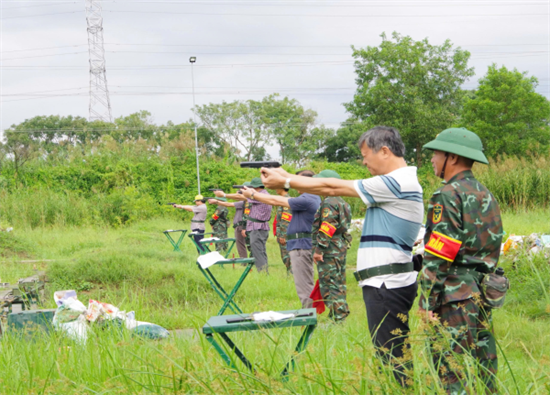 |
| Conducting shooting test for category-2 learners |
First and foremost, the School emphasises the role and responsibility of Party committees and commanders at all levels in implementing the task of educating and fostering national defence and security knowledge. The School regularly and thoroughly grasps the resolutions and directives of the Party and Government, as well as the circulars and guidelines of the Ministry of National Defence and the Ministry of Education and Training regarding the work of national defence and security education and training, particularly the plans and guidelines of the Military Region’s Council for National Defence and Security Education. Annually, the School’s Party Committee and Party committees at all levels - especially the Training Department, faculty groups, and the National Defence and Security Education Centre - incorporate this task into their regular leadership resolutions with specific targets and solutions; assigning duties to cadres in charge of monitoring, deploying, inspecting, and urging, ensuring strict, serious, uniform, and highly effective implementation. During execution, they closely adhere to action plans and programmes for implementing resolutions; proactively review, amend, and supplement rules and regulations to create uniformity in direction, management, and administration; and regularly hold thematic conferences and seminars to promote democracy and collective wisdom in proposing solutions to improve the quality of education and training in an accurate and appropriate manner.
Every year, based on the plan of the Military Region’s Council for National Defence and Security Education, the School directs the Training Department to coordinate with the National Defence and Security Education Centre to proactively research, advise, and collaborate with provinces and units in the area to review the composition and subjects of training in accordance with regulations; closely coordinate with assigned universities and colleges to unify the schedule and volume of students; develop training and education plans that are scientific and suitable to practical conditions, avoiding overlaps with other training and education activities for other subjects of the School. Concurrently, the School directs the faculty groups to research, integrate, and optimise the training plans and programmes for military objects with the national defence and security education and training plans, creating favourable conditions for concurrently cadres and teachers to participate in this work with high results; assigns duties to fully prepare textbooks, materials, lectures,, and conducts serious and strict training for teachers. The School directs the National Defence and Security Education Centre to well prepare for reception, consolidate accommodation and dining facilities, and supplement infrastructure, ensuring the best service for learners to study and train in accordance with the specific characteristics of the military environment; and to balance the national defence and military knowledge with security knowledge to suit each target group, especially local cadres.
A distinctive feature of the learners of national defence and security education - especially category 2 personnel - is their high level of education, awareness, and extensive leadership and management experience. Therefore, the School pays special attention to selecting, fostering, and assigning cadres and teachers with excellent qualifications and capabilities to teach this group. Over the past period, the School has implemented various measures to consolidate the contingent of dedicated cadres and lecturers, wherein the School Board of Management, cadres from departments, sections, and faculties, heads of departments, and highly specialised personnel with practical field experience at units take charge of the training work for this type of learners. For key and specialised topics, the School invites leaders of the Military Region, leaders of provinces and cities, as well as police and border defence forces to participate in teaching and sharing practical experiences.
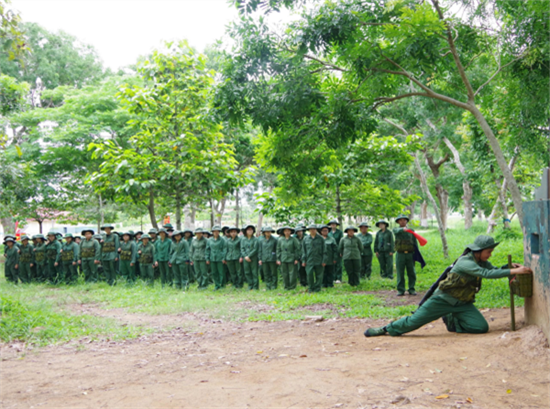 |
| Conducting infantry combat drill training for students |
To enhance the qualifications of the teaching staff, the School proactively proposes sending personnel for training at academies and schools; for practical internships, study tours, research, and observation of defensive zone exercises, creating favourable conditions for cadres and teachers to update their knowledge and experience to meet the ever-increasing demands of teaching. At the same time, the School promotes methodological activities; maintains regular excellent teacher and excellent manager competitions at all levels to select participants for the Ministry of National Defence-level teaching competition. This allows for quality assessment and classification, serving as a foundation for developing annual training and fostering plans for the teaching and management staff. Additionally, the School expands exchanges with local universities, holds visits, shares experiences, and improves pedagogical qualifications and methods. As a result, to date, the concurrently cadres and teachers at the National Defence and Security Education Centre have basically met the required standards; 100% hold university and post-graduate degrees. 100% of lecturers hold pedagogical certificates and effectively handle the prescribed specialised topics; many have won the title of excellent teacher in the competitions for lecturers of national defence and security education centres.
Renewing the teaching - learning content and methodology is an urgent issue, aimed at meeting the objectives of national defence and security education amidst the dynamics and development of the practical situation. Based on the prescribed framework programme and the guidance, direction of the Military Region’s Council for National Defence and Security Education, the School researches and develops content divided into a system of topics with a depth appropriate to each subject. It emphasises streamlining outdated content and updating new content regarding the guidelines, military, national defence, and security affairs of the Party, as well as practical experiences in leading and directing national defence and military work at the local level, etc. To impart a large volume of knowledge in a short time, the School directs a harmonious combination of traditional and modern teaching methods, adopting a learner-centred approach to maximize learners’ engagement and proactivity in researching and acquiring knowledge. For theoretical content, teachers combine lecturing with documentary film screenings and timely updates on new issues related to national defence and security. They guide students on how to study, research, and solve problems; foster their thinking capacity, and cultivate their awareness of exploiting and processing information and handling situations arising in military activities.
Aimed at training military skills, the School leverages the role of management cadres in coordinating with teachers to organise, guide, and maintain learners’ practice sessions; organises practice by dividing learners into groups taking turns to practice the content, while cadres and teachers monitor and correct them using model actions. This creates a close and open atmosphere, helping learners to “easily listen, easily understand, easily absorb, and easily follow”, thereby contributing to improving the quality of teaching and learning. In addition, the School directs the enhancement of extracurricular activities, such as artistic activities, sports competitions between companies and battalions, creating a vibrant, joyful, and healthy atmosphere. This contributes to building a spirit of solidarity and training collective living skills for students.
Along with the above solutions, the School emphasises strengthening inspection, examination, and infrastructure assurance. In evaluating results, the School conducts comprehensive assessments; each learning module involves test scoring using multiple-choice, essay, and oral examination formats, thereby accurately assessing students’ basic military skills through specific scoring of practical movements. Simultaneously, members of the Centre’s Board of Directors are regularly assigned to strictly implement plans and routines for direct class observation, ensuring correct and complete teaching of contents, programme, and plan, and aligns with the Party’s guidelines and viewpoints, as well as State laws. Along with this, the School proactively advises, proposes, and mobilises investment resources for teaching equipment for the subject in accordance with Circular No. 19/2022/TT-BGDĐT, dated 22 December 2022, of the Ministry of Education and Training. To date, all classrooms are fully equipped with projectors and speakers, meeting the requirements of teaching and studying; drill grounds and training fields have been invested in and upgraded; and centralised accommodation and living areas are sufficient for 10,000 students per year.
Drawing from the experiences and achieved results, in the coming time, the Military School of Military Region 9 will continue to strengthen leadership and direction, accelerate innovation, and continuously improve the quality and effectiveness of national defence and security education and training for all subjects, contributing to building a robust and modern all-people national defence and people’s security in the new situation.
Sr. Col. PHAM THANH BINH, Principal of the School