Military School of Military Region 5 improves the quality of legal dissemination and education
Respect for the rule of law is a fundamental principle of a modern society. This is even more important to the military environment characterised by self-discipline. Hence, in recent years, the Party Committee and Board of Directors of the Military School of Military Region 5 have taken numerous measures to raise the quality of legal dissemination and education, contributing to building the School into an “exemplarily, typically” comprehensively strong unit.
Each year, the Military School of Military Region 5 admits about 4,600 learners from over 45 groups. As each training course is relatively short, legal dissemination and education can easily be overshadowed by the intensive pace of training and education. To make legal dissemination and education more systematic and effective, to foster respect for State law, military discipline, and the School's regulations among cadets, and to prevent violations early and from afar, the School’s Party Committee and Board of Directors have identified legal dissemination and education as a central, routine, important task. Accordingly, strengthening the leadership and direction of all-level party committees and commands over this important work has been regarded as the foremost solution.
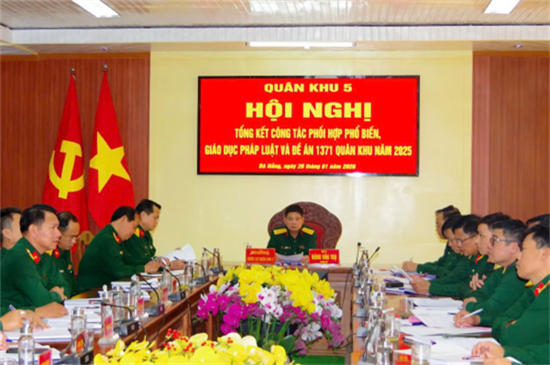 |
| Conference held by Military Region 5 to review the work of legal dissemination and education and Project 1371 in 2025 |
To enable leaders and commanders at all levels, together with cadres, lecturers, cadets, employees, and soldiers, to fully understand the importance of legal dissemination and education, the School has focused on introducing and strictly implementing higher-level directives, resolutions, circulars, plans, and guiding documents issued on this work. Attention has been paid to the Government’s Decree 28/2013/NĐ-CP, dated 4 April 2013, detailing a number of articles and measures for executing the Law on Legal Dissemination and Education, Circular 42/2016/TT-BQP, dated 30 March 2016, by the Minister of National Defence regulating legal dissemination and education within the Ministry of National Defence (MND), Directive 103/CT-BQP, dated 28 November 2019, by the Minister of National Defence on strengthening discipline management and education and ensuring safety within the Vietnam People's Army (VPA), and the annual plan of the Military Region Command on legal dissemination and education.
Based on an accurate assessment of the performance of this work and the causes of existing shortcomings, party committees and party organisations at all levels have translated these into specific objectives and targets, formulating leadership measures, allocating resources properly to raise the quality of legal dissemination and education in accordance with the characteristics and task requirements of each agency, faculty, and unit. Agencies, faculties, and units have made plans for legal dissemination and education in a serious, close manner, incorporating this work into the goals and targets of both regular and peak emulation movements, using the results of this work as an important criterion for evaluating and classifying party organisations, party members, and cadres, assessing cadets' learning and training performance, and building “exemplarily, typically” comprehensively strong units. Competent agencies have closely worked with all-level party committees and commands to enhance inspection, conduct preliminary reviews, draw lessons, supplement and adjust measures, and address weaknesses in the process of leadership, direction, and implementation. As a result, the awareness and sense of responsibility of party committees, key cadres, party members, and the masses have improved markedly; the School's legal dissemination and education work has become more systematic and effective.
Besides, the School has attached importance to promoting the role of the Council for Legal Dissemination and Education in performing this work. While proactively consolidating the Council with sufficient personnel and a proper organisational structure, the School has focused on fully and effectively performing the Council's duties and authority, strengthening coordination among Council members in implementing assigned tasks. The Council's advisory capacity has been improved to enable the School’s Party Committee and Board of Directors to provide focused, unified, effective leadership and direction. The Council has also played a central coordinating role, demonstrating a high sense of responsibility in guiding, inspecting, and urging agencies, faculties, and units to realise legal dissemination and education plans.
Building a pool of law rapporteurs and communicators capable of meeting their task requirements and promoting their role has been seen as another important solution. The School has selected cadres and lecturers who have received formal training and possess necessary qualities, professional competence, and sound pedagogical skills as law rapporteurs and communicators at all levels. Training and refresher courses have been regularly organised in various forms to enhance their capacity and equip them with in-depth legal knowledge, core points of newly issued legal documents, complex legal content, methods for delivering specialised topics, skills in legal dissemination and education, and ways of handling common legal situations encountered in units. Consideration have been given to upholding the initiative, a sense of responsibility, and meticulousness at every stage of preparing legal education topics; strict procedures for lecture approval and rehearsal have been maintained to draw lessons and help rapporteurs improve their content, master their methodology, and enhance their confidence before delivering lectures. Since 2020, the School has consolidated its team of law rapporteurs to ensure sufficient numbers in accordance with regulations, with 100% holding university degrees or higher.
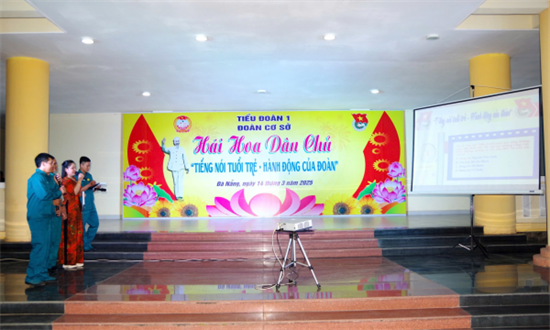 |
| Diversifying forms of legal dissemination and education |
Due regard has been paid to selecting legal content and providing legal knowledge relevant to daily life to bring legal documents closer to troops. Under the principle of “placing troops at the centre”, the content of legal dissemination and education has been tailored to different groups and aligned with the characteristics, task requirements, and operational nature of each agency, faculty, and unit.
For cadres, lecturers, and soldiers, in addition to completing 100% of the prescribed topics, the School has closely followed higher-level guidance and these staff members’ actual compliance to State law and military discipline to determine appropriate optional topics. Based on the list of legal documents identified by the School's Council for Legal Dissemination and Education, agencies, faculties, and units have selected regular educational content focusing on newly promulgated legal documents and the regulations of the Military Region and the School. Efforts have been made to raise troop awareness of the negative effects of harmful publications and social evils, hostile forces’ schemes and tactics, as well as the negative impacts of cyberspace and the dangers of alcohol and tobacco. While ensuring the completeness and accuracy of the core content, the School has attached significance to providing ideological guidance and directing practical action in each legal topic for every target group.
For cadets, the School has concentrated on disseminating educational and internal regulations, guaranteeing the successful completion of legal modules included in the curriculum for each target group. Legal education has been integrated into the teaching of academic subjects, especially in social sciences and humanities. The overarching objective is not only to improve cadets’ law-abiding awareness during their course at the School, but also to help them understand the long-term benefits of legal knowledge in fulfilling their responsibilities in grass-roots units after graduation.
To improve the effectiveness of legal knowledge acquisition, the School has actively renewed its forms and methods of legal dissemination and education in a more diverse, visual, memorable, accessible manner. For classroom-based legal topics, flexible teaching methods have been applied, with greater use of visual materials such as images and video clips. Problem-based teaching and hypothetical situations have been emphasised to encourage learners to actively acquire and apply legal knowledge during lessons. To make legal education more engaging and to help participants gain a deeper understanding and better retention of legal content, the School has closely directed agencies, faculties, units and mass organisations to develop plans, make thorough preparations, and effectively organise forums, seminars, and legal knowledge competitions in theatrical formats linked with national holidays, traditional anniversaries, and political education activities. It has continued to improve the quality of the Legal Study Day and the Political and Cultural Day within units, maintaining the models of “Each lesson, one legal provision” and “One question a day”, promoting the role of “Psychological and Legal Advisory Teams” and legal bookcases at all levels. It has proactively coordinated with the Military Region's Criminal Investigation Division to organise specialised legal talks.
In particular, legal dissemination and education through the School's web portal, social media platforms, noticeboards, and internal broadcasting system has become one of its major strengths. Agencies and units have been encouraged to apply information technology to produce video clips and legal leaflets for publication on personal Facebook accounts and the School's “Land and People of Hoa Cam” Facebook fanpage, thereby fostering a vibrant movement of legal self-study, research, and knowledge exchange across the School and online communities.
Since 2020, the School has delivered 65 legal education topics and published 5,040 news items and articles on its Facebook fanpage and internal broadcasting programmes as well as on media platforms of its agencies, faculties, and units. As a result, there has been a marked improvement in law-abiding awareness among its cadres, lecturers, cadets, employees, and soldiers.
Closely integrating legal dissemination and education with political and ideological education, regularity building, discipline management, and safety assurance has proved itself to be an effective approach to transforming troops’ awareness into their voluntary compliance with the law. The School has strictly maintained its internal regulations, requiring the entire institution to act according to military discipline. Agencies, faculties, and units have been directed to strengthen ideological management, discipline maintenance, and the management of troops’ social relationships, both in daily life and in cyberspace, so as to proactively detect and prevent violations. The exemplary role of cadres and party members has been fully promoted, while persistent guidance and training have been provided to cultivate law-abiding awareness via education, training, and specific deeds. Due regard has been paid to bettering troops’ material and spiritual life, promoting emulation movements, fostering the building of a legal culture and the spirit of solidarity and democracy, thereby creating favourable conditions for self-improvement among cadres, lecturers, cadets, employees, and soldiers.
With great resolve and tireless efforts aimed at transforming legal knowledge into law-abiding awareness and standards of conduct for every cadre, lecturer, cadet, employee, and soldier, the Military School of Military Region 5 has achieved encouraging results in its legal dissemination and education work. This provides an important foundation for realising the objective of building the School into an “exemplarily and typically” comprehensively strong institution capable of meeting the requirements of education and training in the new situation.
Sr. Col. TRUONG THANH QUANG
Deputy Political Commissar of the School