Thoroughly grasping the Party’s military and defence lines and the requirements of building the Military and defending the Fatherland in the new situation, the Commando Corps has been resolutely, synchronously implementing measures to realise its “Three Breakthroughs” for building a “particularly elite and modern” Corps capable of undertaking and successfully accomplishing all assigned tasks.
The Commando Corps is a particularly elite combat force of the Vietnam People’s Army (VPA). Throughout nearly 60 years of construction, combat, and development, officers and soldiers of the Corps have always upheld courage, ingenuity, and creativity, daring to think, daring to do, and daring to confront difficulties and challenges. They have continuously strived to fulfil their missions with distinction, achieving many resounding feats, making important contributions to the cause of national liberation and Fatherland protection, thereby forging their glorious tradition: “Particularly Elite, Exceptionally Heroic, Ingenious and Bold, Striking Vital Targets to Achieve Great Victories”.
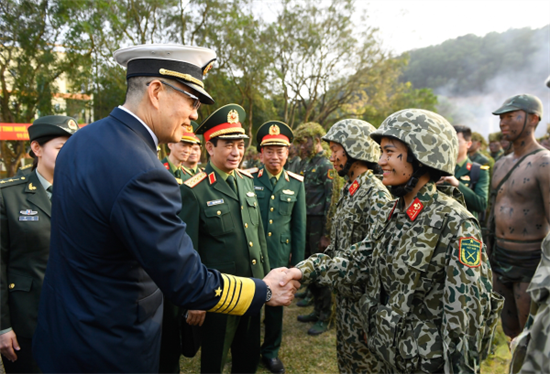 |
| Chinese Defence Minister gives encouragements to the performance of Commando Brigade 113 |
At present, the world is undergoing epochal changes; strategic competition among major powers, disputes over territorial sovereignty, borders, and seas, and armed conflicts are occurring in many places, profoundly affecting all nations. Our country is implementing historic strategies in a new era of development. This situation poses many new, heavier, more complex tasks for the entire VPA in general and the Commando Corps in particular. In order to continue promoting its tradition and successfully fulfil its missions, the Corps has determined to further intensify the implementation of the “Three Breakthroughs” for building a revolutionary, regular, particularly elite, modern commando force capable of meeting its task requirements in the new context.
1. Streamlined and modern in organisation, personnel, and weaponry
In recent years, thanks to our Party and State’s due regard, the Corps has achieved a new, comprehensive development in politics, ideology, organisational structure, and weaponry, as well as in capability, combat power, and combat readiness. Building on these results and experiences, in the coming time, the Corps will continue reviewing and implementing the Project to develop the Commando Force until 2030 and beyond, ensuring that its organisational structure is truly streamlined, compact, and strong. It will give advice to the Central Military Commission (CMC) and the Ministry of National Defence (MND) on the organisation and development of specialised units, such as counter-terrorism units, airborne special units, special operations vessel and craft units, electronic warfare units, and unmanned aerial vehicle control units, in accordance with the criteria of a modern Commando Corps.
At the same time, the Corps will continue leading and directing its agencies, units, and schools to grasp major lines, orientations, objectives, and tasks, as well as new issues of principle on Party and VPA building according to the Resolutions of the 14th National Party Congress and the 12th Military Party Congress. Action plans and programs for those resolutions will be developed; leadership and working regulations of party committees and commands at all levels will be revised and improved in line with the practical missions of each agency and unit. Efforts will be intensified to renew leadership methods and ensure that words will be matched by deeds, and that tasks will be carried out with clear plans and pursued to completion. Due attention will be paid to building pure, strong party organisations in tandem with “exemplarily, typically” comprehensively strong units, thereby raising the effectiveness and efficiency of organisations, agencies, and units.
Weaponry constitutes one of the deciding factors in enhancing the combat strength of a unit, particularly in the new conditions of a Fatherland protection war, where adversaries employ high-tech weapons. In order to improve the combat performance of the Commando Force, while maximising the technical and tactical features of its existing weapons and equipment, the Corps will continue advising the MND to manufacture and acquire new weapons that are lightweight, multifunctional, highly powerful, and suitable for each commando component and combat environment. Consideration will be given to developing personal weapons, unmanned combat vehicles (UAVs, USVs, UGVs), underwater combat weapons, remotely controlled explosive devices, day-time and night-time reconnaissance and observation equipment, as well as various types of automobiles, motorcycles, high-speed vessels and boats. The Corps will actively propose adjustments to the deployment of commando units and the construction of combat bases in strategic theatres and areas, meeting the requirements of Fatherland protection.
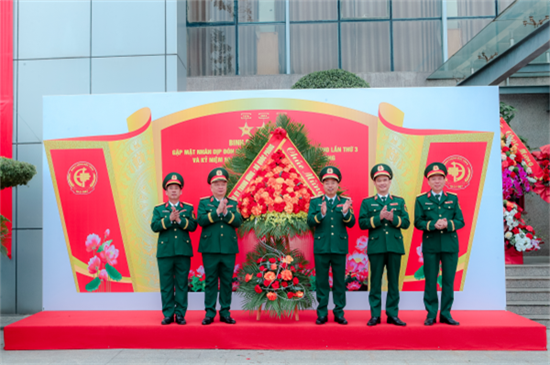 |
| Sr. Lt. Gen. Nguyen Quang Ngoc, Deputy Minister of National Defence at the ceremony to receive the title of Hero of the People’s Armed Forces held by the Commando Corps |
2. Researching and developing the art of commando warfare under new conditions
“Taking the small to defeat the large” and “using the few to defeat the many” are a unique military art of our nation that the Commando Force applied and developed to a high level in our resistance wars. Reality has proven that operations of the Commando Force achieve very high efficiency: a commando team of three to five personnel can destroy an entire enemy airfield, seaport, or depot at operational or strategic level; a commando company or a commando battalion can eliminate thousands of enemy troops. In order to promote that traditional thinking and military art in the new context, the Corps will keep enhancing research and development of the art of modern commando warfare, seeing this as a major breakthrough to improve the combat strength of the heroic Commando Force.
To that end, first of all, the Corps will focus on researching into the enemy’s situation, especially their forms of warfare, operational schemes and tactics, force organisation, and weaponry. Based on those researches, it will further develop the art of employing personnel and commanding special operations in various types of operational and strategic combat, tactical forms, and different combat environments and areas. Emphasis will be placed on developing combat methods for newly established specialised forces. The development of combat methods must bring into play traditional excellence while integrating modern elements, suitable for specific operational opponents, requirements, and objectives. Great value will be attached to maintaining secrecy, surprise, and deep penetration, striking vital targets, attacking from within outward, from outside inward, from below upward, and from above downward, attacking critical enemy targets, striking where the enemy least expects and at the moment when they are most vulnerable and least prepared, turning opportunity into strength, increasing combat efficiency, and rendering the enemy shocked, frightened, and quickly defeated.
In addition, as the leading force of the entire VPA in counter-terrorism operations, the Corps will proactively coordinate with competent agencies and other specialised counter-terrorism forces to study, review, and draw lessons from exercises under A, A2, A3, counter-terrorism, and anti-subversion missions held by the MND, as well as experiences from other countries around the world. It will continue to research, develop, and perfect the combat methods of its specialised units in charge of counter-terrorism and anti-subversion, thereby improving the quality of training and combat readiness and the capability to fight and to win, maintaining political security, social order and safety, protecting the Party, State, people, and socialist regime in all situations.
3. Specialised and elite combat training
Implementing the CMC’s Resolution 1659-NQ/QUTW, dated 20 December 2022, on improving training quality for the period of 2023 - 2030 and beyond, the Corps will focus on making breakthroughs in specialised and elite combat training, taking the training of combatants and forward combat units as the centre, considering the training of officers as the key factor. Training in confrontation between personnel and the enemy’s modern weaponry, confrontation among commando units themselves and with other forces will be intensified, with the destruction of enemy command posts at all levels, the attrition of enemy manpower, and the destruction of enemy war materiel serving as the goal of training.
In order to realise this breakthrough, while vigorously renewing training content, organisational forms, and training methods and raising the quality of training management and direction in line with its tasks, operational plans, battlefields, and operational opponents, the Corps will direct its agencies, units, and schools to focus on solid technical training and mastery of tactics, ensuring the capability to conduct both independent and joint operations. Alongside intensive training to master new, modern weaponry, martial arts, and marksmanship, units will strengthen the training of their troops in camouflage techniques, settlement of obstacles, disguise, grasp of terrains and targets, covert base development, endurance swimming, drifting techniques, stealth swimming, deep-sea diving, counter-terrorism techniques, parachuting skills, and airborne assault operations across different terrains and areas according to tactical forms such as covert raid, covert destruction operations, and ambush.
To raise the quality of training and combat readiness, the Corps will place emphasis on enhancing the capability of officers at all levels in conducting training as well as their operational staff work. Military training will be combined with political education and physical training; troops will be actively placed in difficult, harsh environments to improve their political steadfastness, determination, survival skills, and combat effectiveness. The Commando Officer College will be directed to promote innovation in training programmes, organisational forms, and teaching methods, actively apply information technology and simulation software in educational management and training, build a smart, standardised, modern school capable of meeting the requirements of training cadres in the new era.
The Corps will continue to direct its affiliates and the Commando Force across the entire VPA to proactively conduct reconnaissance and thoroughly grasp operational areas, targets, and assigned battlefields as the basis for reviewing, supplementing, and completing operational documents. Efforts will be intensified to renew the content, forms, and methods of exercises in accordance with plans and missions for specialised units, including ground commando units, urban commando units, naval commando units, and counter-terrorism units. Resources will be mobilised to complete the construction of training grounds, deep diving training centres, close-combat training centres, airborne assault training centres, and training centres for the ground commando force; digital transformation and automated command systems will be applied in training and exercises on counter-terrorism and search and rescue operations.
Promoting the tradition of a unit three times honoured with the title of Hero of the People’s Armed Forces, officers and soldiers of the Commando Corps are determined to realise the “Three Breakthroughs”, building a revolutionary, regular, particularly elite, modern Corps worthy of being an absolutely loyal and reliable combat force of the Party, State, and people, ready to undertake and successfully accomplish all missions, defeat all enemies, and contribute to safeguarding national independence, sovereignty, and territorial integrity and maintaining a peaceful, stable environment for the country to develop rapidly and sustainably in the new era.
Maj. Gen. HOANG MINH SON
Commander of the Commando Corps