The entire Military focuses on successfully implementing defence external tasks of 2026
Promoting international integration and defence diplomacy is one of the main solutions identified in the Resolution of the 12th Congress of the Party Committee of the Vietnam People's Army, aiming to enhance the international status and prestige of the country and the Military, and firmly protect the Fatherland through peaceful means. Therefore, Party committees and commanders of agencies and units throughout the Military need to focus on leading and directing this important task by means of decisive and synchronised solutions.
Defence diplomacy is one of the pillars of Party diplomacy, State diplomacy, and people-to-people diplomacy, aiming to harness the strength of the era, contributing to consolidating defence potential and firmly protecting the Fatherland early and from afar by peaceful means.
Fully aware of its position, agencies and units throughout the Military have thoroughly grasped the Party and State's foreign policies, the resolutions and directives of the Party Central Committee, the Central Military Commission, and the Ministry of National Defence on international integration and defence diplomacy. They have focused on leading, directing, and implementing solutions decisively and synchronously, achieving several important results, most notably: proactively researching, grasping, forecasting, and accurately assessing the regional and global situations; promptly proposing to the Central Military Commission and the Ministry of National Defence to advise the Party and State on effectively resolving strategic issues and sensitive situations related to national defence, military, security, territorial sovereignty, borders, seas, and islands; harmoniously handling relations with partners, ensuring national interests to the utmost, and avoiding passivity and surprise in all situations.
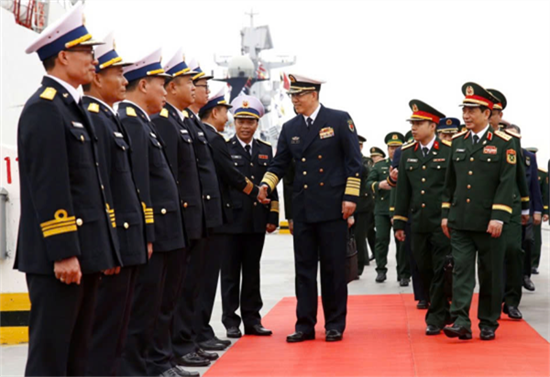 |
| General Phan Van Giang, Minister of National Defence and his Chinese counterpart visit the Vietnam People's Navy in the framework of the 10th Vietnam-China border defence exchange in 2026 |
2026 marks the first year of implementing the Resolution of the 14th National Congress of the Party and the Resolution of the 12th Congress of the Military Party, together with many other new policies and guidelines. The Military is to build a revolutionary, regular, elite, and modern force, including the “...active development and implementation of programmes and plans for foreign defence capabilities to meet the requirements of national construction and defence”. The global and regional situations continue to witness complex and unpredictable evolutions; strategic competition among major powers, territorial disputes, and armed conflicts continue to impact many countries; ASEAN region continues to see dynamic developments, but some countries still harbour elements of instability. Non-traditional security challenges are becoming increasingly uncertain and extreme. Domestically, the country still enjoys high economic growth, socio-political stability, and strengthened national defence and security. However, hostile forces are likely to continue their subversive activities against the Party and the State, aiming to promote “self-evolution” and “self-transformation” within the Party and “Military depoliticisation”. The task of strengthening national defence and protecting the Fatherland places increasingly high demands, making the role of defence diplomacy particularly important. To successfully complete the defence external tasks in 2026, the entire Military needs to focus on the following measures:
Firstly, continuing to educate and improving the awareness and responsibility of cadres and Party members regarding international integration and defence diplomacy. Party committees, commanders of agencies and units, and cadres and Party members, especially those working in foreign affairs, must fully understand that, along with national defence and security, foreign affairs is a “crucial and ongoing” task in the new era of development; the importance of building strategic trust, generating interwoven interests, and preventing the risk of conflict, etc., thereby upholding their responsibility in task performance. The content of education should focus on resolutions, directives, and guidelines of the Party Central Committee, the Central Military Commission, and the Ministry of National Defence on international integration and defence diplomacy, particularly the foreign policies defined in the Resolution of the 14th National Congress of the Party; international integration and defence external tasks defined in the Resolution of the 12th Military Party Congress; Resolution No. 59-NQ/TW, dated 24 January 2025, of the Politburo on international integration in the new situation; Conclusion No. 53-KL/TW, dated 28 April 2023, of the Politburo on international integration and defence diplomacy until 2030 and beyond; and Resolution No. 2662-NQ/QUTW, dated 26 February 2024, of the Central Military Commission on international integration and defence diplomacy until 2030 and beyond.
Secondly, researching, grasping, forecast, and accurately assessing the situation, and promptly advising and proposing solutions to handle relations with other countries harmoniously. Agencies and units of the Army, especially strategic advisory agencies, should proactively coordinate with relevant forces to research, grasp, forecast, and accurately assess the global and regional situations; identify early trends, intentions, and changes in the policies and strategies of major powers; developments in the flashpoints; anticipate the conspiracies and subversive tactics of hostile forces, etc., to promptly advise the Central Military Commission and the Ministry of National Defence to propose to the Party and State policies and solutions to effectively handle issues related to international integration and defence diplomacy in accordance with the foreign policies of “independence, self-reliance, self-resilience, peace, friendship, cooperation and development, multilateralisation and diversification of foreign relations” as defined in the documents of the 14th National Party Congress, ensuring harmony and balance of relations with neighbouring countries, major powers, strategic partners, comprehensive partners, countries in the region and traditional friends, avoiding strategic passivity and surprise.
Strategic advisory agencies should strengthen research and analysis of international development trends; improve forecasting capabilities; coordinate closely with the Ministry of Foreign Affairs and the Ministry of Public Security to propose to the Party and State measures for effectively handling issues related to national defence and security; resolutely and persistently protect the independence, sovereignty, unity, territorial integrity, borders, seas, and islands of the Fatherland; protect the Party, the State, the People, the socialist regime, and the achievements of the renewal cause; and build peaceful, cooperative, and developing borders with neighbouring countries. Promote the application of digital technology and artificial intelligence in information collection and processing; and build databases to serve the planning of foreign and defence policies.
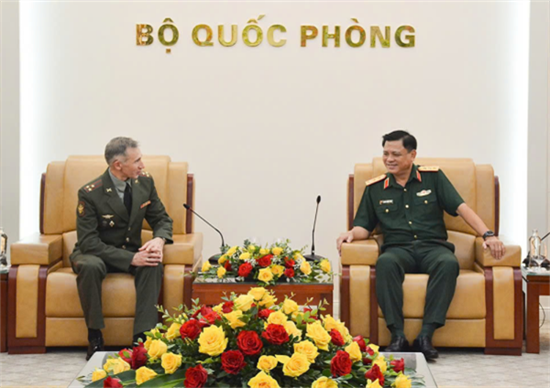 |
| Sr. Lt. Gen. Nguyen Truong Thang talks with Senior Colonel Belosludtsev Sergey Vladimirovich, Russian Defence Attaché to Vietnam |
Thirdly, enhancing the effectiveness of bilateral defence diplomacy; continue to promote Vietnam's role in international and regional multilateral mechanisms and forums. Party committees and commanders of relevant agencies and units throughout the military should focus on leading, directing, and effectively implementing bilateral defence cooperation programmes and plans with key partners, deepening the established framework of relations, making them more substantive and effective, and aligning with the interests of Vietnam and its partners. Continue to prioritise defence cooperation with neighbouring countries, major powers, strategic partners, comprehensive partners, countries in the region, and traditional friends, while expanding relations and cooperation with potential countries based on the “Four No's” defence policy, meeting strategic goals and national interests. Strengthen cooperation with neighbouring countries in the construction, management, and control of border lines; maintain and enhance the effectiveness of the mechanisms for border defence exchange and cooperation between functional forces. Implement synchronised cooperation across all fields and levels; increase political trust and the degree of intertwined interests; handle relations with major powers harmoniously, in accordance with the practical situation.
In addition, the Military is to participate in regional and international multilateral mechanisms and forums in a proactive and responsible spirit, especially multilateral defence cooperation mechanisms within the framework of ASEAN and the ASEAN-led ones. Proactively propose initiatives to demonstrate the leading or co-leading role in areas where we have strengths and potential; research and participate in some multilateral exercises in humanitarian fields, such as search and rescue and disaster relief at different levels; effectively implement programmes and projects to address the consequences of war; continue the effective participation in United Nations peacekeeping operations, etc.
Fourthly, developing defence diplomacy capabilities commensurate with the country's strength and the military's position, meeting the requirements of Fatherland defence in the new situation. Party committees and commanders of agencies and units should pay attention to investing in building modern defence diplomacy infrastructure in terms of equipment and facilities; building a security and safety database according to the digital architecture framework of the diplomacy sector, in line with assigned tasks. Functional agencies of the Ministry of National Defence, in which the Foreign Affairs Department and the Legal Department play the core role, should closely coordinate with ministries and agencies to build a system of documents and guidelines for implementing Resolution No. 250/2025/QH15, dated 10 October 2025, of the National Assembly on some specific mechanisms and policies to enhance the effectiveness of international integration in accordance with the specifics of military operations. Pay attention to developing human resources for foreign affairs work in accordance with the functions and tasks of each agency and unit. This includes building a team of cadres and staff doing external affairs “both red and expert”, able to successfully fulfill all tasks of defence diplomacy. Continuing to innovate thinking and methods in defence diplomacy towards professionalism and modernity; promote digital transformation and the application of science and technology in defence diplomacy to meet the requirements of the new development era.
Finally, strengthening defence foreign affairs information work. Foreign affairs information work plays a very important role, is a strategic component in the overall national soft power, and makes a positive contribution to promoting Vietnam's independence, self-reliance, and righteousness on the international stage. Therefore, Party committees and commanders of agencies and units must attach importance to disseminating information about defence foreign affairs; at the same time, promote the image of peace-loving Vietnamese people and the noble qualities of “Uncle Ho's Soldiers” to international friends; resolutely combat and refute erroneous views and distortions of Vietnam's foreign policy and national defence policy.
Continuously innovate thinking and ways of implementation, ensuring strategic proactiveness both in the short and long terms; build a well-structured communication plan which is rich in content, attractive and persuasive in formats, accessible, and modern. In particular, it is necessary to focus on foreign affairs activities of leaders of the Ministry of National Defence, the General Staff, the General Political Department, and major foreign affairs activities in 2026, such as: the 3rd Vietnam International Defence Expo; friendly border defence exchanges with neighbouring countries; and multilateral defence diplomacy activities on an annual and rotating basis, etc. Effectively leverage global media platforms; build a close and effective coordination mechanism between agencies and units with ministries, departments, and localities; between military and civilian press and international media to form an increasingly practical and effective defence foreign affairs information network.
The year of 2026 begins a new phase of national development, marked by intertwined opportunities and challenges. Adhering closely to the directive of “2 steadfast, 2 strengthen, and 2 prevent” and the “5 firm” principle of General Secretary To Lam, Secretary of the Central Military Commission, spoken at the 12th Military Party Congress; under the leadership and guidance of the Central Military Commission and the Ministry of National Defence; with the proactive, creative, united, and disciplined spirit of all officers and soldiers, it is expected that international integration and defence diplomacy in 2026 will continue to be implemented in a comprehensive, substantive, and effective manner; contributing to maintaining a peaceful and stable environment, creating favourable conditions for national development; and firmly protecting the Fatherland early and from afar.
Senior Lieutenant General NGUYEN TRUONG THANG, Member of the Party Central Committee, Member of the Central Military Commission, Deputy Minister of National Defence