Chemical Corps steps up science and technology development and digital transformation
As the core force responsible for chemical defence, responding to chemical, biological, radiological, nuclear (CBRN) incidents, preventing the proliferation of weapons of mass destruction (WMD), remediating post-war toxic chemical consequences, and taking part in responding to environmental disasters, the Chemical Corps has been making breakthroughs in science and technology development and digital transformation to improve its overall quality and combat strength and successfully fulfil its assigned tasks.
Today, the rapid development of science and technology, particularly artificial intelligence (AI), biotechnology, chemistry, new materials, quantum technology, robotics, and autonomous systems, both creates favourable conditions and gives rise to numerous risks and challenges for the Chemical Force in performing its missions.
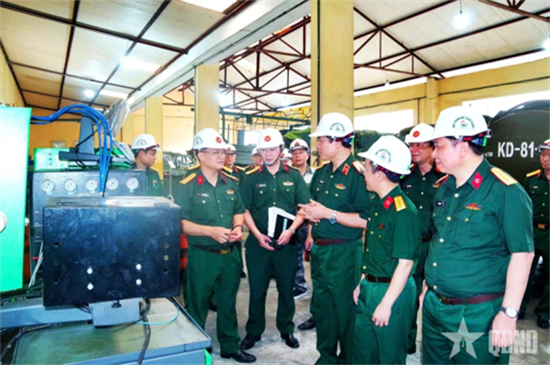 |
| Chemical Corps Command inspects the work of applying science, technology, and digital transformation at Factory X61 (photo: qdnd.vn) |
Against this backdrop, over the years, while consolidating the force’s organisational structure in an “adept, compact, strong” manner and building “exemplarily, typically” comprehensively strong units, the Chemical Corps’ Party Committee and Command have attached importance to leading and directing the research, application, and mastery of scientific and technological advances, improving the quality of training, combat readiness, and response to CBRN incidents, preventing the proliferation of WMD, remediating the consequences of war, and taking part in responding to environmental disasters. In particular, after the issuance of Resolution 3488-NQ/QUTW, dated 29 January 2025, by the Central Military Commission on breakthroughs in science and technology development, innovation, and digital transformation in the Military, the Corps Party Committee has grasped and widely disseminated the Resolution, formulating action plans, establishing a Steering Board and specialised working groups to direct agencies and units in the realisation of the Resolution.
With strong political determination and appropriate scientific solutions, the Corps has made significant progress in science and technology development and digital transformation. In the 2021 - 2025 period, it completed hundreds of scientific research projects and technical initiatives, including numerous projects and tasks at national and Ministry of National Defence (MND) levels, thereby practically contributing to enhancing its capacity to research, design, and manufacture chemical defence equipment, developing monitoring and warning systems, applying digital technology in command, management, and training, and improving its own overall quality and combat readiness.
However, alongside the results achieved, there have been certain shortcomings in the Corps’ science, technology, innovation, and digital transformation work. The Corps’ capacity to master technology in some key areas has not kept pace with the development of its task requirements. Some research products have not been closely aligned with the requirements of training, combat readiness, and chemical defence under high-tech warfare conditions. The Corps still lacks high-quality human resources, particularly leading experts in emerging fields. Its digital infrastructure remains unsynchronised, while data is still fragmented and not interconnected; digital knowledge and skills of some cadres and employees have not kept pace with their mission requirements.
For that reason, the Corps determines that it shall further renew its thinking on science and technology development and bring about a shift from individual research projects to the development of key programmes with clear products and application destinations as well as from partial technology application to mastery of core technologies. Besides, it shall master foundational technologies, create products with high scientific and technological content, and transform from manual and fragmented management to digital command and management. To that end, the Corps’ Party Committee and Command will continue leading and directing the synchronous implementation of solutions, with a focus on the following.
First, strengthening dissemination and education to build great political resolve and create new momentum for science and technology development and digital transformation across the Corps. The Corps will continue grasping and widely disseminating higher-level resolutions, directives, and guidance on science and technology development and digital transformation, making huge changes in the awareness and sense of responsibility of party committees and commands at all levels towards this important task. Agencies, units, and schools will be directed to review, supplement, and include science, technology, and digital transformation tasks in their action programmes and annual and period-specific work plans.
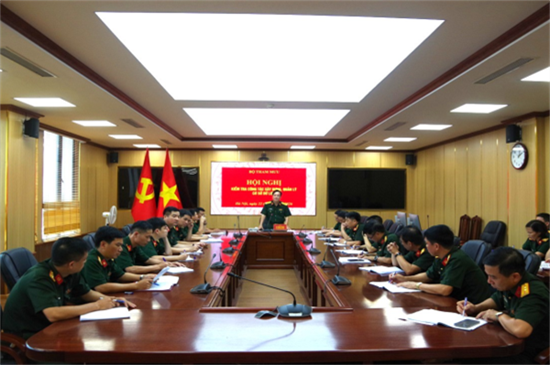 |
| Conference to inspect the building and management of databases (photo: binhchunghoahoc.vn) |
The implementation of movements such as “Digital Literacy”, “Digital Learning” and “Digital Soldiers” will continue to be furthered so that every cadre and soldier will become a “digital soldier”, master digital platforms, and possess necessary skills to successfully perform all assigned tasks. Inspection and supervision will be strengthened; the responsibility and role of key cadres in the process of leadership, direction, and implementation will be promoted; the results of scientific and technological research and application, innovation, and digital transformation will be used as one of the criteria for annual emulation and commendation.
Second, developing scientific and technological potential in a synchronised, modern direction, renewing mechanisms for managing scientific and technological activities, linking research with task performance. The Corps will continue resolutely implementing Plan 569-KH/ĐU, dated 3 June 2025, by the Corps Party Committee on realising Resolution 3488-NQ/QUTW, reviewing and stepping up personnel training and development in tandem with personnel planning and use, building a contingent of technical professional cadres and employees with a proper balance between specialisations. Priority will be given to training and developing experts in chemistry, radiological and nuclear sciences, AI, automation, and data analysis. Mechanisms will be established to detect, develop, and utilise young cadres with research capabilities, while favourable conditions will be created to encourage cadres to devote themselves to their duties and promote their creativity.
Besides, the Corps will actively mobilise resources to upgrade research agencies, training institutions, and specialised laboratories, gradually invest in synchronised research, testing, analysis, and evaluation equipment for military chemistry, military biology, radiological and nuclear sciences, and military environment. Task-based research commissioning mechanisms will continue to be improved; coordination among staff agencies, scientific agencies, research institutes, schools, factories, and units will be strengthened to form a closed cycle from research, testing, production, and provision to operation, improvement, and completion of products. Due attention will be paid to stepping up technology transfer, commercialising products with broad application potential, and developing the scientific and technological potential of Factory X61, Institute of Military Environmental Chemistry, Centre 81, Chemical Officer College, and other specialised agencies across the Corps.
Third, researching and mastering core technologies for training, combat readiness, chemical defence, response to CBRN incidents and non-traditional security challenges. The Corps will accelerate scientific research, with a focus on AI, specialised robots, smart sensors, and simulation technology, in order to enhance its capability to conduct reconnaissance and rapidly identify CBRN agents as well as develop multi-layered early-warning systems, new-generation decontamination equipment, technologies for environmental remediation following CBRN incidents, technologies for protecting personnel operating in contaminated environments, and unmanned vehicles for reconnaissance and incident response.
Great value will be attached to researching into the improvement, manufacture, and localisation of specialised technical equipment, enhancing the technical and tactical performance of existing equipment, and gradually mastering foundational, core, and dual-use technologies to contribute to raising the efficiency of investment, increasing the capability to mobilise social resources, and facilitating the development of a high-tech defence industry.
Fourth, comprehensively stepping up digital transformation and building the Corps according to a modern governance model. As an immediate priority, the Corps will focus on developing and managing “accurate, complete, clean, live” digital databases on personnel, equipment, supplies, chemicals, monitoring results, environmental information, and maps of CBRN hazards, and formulating incident response plans. Data connectivity and sharing among agencies and units and with ministries and sectors will be fostered under regulations. The development of digital command-and-control systems will be accelerated; shared data centres will be developed; smart schools, warehouses, and factories will be built; equipment, supplies, technical and logistics management systems will be operated using digital technology; AI will be applied to support analysis, forecasting, early warning, and decision-making in response to CBRN situations. Simulation and virtual reality technologies will be actively applied in training, including the development of digital training grounds, electronic lesson plans, and systems for evaluating training results in real time, thereby contributing to improving training quality, saving time and material resources, and enhancing combat readiness.
Fifth, expanding domestic and international cooperation, mobilising resources for science and technology development, innovation, and digital transformation. Given the rapid development of science and technology and the Corps’ limited resources, in order to meet its mission requirements, the Corps will promote cooperation with academies, schools, research institutes, and scientific and technological establishments inside and outside the Military to exchange and share experience, and coordinate research, technology transfer, and scientific and technological application. It will proactively take part in key national and MND science and technology projects and bring into play coordination among management agencies, research agencies, training institutions, and end-user units to ensure that scientific research is closely linked with realities. International cooperation will be intensified in preventing the proliferation of WMD, responding to CBRN incidents, protecting the environment, and remediating post-war toxic chemical consequences. In the process of cooperation, the Corps will adhere to the principles of independence and self-reliance, safeguard military secrets and technological security, and closely combine the acquisition of scientific and technological advances with the promotion of domestic capabilities and the enhancement of national research and innovation capacity. The ultimate goal is to gradually build the Corps into the core force in researching and applying science and technology in chemical defence, preventing the proliferation of WMD, responding to non-traditional security challenges, and protecting the environment.
Building on its glorious tradition of “effective prevention, excellent combat”, the Chemical Corps will continue to uphold self-reliance and self-strengthening, vigorously renew its thinking, master science, technology, and digital transformation, build a highly qualified contingent of cadres, develop core technologies, and actively apply scientific and technological advances to training, combat readiness, chemical defence, and response to CBRN incidents, with a view to meeting the requirements of Fatherland protection in the new situation.
Maj. Gen. NGUYEN DINH HIEN
Commander of the Chemical Corps