Infantry Officer College No.2 makes breakthroughs in the quality of education and training
Raising the quality of education and training is a major, consistent policy of our Party and State. Thoroughly grasping this policy, the Party Committee and Board of Directors of Infantry Officer College No.2 (Nguyen Hue University) have been focusing their leadership and direction on making breakthroughs to further improve the quality of this important work, meeting the requirements of building the Vietnam People’s Army (VPA) and defending the Fatherland in the new situation.
Infantry Officer College No.2 was established on 27 August 1961, during the fierce years of the resistance war against the US for national salvation, tasked with training and developing a corps of tactical-level command and staff officers for the South battlefield.
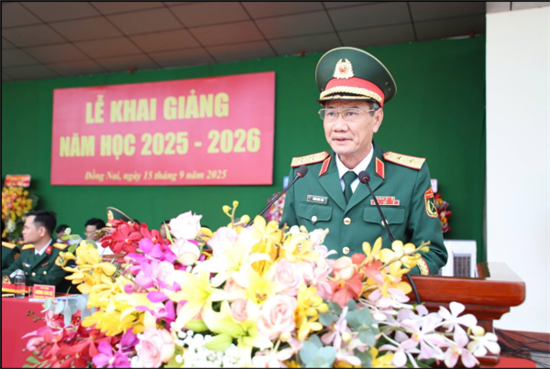 |
| Lt. Gen. Luong Dinh Lanh addresses the opening ceremony of the 2025 - 2026 academic year |
Over the past 65 years of construction, combat, and development, under the leadership of the Party, particularly the Central Military Commission (CMC) and the Ministry of National Defence (MND), with the support of local party committees, authorities, and people, as well as agencies and units both inside and outside the VPA, the College has continuously developed in all respects and excellently fulfilled all assigned tasks. Tens of thousands of command and staff officers at various levels were trained at the College; they subsequently served on battlefields during the resistance war against the US for national salvation and noble international missions, forming a core command and staff force at tactical level across the VPA. Many of them have become senior leaders, generals, and scientists, holding important positions within the Party, State, and VPA.
In the cause of Fatherland construction and protection, the College has affirmed its position as a leading centre of the VPA for military education, training, and scientific research in the South. Currently, the rapid development of the 4th industrial revolution, particularly digital technology, artificial intelligence (AI), big data, and new technologies, has been profoundly changing the military environment, methods of warfare, as well as the requirements of VPA building and Fatherland protection. The building of a revolutionary, regular, elite, modern VPA necessitates education and training taking the lead in innovation in terms of both content and methodology, to be relevant to units’ task requirements. This both creates opportunities for the College to improve the quality of education and training and imposes new, higher requirements, particularly regarding the quality of its “output” - a contingent of tactical-level command and staff officers with not only political steadfastness, good morality, comprehensive military knowledge, but also innovative thinking, digital skills, and the capacity to analyse, forecast, and effectively handle situations in management, command, training, and combat readiness.
To meet these requirements, the College is performing all its areas of work via synchronous solutions aimed at renewing and improving education and training, with a focus on the following.
First of all, the College is proactively renewing its processes, programmes, and content of training, education, and scientific research towards “standardisation and modernisation”, closely linked with the requirements of VPA building and trends in military science and technology development. To achieve high effectiveness, the College will continue to grasp and realise the Politburo’s Resolution 71-NQ/TW, dated 22 August 2025, on breakthroughs in education and training development, the CMC’s Resolution 290-NQ/QUTW, dated 7 January 2026, on breakthroughs in education and training development in the VPA, and the CMC’s Resolution 3488-NQ/QUTW, dated 29 January 2025, on breakthroughs in science and technology development, innovation, and digital transformation in the VPA. Emphasis will be placed on renewing training and education processes, programmes, and content to ensure their compatibility with military art, science, and technology development as well as realities of training and combat readiness in units. Training programmes and content for different target groups will be reviewed, supplemented, and improved towards greater connectivity and continuity among different educational levels and subjects, with a view to thoroughly removing fragmented knowledge and overlapping content, ensuring a balance between basic and specialised subjects, between military science and social sciences and humanities as well as between theory and practice. New knowledge of politics, law, economics, society, science, high-tech warfare, cybersecurity, electronic warfare, data science, and military art will be regularly updated and incorporated into training programmes for target groups. In the upcoming years, the College will continue supplementing and completing the training programme system for specialities to closely match training objectives and requirements, ensure scientific rigour, and provide the full volume of knowledge prescribed.
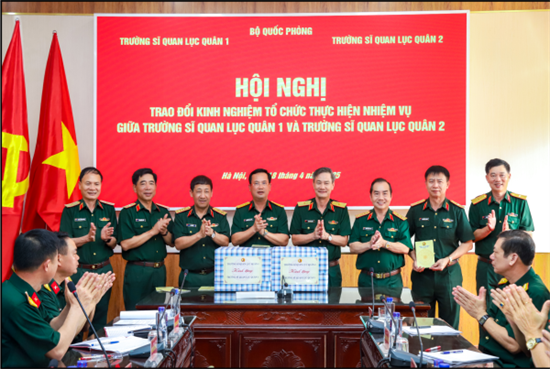 |
| Experience sharing conference with Infantry Officer College No.1 |
In the training process, the College will flexibly apply 3 viewpoints, 8 principles, and 6 combinations, place learners at the centre, and promote their dynamism and creativity. Lecturers will effectively perform their roles as organisers, facilitators, and guides who help cadets acquire knowledge and develop skills and practical proficiency, with a focus on fundamental and practical issues that meet the requirements of their duties and responsibilities after graduation. Teaching and learning methods will be actively renewed; traditional teaching methods will be combined with advanced approaches; information technology application and learners’ thinking capabilities, dynamism, and creativity will be encouraged; teaching, learning, examinations, and evaluation of learning outcomes will be carried out creatively and substantively. Training in “knowledge”, “skills”, and “ethics” will be combined with one another, while cadets’ thinking and practical capabilities will be improved to ensure that, after graduation, they possess the qualities and capabilities necessary to meet their task requirements and keep pace with developments in modern military science and art and the general level of the national education system.
Alongside this, the College will develop plans and a road map to place all activities in a digital environment, thereby guaranteeing connectivity, synchronisation, and confidentiality. It will gradually, effectively apply digital technology and AI to management, training, education, and scientific research, and accelerate the integration of advanced technologies, AI, and digital platforms into teaching and learning. Emphasis will be placed on developing data infrastructure and shared, interconnected digital databases, integrating digital training platforms and digital learning resources, and eliminating passive teaching and learning that are overly theoretical and disconnected from realities of combat training in units. Importance will be attached to making appropriate investment in developing cadets’ scientific research capabilities and organising College-level “Youth Innovation” Awards in a rigorous and effective manner as the basis for selecting high-quality initiatives and research projects to participate in the annual “Youth Innovation” Award of the VPA.
To realise the Project on “building a contingent of teachers and educational managers in the VPA for the 2023 - 2030 period and beyond”, the College will make breakthroughs in training, developing, and standardising its contingent of teachers and educational managers, with sufficient numbers, a proper age structure, political steadfastness, good morality, and high levels of academic qualifications and capabilities in leadership, command, management, teaching, scientific research, and professional expertise. By 2030, the College aims to have at least 95% of its teachers and educational managers meeting prescribed standards, 100% meeting digital competency standards and capable of applying AI in teaching and management, and at least 30% capable of working in international environments. It strives to have more than 30% of its teachers holding doctoral degrees, 75% of its teachers having held appropriate command or management positions in units in line with its training objectives and requirements set for target groups, between 5 and 7 staff members being recognised as associate professors, and 1 or 2 individuals being awarded the title of Meritorious Teacher.
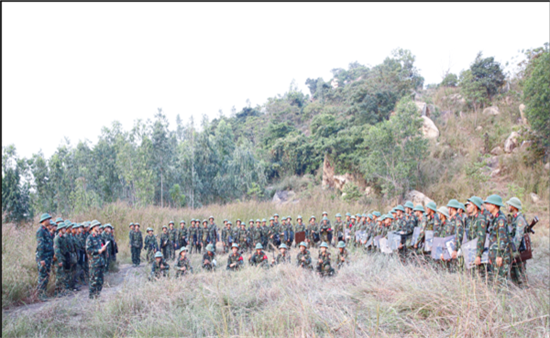 |
| Graduation exercise |
To achieve the above objectives, the College will continue directing a substantive review and assessment of its contingent of cadres and lecturers as the basis for personnel planning, particularly the planning of key leaders, leading scientific experts, core lecturers, and young lecturers with comprehensive capabilities, ensuring synchronisation, a proper structure and age distribution, forming successive generations of incumbent, successor, and future cadres, meeting both short-term and long-term task requirements. It will continue synchronously adopting solutions for ideological work, organisational work, and policy work, proactively developing human resources, training and assigning cadres and lecturers properly, building a corps of highly qualified lecturers, excellent lecturers, teachers holding academic titles, and young lecturers. It will actively execute short-, medium-, and long-term training and development plans, as well as practical assignments to units, while cadres and lecturers will be encouraged and enabled to engage in self-study and self-research to improve their own professional expertise and pedagogical methodology.
Consideration will be given to political and ideological education, cultivating political steadfastness, professional ethics, and lifestyle among cadres and lecturers so that they truly become role models for cadets to follow. Due regard will be paid to improving personnel’s material and spiritual life, supplementing mechanisms and policies to attract cadres who possess necessary qualifications, experience, and pedagogical methodology from units and recruit high-quality personnel in specialised fields from the outside.
In recent years, with investments from the MND, the College has developed a relatively comprehensive system of lecture halls and training grounds, together with a range of synchronised teaching and learning equipment. However, to meet the requirements of renewing and improving education and training, the College will continue to make breakthroughs in mobilising resources and investing in facilities and teaching and learning equipment. Under the policy of speeding up the building of “a smart school approaching the 4th industrial revolution”, the College will focus on executing approved investment projects to standardise and modernise teaching equipment. Priority will be given to modernising the management and administration of education and training, specialised classrooms, equipment for training and exercises, and tactical training simulation software, researching and developing curricula and materials, building and improving digital infrastructure, digital learning-resource systems, and smart education management and school administration systems. By the end of 2027, the College strives to complete the upgrading of information technology equipment to ensure connectivity, synchronisation, and a closed system, with sufficient transmission capacity to facilitate teaching, learning, and education and training management, extend network connectivity to classrooms, virtual firing rooms, meeting halls, and Ho Chi Minh halls of agencies, faculties and units, and develop an online teaching system. By the end of 2030, the College’s learning resource system will be standardised, modernised, and unified; data, digital technology, and AI will be effectively applied in the management and organisation of teaching, learning, and scientific research activities.
Building on its glorious 65-year tradition of education, training, combat, and development, Infantry Officer College No.2 will continue upholding the spirit of “courage, creativity, unity, discipline, good teaching, good learning” and further improving the quality of education and training to meet the requirements of VPA building and Fatherland protection in the new era.
Lt. Gen. LUONG DINH LANH
Rector of the College