Restrained rhetoric, vigorous action, and steadfast implementation — The Party’s political commitment in the new era
The 14th National Party Congress requires the Party to look directly at the truth, accurately assess the situation, resolutely renew thinking, improve institutions, enhance national governance capacity, and pursue strong, breakthrough, and effective action. To fulfil these requirements, General Secretary and State President To Lam emphasised that the strategic direction has already been clearly defined and the contingent of cadres has largely been put in place; what matters most now is implementation: ‘restrained rhetoric, vigorous action, and steadfast implementation’. This constitutes the Party’s political commitment, shaping the nation’s core values and credibility in the new era.
From both theoretical and practical perspectives, political commitment represents the unity between words and actions of a governing authority in pursuing development goals, safeguarding the interests of the People, and contributing to the common values of the international community. The gap between commitment and implementation is therefore the most important measure of national governance capacity.
In not a few countries, and even in some places within our own country, there have been cases of what may be termed “commitment inflation”, where official declarations are made frequently but lack effective implementation mechanisms, consistency, and verification through practical results. It is precisely for this reason that the spirit of “restrained rhetoric, vigorous action, and steadfast implementation” articulated in the Political Report of the 14th National Party Congress, presented by General Secretary To Lam, carries particularly profound significance: restraint in words coupled with resolute action; an emphasis on substantive outcomes rather than formality; and perseverance in carrying initiatives through to completion rather than merely launching them.
The spirit of “restrained rhetoric, vigorous action” is deeply rooted in the historical traditions of the Vietnamese nation. Throughout thousands of years of nation-building and national defence, the Vietnamese people have forged a value system that emphasises practical action and places greater importance on effective implementation than on rhetoric. The nation’s major strategic decisions have typically been prepared with great care and executed in a prudent, resolute, and discreet manner, generating tremendous effectiveness and creating historic turning points. Strategic thinking such as “remaining constant in principles while adapting to changing circumstances”, “using the few to cope with the many”, “using the weak to defeat the strong”, and “using righteousness to triumph over brutality, using benevolence and wisdom to replace force and oppression” not only reflects the wisdom and core military and diplomatic philosophy of the Vietnamese nation, but also embodies a distinctive style of action: restrained yet decisive, quiet yet profound, persistent, systematic, and effective.
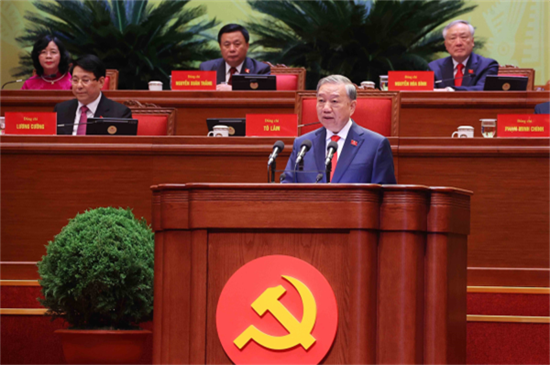 |
| General Secretary To Lam reports political documents at the 14th National Party Congress |
Amid the turbulence of the contemporary world, where political declarations often appear more abundant than practical action, Vietnam’s consistent philosophy of action, “restrained rhetoric, vigorous action, and steadfast implementation”, stands out as particularly noteworthy. This is not merely a symbolic slogan; rather, it has become a guiding principle throughout Vietnam’s leadership, national governance, and international integration process. From the cautious yet steadfast steps taken during the renewal process to flexible policy decisions in the context of globalisation and digital transformation, Vietnam has continuously affirmed a distinctive model of political commitment: neither ostentatious nor noisy, yet profound, persistent, and effective.
In modern national governance, the principle of “steadfast implementation” is clearly reflected in Vietnam’s approach to addressing major issues. From economic development and social welfare to national defence, security, and foreign affairs, institutional reforms have been pursued across multiple sectors. In particular, in recent years, political determination in combating corruption, wastefulness, and other negative phenomena has been demonstrated through concrete, continuous, and uncompromising actions, with no “off-limits” areas. This process has not been confined to short-term campaigns; rather, it has been maintained as a regular and institutionalised mechanism involving multiple agencies and subject to public oversight. Such persistence and consistency have significantly strengthened the People’s confidence in the political system and state apparatus.
In economic development, the commitment to “restrained rhetoric, vigorous action” has been reflected in Vietnam’s emphasis on institutional innovation, improving the investment environment, enhancing national competitiveness, and proactively advancing international integration. Rather than setting overly ambitious goals lacking practical feasibility, Vietnam has generally adopted concrete plans with clear roadmaps aligned with available resources. As a result, the economy has maintained relatively high growth rates over many consecutive years, preserved macroeconomic stability, and steadily enhanced the country’s international standing. These achievements are not the product of grand declarations, but of a wide range of specific policies implemented in a coordinated and persistent manner.
With regard to national defence, security, and foreign affairs, the 14th National Party Congress set forth a highly concise guiding viewpoint: “Strengthening national defence and security and advancing foreign affairs and international integration constitute regular and essential tasks.” Although the Party’s directive is expressed succinctly, its implementation entails a vast range of undertakings. These include building revolutionary, regular, elite, and modern People’s Army and People’s Public Security forces; firmly safeguarding the Socialist Republic of Vietnam; and “ensuring and protecting to the highest degree the national interests; resolutely and persistently safeguarding the independence, sovereignty, unity, and territorial integrity of the Fatherland; protecting the Party, the State, the People, and the socialist regime; safeguarding the achievements of the revolution, renewal, industrialisation, and modernisation; preserving and promoting the traditional cultural values of the nation; and enhancing the country’s international standing.”
At the same time, Vietnam has pursued synchronised and innovative diplomatic activities and comprehensive, in-depth, and effective international integration: “Continuing to uphold the pioneering role of foreign affairs, in close coordination with national defence, security, sectors, levels, and localities, proactively preventing the risks of war and conflict, creating and maintaining a peaceful and stable environment, firmly safeguarding the Fatherland, and mobilising external resources and favourable international conditions for national development.” Thus, when the Party speaks briefly of strengthening national defence, security, and foreign affairs as regular and essential tasks, the scope of implementation in reality encompasses these major undertakings. Steadfast implementation ultimately means ensuring that all such efforts effectively and comprehensively serve the cause of national construction and defence.
A vivid example of Vietnam’s action-oriented political commitment can be seen in its response to global challenges such as pandemics, climate change, and energy transition. During the Covid-19 pandemic, as well as in disaster prevention and response efforts, Vietnam not only issued strong messages on protecting public health but also rapidly implemented preventive measures and mobilised the entire political system into action. Despite numerous difficulties, the country’s proactive, flexible, and consistent approach enabled it to control the situation and achieve a relatively rapid economic recovery. More importantly, lessons drawn from practical experience were consolidated and transformed into long-term policies rather than remaining merely temporary responses.
Vietnam has likewise demonstrated a substantive approach in fulfilling international commitments on climate change by setting out clear targets for emissions reduction and transition to clean energy, while formulating concrete action plans to realise those objectives. The development of renewable energy, promotion of a green economy, and enhancement of climate resilience have been carried out with the participation of both the public and private sectors. This demonstrates that political commitment does not stop at declarations, but is translated into concrete programmes, projects, and practical resources, alongside determined efforts to accomplish the goals set forth.
Notably, while many countries adopt high-profile approaches to promote their image and policies, Vietnam tends to favour a more restrained but reliable approach, “speaking less, but acting with certainty”. This does not mean that Vietnam undervalues communication; rather, it prioritises substantive outcomes. When policies deliver tangible results, those results themselves become the most persuasive message. Such an approach helps avoid the gap between inflated expectations and practical capacity, thereby fostering long-term credibility and trust.
Nevertheless, the principle of “restrained rhetoric, vigorous action” also places considerable demands on the political system and administrative apparatus. To accomplish more and to carry tasks through to completion requires strong implementation capacity, effective coordination mechanisms, and a contingent of responsible cadres. Without these elements, “vigorous action” may lead to overload or lack of synchronisation, while “steadfast implementation” may encounter obstacles during implementation. Therefore, “restrained rhetoric, vigorous action, steadfast implementation” represents not only political determination, but also requires high implementation capacity.
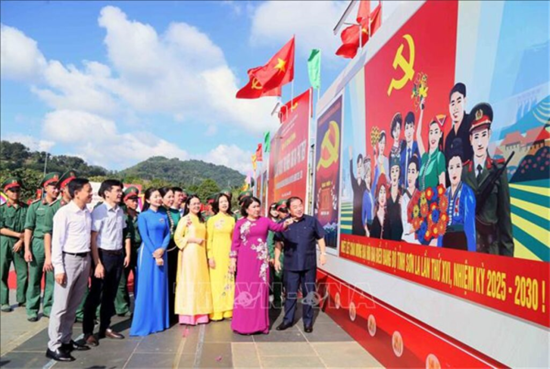 |
| The message of "Restrained rhetoric, vigorous action, steadfast implementation" has spread eager and a new atmosphere in the entire People (Photo: VNA) |
In the context of digital transformation and the new industrial revolution, the requirement for “steadfast implementation” has become increasingly complex, as issues are now more interconnected across sectors and fields and demand coordination at multiple levels. The development of digital government, the digital economy, the digital society, and digital transformation is not merely a set of strategic objectives, but also a test of the capacity to fulfil political commitments. Digital transformation projects that remain only at the planning stage or are implemented half-heartedly are unlikely to deliver meaningful results. Conversely, when implemented consistently, with clear roadmaps and close oversight, they can generate profound transformations in national development.
Another important dimension of political commitment is transparency and accountability. “Restrained rhetoric” does not mean withholding information; rather, it must go hand in hand with providing adequate, accurate, and timely information to implementers and, more broadly, to the public. When the People clearly understand the objectives, methods, and outcomes of policies, they are better positioned to supervise and accompany the State in the implementation process. This is also an essential factor in ensuring that “vigorous action” and “steadfast implementation” proceed in the right direction and deliver tangible benefits.
Practice has shown that public trust is not built upon promises, but upon concrete and consistent results over time. When the People witness policies being implemented effectively and issues being resolved thoroughly, their confidence in the system is strengthened. Conversely, any disparity between words and actions will erode trust. Therefore, the principle of “restrained rhetoric, vigorous action, and steadfast implementation” is not only a strategic choice but also a prerequisite for sustaining and reinforcing social trust.
In the future, as Vietnam continues to deepen international integration and confront new challenges, action-oriented political commitment will become even more important. Issues such as energy transition, population ageing, technological competition, and external geopolitical impacts require not only strategic vision but also effective implementation and responsive governance capacity. In this context, maintaining and promoting the principle of “restrained rhetoric, vigorous action, and steadfast implementation” will constitute a major advantage, enabling Vietnam not only to adapt but also to proactively shape its future.
It can be said that, in a world marked by profound volatility, consistency between words and actions is an indispensable value. Through a cautious yet steadfast approach, Vietnam has demonstrated, and continues to demonstrate, that major transformations do not necessarily arise from grand declarations. Rather, on the foundation of clear and scientific policies and plans, it is concrete actions, carried out persistently and to completion, that provide the firmest basis for national development and credibility.
The principle of “restrained rhetoric, vigorous action, and steadfast implementation” is therefore not merely a slogan, but a philosophy of action and a political commitment of the Party, embodying a distinctly Vietnamese identity in this era of national rise.
Professor, Dr VU VAN HIEN, Former Member of the Party Central Committee, Former Editor-in-Chief of the Communist Review