Bringing into play its recorded results, the Air Defence - Air Force Service continues to synchronously implement solutions to transform itself into a modern force, contributing to building a modern Vietnam People’s Army (VPA) under the Resolution of the 14th National Party Congress, meeting the requirements of Fatherland protection in the new situation.
The Air Defence - Air Force Service is the core force in managing and protecting the nation’s airspace and has been identified by the Party and State as one of the forces advancing straight to modernity. In recent years, the task of building a modern Service has been carried out actively and has obtained fairly comprehensive achievements. As a result, the Service’s combat readiness has been further enhanced as a solid foundation for firmly safeguarding the nation’s airspace in all situations.
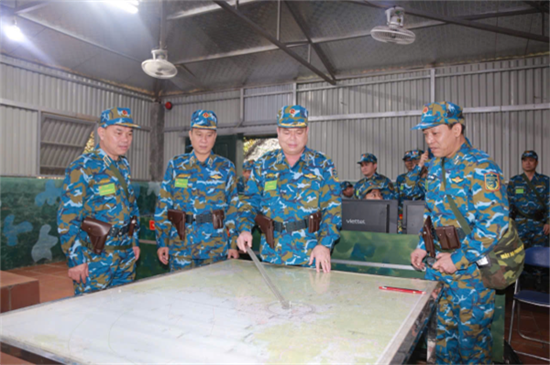 |
| Directions given to the first phase of the combat readiness exercise of 2026 by the Service Command |
The 14th National Party Congress has set forth political lines and major policies and strategic breakthroughs aimed at maintaining a peaceful and stable environment and enabling the country to develop rapidly and sustainably in the new stage. Among them is the determination to build a “revolutionary, regular, elite, modern” VPA. Thoroughly grasping the Resolution of the 14th National Party Congress, and with its role as a force prioritised for investment to advance straight to modernity, the Service clearly recognises its position and determines that it must take the lead, serve as a core force, and spread its experience, thereby contributing to successfully implementing the policy of building a modern VPA.
Building on its achievements, the Service will continue promoting modernisation with great resolve, strongly renewing its thinking and action, upholding the responsibility of party committees and commands at all levels, and ensuring clear results.
First, prioritising the building and development of high-quality human resources - the decisive factor in building a modern Service. “Focusing on restructuring and improving human resources and developing high-quality, highly qualified human resources…” is one of the strategic breakthroughs set by the Resolution of the 14th National Party Congress. Thoroughly grasping this policy, the Service’s Party Committee and Command will prioritise the building and development of high-calibre human resources, under the principle of “modernising personnel before modernising weapons and equipment”. The Service will foster its troops’ political steadfastness and absolute loyalty to the Fatherland, Party, State, and people; its cadres and soldiers shall have pure morality, a strong sense of responsibility, and exemplary lifestyle characterised by “diligence, thrift, integrity, righteousness, and selflessness”. It will build a contingent of “both red and expert” cadres, especially leaders at all levels, according to the “seven dares” spirit; they shall possess scientific working methods, high professional qualifications, and sufficient capability to command and conduct operations in conditions of modern warfare, as well as the capacity to master science and technology. Pilots, engineers, and specialists shall have solid specialised knowledge and mastery of the art of air defence - air force operations, as well as foreign language and information technology proficiency to meet the requirements of working in an international environment. Due attention will be paid to building a pool of leading experts and scientists capable of working under harsh conditions, thereby contributing to enhancing research, improvement, and modernisation of weapons and equipment and providing effective technical support for forces.
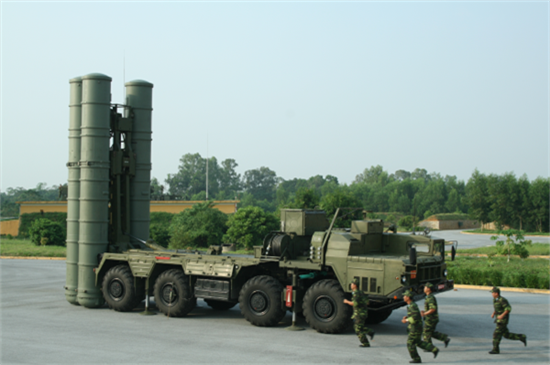 |
| S-300PMU1 air defence system |
Agencies and units across the Service will be directed to review and complete personnel planning, training, utilisation, and development in a synchronous, professional, specialised, practice-oriented manner; coordination between units and academies, schools, research institutes, centres, factories, and enterprises will be strengthened to closely integrate research, training, and production with training, combat readiness, and modernisation of weaponry. Cadre training, management, and utilisation will be strongly renewed to ensure objectivity, democracy, substance, and effectiveness. There will be policies to attract and recruit talented individuals to the Service; a healthy environment will be created to encourage cadres to continually study, train, and strive for advancement.
Second, improving training quality and combat readiness, striving to become a model training force across the entire VPA. Raising the quality of training and education is one of the main goals identified in the Resolution of the 12th Military Party Congress. To realise this goal, the Service will lead and direct its agencies and units to comprehensively renew training work to be relevant to real combat conditions, with national airspace protection as the highest objective. Emphasis will be placed on elaborate preparation and effective conduct of training, organising training work in accordance with established guidelines, principles, and connections, increasing night-time training, training under complex weather conditions and in heavily jammed electronic environments, and cyberspace operations training.
For the air defence force, training will be centred on improving basic individual movements and strengthening coordination among batteries, squads, vehicle crews, radar stations, and command post combat teams. Training will be intensified to convert and master new, modern weapons, equipment, and technical systems under complex conditions, where the enemy uses high-tech weapons, strong electronic warfare, and extensive cyberspace operations. For air force units, great value will be attached to complex flight training, combat flight training, long-range maritime flight training, and advanced flight training on new aircraft for pilots and aircrews as well as improving the command, guidance, and handling of situations in the air. Attention will be paid to raising the quality of combat exercises, enhancing command and coordination among forces, proactively detecting and effectively handling all aerial situations to avoid passivity, surprise, missed opportunities, or undetected targets. Inspection and evaluation of training results will be strengthened to ensure substantive outcomes; the quality of competitions and contests will be improved to create motivation and vibrant emulation movements among agencies and units.
Adhering to the motto “The quality of training at schools is the combat readiness capacity of units”, the Service’s training institutions will step up a reform in training content, curricula, and methods, actively apply science and technology and digital transformation in education and training, and build smart, standardised, exemplary, modern schools to contribute to the training of high-quality human resources for the Service. At the same time, international cooperation in training, retraining, and transfer of new, modern weapons and technical equipment will be enhanced with traditional partners and countries having advanced military science and technology.
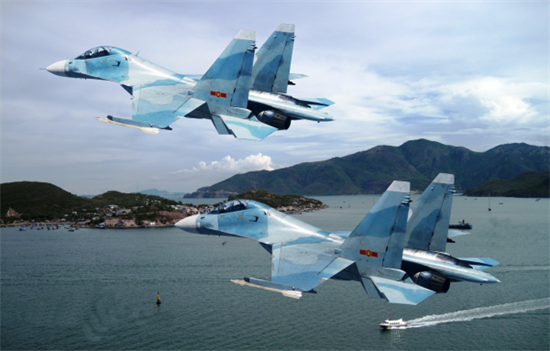 |
| A Su-30MK2 squadron during training |
Third, accelerating the modernisation of weapons and technical equipment. Grasping the policy of building a revolutionary, regular, elite, modern VPA, the Service will synchronously implement solutions to modernise its weapons and technical equipment according to the established road map. In the immediate term, priority will be given to improving the capability to operate, master, and technically ensure existing weapons and equipment as well as newly introduced modern systems. Cooperation with corporations, research institutes, factories, and schools will be strengthened to research, design, manufacture, improve, and modernise weapons and equipment, increase the level of automation, enhance accuracy, integration capability, and system synchronisation, and perfect technologies for repair, maintenance, and service life extension of weapon systems. Modern missile, radar, and equipment systems will be received and put into service. Science and technology will be applied to manufacture materials and spare parts and ensure self-reliance in technical support and proactive capability in the design and production of important equipment and technical components without dependence on imports.
Additionally, the Service will continue giving advice to the Central Military Commission and the Ministry of National Defence on prioritising investment in the procurement and development of long-range surveillance radar systems, multi-layer and multi-range air defence missile systems, new-generation aircraft, unmanned aerial vehicles, and automated command and control systems. These efforts will help build an interconnected, multi-layered air defence - air force posture and form a “robust air defence dome” capable of managing and protecting the country’s airspace.
Fourth, making breakthroughs in the development of science and technology, innovation, and digital transformation. This is one of the key tasks set by the 14th National Party Congress. Hence, the Service will promote research and application of technological advances to enhance its capabilities in management, command, and operational control, with a focus on: notification and warning, national airspace surveillance and protection, and automated firepower control and guidance systems. Importance will be attached to developing automated command and control systems, integrating digital technologies and artificial intelligence, ensuring seamless connectivity from the Service’s headquarters to subordinate units. The application of big data analysis technology will be promoted to improve the capability to detect and classify targets, and forecast the operational directions and intentions of potential adversaries. Battlefield simulation systems and virtual reality technology will be applied in training and exercises to contribute to improving the handling of complex combat situations relevant to modern warfare conditions.
Furthermore, consideration will be given to building digital infrastructure and ensuring military cyber safety and security, developing database systems associated with the establishment of data centres based on the “accurate, sufficient, clean, live, unified, and shared” principle to guarantee the safety of command and control information systems and operational databases. The digitalisation of records and administrative procedures, together with the “Digital Literacy” movement will be widely carried out to turn every cadre and soldier into a “digital soldier” capable of mastering digital platforms and possessing digital skills to meet their task requirements. Efforts will be concentrated on researching and further developing the art of air defence - air force combat in modern warfare. Due regard will be paid to researching, compiling, and completing the system of operational regulations, combat regulations, and air defence - air force training documents. By 2030, over 90% of the scientific research results shall be applied in practice; 75% of the scientific and technological research topics shall be put into pilot production or mass production.
Thoroughly grasping the Resolutions of the 14th National Party Congress and the 12th Military Party Congress, the Air Defence - Air Force Service is determined to improve its overall quality and combat strength, promote the building of a modern Service, and contribute to firmly safeguarding the Socialist Vietnamese Fatherland.
Lt. Gen. VU HONG SON
Member of the Party Central Committee
Commander of the Service