Military Logistics and Technical Sector promotes the implementation of Resolution 57-NQ/TW, improving the quality of support work
Thoroughly grasping Resolution 57-NQ/TW, dated 22 December 2024, by the 13th Politburo on breakthroughs in science and technology development, innovation, and national digital transformation, the Military Logistics and Technical Sector has been taking various synchronised, innovative measures, thus achieving many positive results and meeting the requirements of Military building and Fatherland protection in the new situation.
With a proactive spirit and a high sense of political responsibility, immediately after the issuance of the 13th Politburo’s Resolution 57-NQ/TW and Resolution 3488-NQ/QUTW, dated 29 January 2025, by the Central Military Commission (CMC) on breakthroughs in science and technology development, innovation, and digital transformation within the Vietnam People’s Army (VPA), the Logistics and Technical Sector has studied and disseminated those documents among all staff members, translating goals and guiding viewpoints set by the Party and the CMC into its specialised resolutions and action plans with numerous synchronised, innovative measures, creating positive, all-round changes in its task performance.
 |
| Lt. Gen. Tran Minh Duc, Director of the General Department of Logistics and Technical Services inspects specialised operations of the Institute of Design |
Via communication, education, and rigorous, systematic implementation, the awareness and sense of responsibility of officers, employees, and soldiers, particularly key leaders, staff officers, and personnel directly engaged in scientific research, innovation, and digital transformation, have been significantly raised. Leadership and direction exercised by party committees and commands at all levels have been strengthened. Shared applications of the Ministry of National Defence (MND), together with logistics and technical sector platforms and applications, have been widely deployed, thereby contributing to improving staff, command, and direction work relating to logistics and technical support, accelerating a shift from traditional support to modern support based on digital platforms, from decentralised management to integrated governance, enhancing proactiveness, forecasting capability, and self-reliance.
Notably, the General Department of Logistics and Technical Services has completed the establishment of a database platform for electronic identification codes of logistics materials and equipment, as well as electronic identification codes for Group-2 technical equipment and supplies, so as to standardise management, allocation, and sharing across the entire VPA. The Ordnance Department has implemented the project entitled “Completion of the model of an ammunition and weapon depot applying new technologies and integrating an automatic fire-fighting system at Depot KV1/CQK”. The Military Medical Department has deployed electronic medical records on schedule, with high quality. To date, 20 out of 31 hospitals have adopted dual payment methods for medical examination and treatment, including cash and bank transfer. 21 out of 31 hospitals have introduced online medical appointment systems through smartphone applications or their own websites, while integrating electronic health records with VNeID application. Information security and cyber security have been rigorously ensured in accordance with regulations.
In the technical field, many factories and repair facilities have applied simulation technologies and digitalised inspection and repair processes. They have gradually introduced condition-based maintenance and predictive maintenance solutions based on the analysis of operational data from weapons and technical equipment. This represents an important shift from traditional scheduled maintenance to smart maintenance, improving technical reliability, reducing costs, enhancing the combat readiness capacity of weapons and equipment. As a result, the quality of logistics and technical support across all fields has improved comprehensively. In 2025, logistics and technical support was effectively provided for training, combat readiness, large-scale exercises, and major political events of the nation and the VPA. At the same time, the Sector successfully carried out disaster prevention and response, epidemic control, and search and rescue operations, thus contributing to maintaining stability and enhancing the VPA’s overall quality and combat strength.
However, the implementation of Resolution 57-NQ/TW within the Logistics and Technical Sector still faces a number of limitations. Digital infrastructure in some agencies and units remains inconsistent; data is still fragmented and lacks interoperability; data sharing and utilisation remain limited. High-quality human resources, particularly specialists in digital technologies, artificial intelligence (AI), and cyber security, are insufficient. The capacity to master core and foundational technologies is limited. Some staff members’ awareness of digital transformation is not comprehensive, and there remains a reluctance to embrace changes, preventing them from keeping pace with new developments. In addition, ensuring information security, cyber security, and specialised data protection poses growing challenges as digitalisation becomes increasingly extensive.
In order to further improve the quality of logistics and technical support to meet the requirements of VPA building and Fatherland protection in the new situation, the Sector will continue to well implement the following key tasks and solutions.
First, fundamentally renewing thinking and awareness in leadership and direction over science and technology development and digital transformation within logistics and technical work. This is the foremost solution for harnessing the combined strength of all components and forces, ensuring that science, technology, innovation, and digital transformation will develop in a correct direction, with high effectiveness. Accordingly, the General Department will continue directing intensive study and dissemination of the Politburo’s Resolution 57-NQ/TW and the CMC’s Resolution 3488-NQ/QUTW to enable all officers and party members, particularly party committees and commanders at all levels, to gain a clearer understanding of the importance of science, technology, innovation, and digital transformation, thoroughly grasp the guiding viewpoints, development goals to 2030 and vision to 2045, and key tasks and solutions associated with the building of an adept, compact, strong, modern Sector. On that basis, there must be a decisive transition from merely “applying technology” to “mastering and developing technology”, and from traditional management to digital governance, with data serving as the foundation for administration and decision-making. Simultaneously, efforts will be devoted to developing and using digital competency and technology application criteria for evaluating the task performance of officers and units. Doing so will help gradually shape a digital culture in logistics and technical work and meet the task requirements in the new situation.
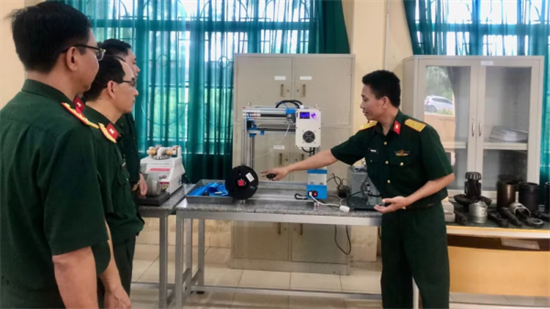 |
| 3D printing model developed by Military Technical College No.1 (photo: nhandan.vn) |
Second, continuing to perfect mechanisms and policies to create a favourable legal framework for science and technology development and digital transformation in logistics and technical work. To promote science and technology development, innovation, and digital transformation, the General Department will continue reviewing, amending, and supplementing regulations related to data management, utilisation, and sharing in a unified and interconnected manner, while guaranteeing military secrecy requirements. On that basis, unified technical standards and regulations for digital infrastructure, management software, and specialised databases will be developed and issued to lay a foundation for connectivity and integration throughout the VPA. Due regard will be paid to improving mechanisms for coordination among agencies and units with clearly defined responsibilities and appropriate decentralisation, stepping up administrative reform, shortening technology appraisal, acceptance, and transfer procedures, and facilitating the rapid application of research outcomes in practice. Policies to encourage innovation will be introduced, together with preferential mechanisms to attract resources from enterprises and research centres both inside and outside the VPA, thereby gradually establishing a modern, autonomous, sustainable logistics and technical ecosystem.
Third, developing synchronised, modern digital infrastructure, guaranteeing interconnectivity and uniformity across the VPA. Based on the approved overall architectural plan, investment in developing shared databases will be continued in a centralised, standardised direction to ensure effective connectivity, sharing, and utilisation.
In the immediate future, cooperation will be fostered with Military Institute of Science and Technology, Vietnam - Russia Tropical Centre, Chemical Corps, Military Logistics Academy, Military Technical Academy, and Viettel Group in surveying, developing, and refining processes for digitalising administrative procedures, medical records, and military personnel health records. Besides, comprehensive digitalisation of records and profiles relating to weapons, equipment, logistics supplies, and technical materials will be actively promoted to create “digital dossiers” for facilitating lifecycle management and timely, accurate decision-making. The development of integrated management systems from strategic to grassroots levels will be accelerated to ensure real-time updates and facilitate command and administration. Special emphasis will be placed on developing “smart depots”, data centres, sensor systems, and the Internet of Things (IoT), gradually establishing modern digital logistics and technical infrastructure. This will provide an important foundation for enhancing forecasting capabilities, optimising support activities, and meeting the task requirements under modern warfare conditions.
Fourth, promoting research, application, and gradual mastery of advanced technologies for logistics and technical work. Thanks to the investment of the Party and State, the VPA have been equipped with many new and modern weapons and technical systems. To meet its task requirements, the Sector will continue promoting research and development and mastering modern technologies for logistics and technical work, particularly digital technologies, AI, big data analytics, simulation technologies, and automation in the management, preservation, maintenance, and repair of weapons and equipment. Greater importance will be attached to transitioning from periodic maintenance to condition-based and predictive maintenance through integrated technologies such as IoT sensor systems mounted on weapons and equipment to collect real-time operational data, as well as data analytics and machine learning to detect early signs of technical degradation and predict failures. These measures will help optimise maintenance cycles, reduce costs, and improve the reliability and combat readiness capacity of weapons and equipment.
Integrated maintenance management platforms will be developed, together with the application of simulation technology and “digital twins” to monitor equipment status and support diagnostics and timely, accurate decision-making. Advanced manufacturing technologies, such as 3D printing for the rapid production and replacement of components, materials, and spare parts, will be applied. Automation in inspection and repair at technical facilities will be gradually introduced. Agencies, units, research centres, and factories across the VPA will be encouraged to proactively conduct research and propose initiatives and technological solutions suited to realities. Cooperation with research institutions and enterprises both inside and outside the VPA will be strengthened to receive, transfer, and gradually master technologies, thereby enhancing self-reliance in logistics and technical support.
Fifth, developing high-quality human resources and building a corps of “digital soldiers” capable of meeting their task requirements in the new situation. Human resources are the key factor in the quality and effectiveness of the revolution in science, technology, innovation, and digital transformation. Following Decision 1045/QĐ-TCHCKT, dated 25 July 2025, by the General Department of Logistics and Technical Services on the action plan for the project on policies to attract and utilise talents within the VPA, the Sector will continue comprehensively reforming education and training towards standardisation and modernisation closely linked to practical logistics and technical tasks. Training content will be updated in line with emerging technological trends and focus on key fields such as information technology, AI, data analytics, cyber security, and digital system administration. Training methods will be renewed via a combination between theory and practice as well as between face-to-face training, online learning, and digital simulation. Training models will be diversified, with close integration between educational institutions and operational units, as well as between domestic programmes and international cooperation. Priority will be given to building a corps of logistics and technical officers with digital thinking, rapid adaptability, and the ability to master and effectively utilise modern systems. Mechanisms and policies for attracting and utilising talents, particularly in cutting-edge technologies, will be refined to develop sustainable human resources for digital transformation and modernisation within the Logistics and Technical Sector.
Sixth, promoting research and development of logistics and technical support theories and art in modern warfare. This issue is of strategic importance to meeting the requirements of VPA building and Fatherland protection under modern warfare conditions. In the immediate future, efforts will be devoted to researching, supplementing, and refining theories about logistics and technical support in multi-domain operations, electronic warfare, cyber warfare, and non-contact warfare. Appropriate support methods will be developed in line with new operational concepts to ensure mobility, flexibility, secrecy, and effectiveness. Research activities will be closely linked to the organisation of an “adept, compact, strong” VPA, the characteristics of modern weaponry, and the requirements of joint operations. Attention will be paid to developing dispersed and mobile support models with resilience and rapid recovery capabilities when subjected to precision-strike attacks. The application of science, technology, digital transformation, and AI in management, forecasting, material support, technical support, and equipment repair will be further accelerated. Research on potential adversaries and future battlefield characteristics will be emphasised in order to establish a robust, in-depth logistics and technical posture capable of ensuring self-reliance and meeting the requirements of Fatherland protection in the new situation.
Science and technology development, innovation, and digital transformation constitute an inevitable trend and the foremost breakthrough task aimed at raising the quality and effectiveness of logistics and technical support. Firmly grasping the goals and guiding viewpoints of the CMC and MND, building upon its recorded results, the Logistics and Technical Sector will continue proactively innovating and developing itself towards greater modernity, smartness, and self-reliance to successfully fulfil all assigned tasks.
Lt. Gen. TRAN MINH DUC
Director of the General Department of Logistics and Technical Services