Making Military Hospital 7A "modern, specialised, patient-friendly" is not only an urgent requirement, but also a social responsibility imbued with profound humanitarian significance. This contributes to improving the quality of healthcare for officers, soldiers, and the masses in Military Hospital 7A’s stationed area, thereby meeting the requirements of national construction and defence in the new situation.
As a grade 1 general hospital and Military Region 7’s tertiary referral hospital, Military Hospital 7A is responsible for medical examinations, admission, and treatment for officers and soldiers of Military Region 7’s armed forces and the masses in its stationed area, participating in epidemic preparedness and response, providing military medical support for Truong Sa Islands and Naval Region 2, etc.
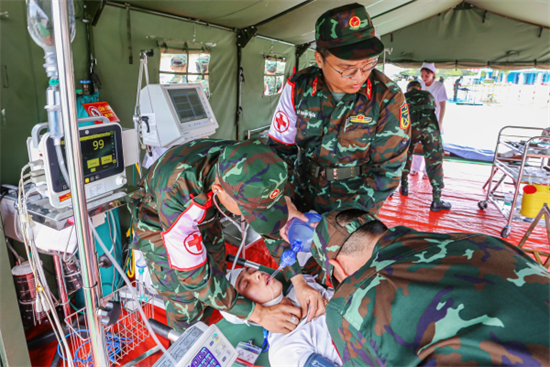 |
| Taking part in Vietnam - Cambodia Border Defence Friendship Exchange |
So far, thanks to the attention and support from superiors, Military Hospital 7A has made comprehensive progress in terms of organisational scale, infrastructure, and equipment, with a full range of specialities and the capacity to perform classified diagnostic and treatment techniques. Professional competence has been enhanced, and many of its techniques have been comparable to those at major hospitals in the South and within the entire Military. Several departments and divisions have achieved ISO certification, including the Medical Laboratory Department, the Equipment Department, and the Finance Department. Annually, the hospital examines, admits, and treats over 250,000 officers, soldiers, and civilians, with absolute safety. The bed occupancy rate consistently exceeds 150%.
At present, the mission of building Military Region 7’s armed forces and safeguarding the Fatherland place significant demands on Military Hospital 7A. In order to fulfil its assigned tasks, Military Hospital 7A is committed to continuous innovation, enhanced professional competencies, and comprehensive development oriented towards being “modern, specialised, patient-friendly”, striving to become one of the South’s leading military hospitals.
First and foremost, Military Hospital 7A focuses on modernising its facilities and medical equipment and accelerating digital transformation with a view to making breakthroughs in fulfilling professional duties. Accordingly, along with bringing into operation the 215-bed Inpatient Treatment Area in the first quarter of 2026, Military Hospital 7A continues to propose additional investment to upgrade equipment for functional units, such as the advanced cardiopulmonary resuscitation (CPR) emergency room, the fluoroscopy room, the intensive care unit, the cardiovascular diagnostic laboratory, the acute stroke care unit, the dermatology examination room, and the specialised skin treatment room. Also, Military Hospital 7A invests in comprehensively upgrading medical equipment, prioritising diagnostic imaging, laboratory medicine, and high-tech surgical equipment, such as spinal endoscopy systems, surgical robots, retinal tomography machines, audiometers/tympanometres, stapedius reflex monitors, jaundice monitors, etc., to raise the quality of medical examination, diagnosis, and treatment.
In parallel, Military Hospital 7A pays attention to accelerating digital transformation and applying information technology to its medical examination and treatment. This aims to reduce administrative procedures, shorten processing times, improve the accuracy of patient data, and provide a smart, convenient medical examination and treatment experience, contributing to realising the goals of digital transformation in healthcare, building a smart hospital model, and integrating into the e-government system. Accordingly, Military Hospital 7A continues to research and implement electronic office software solutions and electronic medical records by increasing investment in and upgrading infrastructure, data storage equipment, security systems, network infrastructure and devices, and software systems, etc. Besides, Military Hospital 7A has completed the integration and upgrading of self-service kiosk systems to allow patients to conveniently register for medical examinations simply by scanning their chip-embedded citizen ID card or by using the national electronic identification application (VNeID). A call centre has been established to support the registration and reception of medical examinations via telephone, software platforms, and the Hospital's mobile app. Moreover, a consultation and appointment hotline has been deployed to provide medical guidance and handle on-demand appointment bookings, thus reducing unnecessary in-person visits. Furthermore, to strongly promote digital transformation in payments, Military Hospital 7A has implemented various QR code scanning methods, including dynamic QR codes for instant transactions and static QR codes, allowing users to flexibly conduct transactions without time or location limitations.
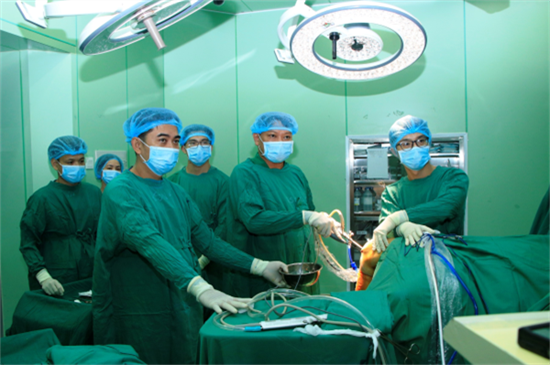 |
| An operation performed by medical staff of the Hospital |
Given the complex nature of various diseases and the high standards required for providing healthcare services for military personnel and the public, Military Hospital 7A has identified specialised medical techniques in examination and treatment as a priority. Building on existing strengths, such as hip and knee replacements, arthroscopic ACL reconstruction, shoulder arthroscopy, and microsurgery combined with plastic surgery, small joint arthroscopy and refining microsurgical techniques for vascular and nerve repair, as well as flap surgery for soft tissue defects, Military Hospital 7A is prioritising investment in cutting-edge techniques, including minimally invasive surgery, cervical spine endoscopy, lumbar spine endoscopy, laparoscopic gastrectomy, laser lithotripsy, removal of residual bile duct stones via the Kehr tube tract, endoscopic retrograde cholangiopancreatography (ERCP) and nephrolithotomy, bipolar and laser prostatectomy. Simultaneously, it is expanding the application of modern medical technologies, such as Phaco, laser surgery, Lasik, intravitreal injections, head and neck oncology surgery, otologic and neurosurgery, dental implants, periodontal surgery, laser-assisted dental treatment, and maxillofacial orthodontics, among others. These aim to bolster professional expertise and make a qualitative leap in diagnosis, emergency care, and treatment outcomes.
Today, robust medical advancements with numerous new and complex inventions and techniques require medical professionals to be "proficient in both medical theory and medical practice". Recognising this as a critical and ongoing priority, alongside requesting additional personnel to fill specialised vacancies, Military Hospital 7A has proactively selected and sent medical staff to both short-term and long-term training courses inside and outside the Military to address the current personnel shortage. Military Hospital 7A aims for 100% of its staff to hold university and postgraduate degrees by 2030 and over 70% of its doctors to hold postgraduate degrees, including at least 40% attaining level-2 specialist certification and 01 to 02 holding doctoral degrees, laying the foundation for its comprehensive and in-depth development across all specialities, especially in surgery and other areas of strengths. Simultaneously, on-the-job training and professional development through specialised activities are highly promoted, in which superiors train inferiors, and experienced and highly skilled staff train novices. Scientific research with new and feasible projects in medical examination and treatment is encouraged. Specialised scientific and technical briefings are strictly maintained, while the activities of the 7A Science and Technology Research Centre are promoted.
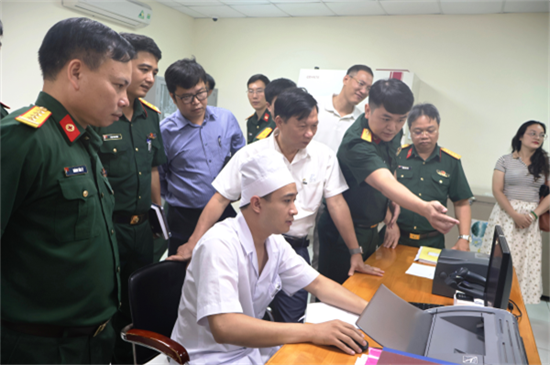 |
| Appraising electronic medical records |
Military Hospital 7A advocates joining major hospitals inside and outside the Military in organising scientific seminars, cooperating with the Centre for Young Scientists and Technologists/Ho Chi Minh City Youth Union, the Ho Chi Minh City Biotechnology Centre, the Centre for New Materials, the Department of Tissue Engineering/University of Science, Ho Chi Minh City International University, etc., to leverage external resources and promote training, scientific and technological research and technical innovation. In particular, it promotes professional cooperation with Cho Ray Hospital, the Hospital for Traumatology and Orthopaedics, the University Medical Centre, Ho Chi Minh City, and Hung Vuong Hospital, etc., to exchange expertise in treatment practices.
A hospital's reputation and prestige are built on not only modern equipment or professional expertise, but also service quality and patient experience. Therefore, making Military Hospital 7A "patient-friendly" is one of its ultimate goals. Accordingly, Military Hospital 7A's Party Committee and Directorate have intensified political and ideological education to build a contingent of healthcare personnel who are exemplary in political will and medical ethics. The study and following of President Ho Chi Minh's teachings and the emulation movement to build "5-Good Military Clinics", have been promoted so that all medical staff are fully aware of their honour and responsibility and devote themselves wholeheartedly to patient care.
Military Hospital 7A keeps promoting the proud traditions of "Military Physicians" with the spirit "all for the satisfaction of patients", enhancing its medical personnel's professional skills and, communication attitudes, and strictly upholding the 12 principles of medical ethics. Simultaneously, the role of the Social Work Team in resolving patients' difficulties is strengthened. Transparency in medical examination and treatment procedures is ensured together with regular inspection and supervision for the sake of patients. It focuses on strengthening the organisation of military medical teams to conduct examinations and treatments in localities, especially in remote areas and on islands, which not only deepens medical personnel's understanding of the hardships faced by soldiers and civilians, but also fosters their sense of gratitude and dedication to the noble mission of “treating diseases and saving lives”.
Military Hospital 7A emphasises maintaining the effective operation of suggestion boxes and hotlines to receive feedback from patients seeking medical examination and treatment. Regular meetings and briefings are strictly upheld to promptly review experiences, rectify shortcomings in attitude, responsibility, and service spirit, and strictly handle violations of medical ethics, thereby fostering patients’ and families’ trust and respect. It also ensures that 100% of its doctors and other medical staff uphold a high sense of responsibility, wholehearted compassion, and dedication to patient care and say "no" to bureaucracy, abuse of power, harassment, and any inconvenience to patients and their families, contributing to spreading the noble image of military physicians.
Military Hospital 7A is determined to achieve the goal of being "modern, specialised, patient-friendly", fulfilling its noble responsibilities and mission, contributing to the cause of protecting and caring for the health of soldiers and the people in the new situation.
Col. DO NGOC THANH, MA
Director of Military Hospital 7A