Building the Office of the Central Military Commission - the Office of the Ministry of National Defence on a par with its missions in the new era
Since its inception 80 years ago, under any circumstances, the Office of the Central Military Commission (CMC) - the Office of the Ministry of National Defence (MND) has always demonstrated unwavering political resolve, a profound sense of responsibility, and a high level of collective wisdom, successfully fulfilling all assigned tasks. Building on its glorious tradition, the Office continues to innovate its thinking, improve the quality of its advisory, synthesis, and support services, meeting the requirements of strategic leadership and direction in the new era.
On 25 March 1946, President Ho Chi Minh signed Decree 34/SL establishing the MND, including the Office of the MND. Since then, the 25th of March has been the Traditional Day of the Office of the CMC - the Office of the MND (hereinafter the Office).
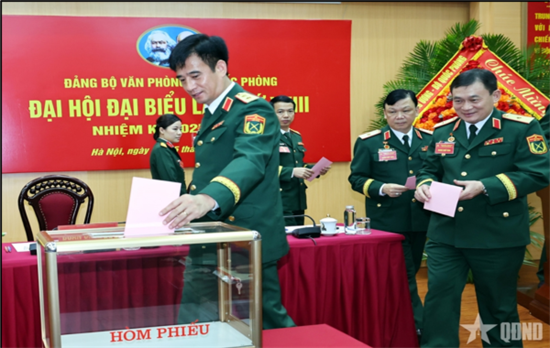 |
| The Office Party Congress for the 2025 - 2030 tenure (photo: qdnd.vn) |
In its early days, with a just over 20-strong workforce and inadequate, outdated equipment, the Office overcame difficulties, working and learning simultaneously, continuously improving its staff members’ professional competence. When the resistance war against French colonialism broke out, the Office closely followed the battlefield realities, grasped the situation, and provided timely advice and support to the General Military Commission and the MND in leading, commanding, and directing our Vietnam People’s Army (VPA) and people to intensify guerrilla warfare, combine various forms and methods of combat, and develop the three-category armed forces. In particular, during the Dien Bien Phu Campaign, a section of the Office, headed by the Chief of the Office, was directly deployed to the front line to serve the Campaign's Party Committee and Command, while its rear-based section fulfilled the mission of assisting the General Military Commission in strategic direction and routine work in the rear, contributing to the historic victory that “resounded across five continents and shook the globe”.
During the resistance war against the US, amid the rapid and fierce developments on the battlefield, the Office's staff members remained united, disciplined, creative, and resilient in the face of hardship and sacrifice. They closely collaborated with other agencies of the MND, assisting the CMC and MND in fulfilling their function of advising the Party and State on military and defence policies and tasks, drafting and issuing many important resolutions and decisions to provide unified leadership, direction, and command across battlefields and campaigns, especially decisive strategic battles. Together with the entire Party, people, and VPA, this effort contributed to the Great Victory of Spring 1975 - the complete liberation of the South and national reunification.
Throughout the two great wars of national resistance, the Office's staff members honed and demonstrated their qualities, independent thinking, sharp strategic insight, comprehensive planning, steadfast willpower, courage, and unwavering dedication.
Since the country entered the period of building and defending the socialist Fatherland, especially the renewal (Doi Moi) period, the Office has consistently taken the initiative to study and thoroughly grasp the Party's viewpoints and lines, as well as the Military's task requirements. It has promptly provided comprehensive advice, proposals, and support to the CMC and MND in leading and directing military and defence tasks at every stage. The Office’s specialised activities, together with those of the VPA-wide administrative sector, have rapidly evolved, enabling timely, effective support for leadership, command, and operational management.
In recent years, in response to the increasingly demanding requirements of its missions, the Office has actively reformed its working methods and professional conduct. Thanks to this, the quality of its research, comprehensive advisory work, and many other functions has continuously improved. Importance has been attached to administrative support for military and defence tasks, state management in the field of national defence, the direction of office work, and the oversight of administrative procedures within the MND. Work review, appraisal, and processing have been carried out rigorously, ensuring timely completion, quality, and adherence to principles and guidelines. The Office has directly appraised major projects, programs, and work plans related to military and defence affairs, building an "adept, compact, strong" VPA, strengthening defence and security capabilities in conjunction with socio-economic development in strategic directions, and resolving difficulties in the use of defence land. It has also maintained coordination to provide effective support for the meetings of the CMC and MND.
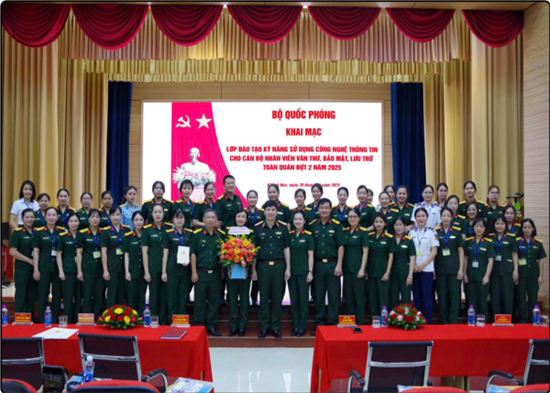 |
| A refresher course on information technology held by the Office (2025) |
In addition, the Office has coordinated with relevant agencies to provide effective advisory support for international integration and defence diplomacy activities, participation in international forums and conferences, delegation exchanges, border defence friendship exchanges, United Nations peacekeeping operations, and the settlement of post-war consequences, among others. Moreover, it has provided effective advice on legal and auditing matters, with a focus on building and perfecting the legal system on military and defence affairs, especially against the backdrop of the two-tier local government model and the reorganisation of local military agencies, disseminating laws, and perfecting the system of legal agencies and internal control systems, thereby contributing to raising public awareness of the law and enhancing the efficiency of state management in the field of national defence across the country.
The Office has also made significant efforts in advising, proposing, guiding, and implementing tasks related to administrative reform, digital transformation, and the Project on Population Data Applications, Electronic Identification and Authentication to Serve National Digital Transformation for the period of 2022 - 2025, with a vision towards 2030 (Project 06) within the MND. It has developed and effectively implemented programs, projects, and plans related to administrative reform, administrative procedure control, e-government, and digital transformation. Training and professional development in administrative reform, administrative procedure control, and ISO standard application have been strengthened. The management and operation of the electronic document system have been effectively deployed and maintained, including digital signatures. Also, document archiving processes have been improved; efforts have been made to collect, digitalise, preserve, and utilise documents, ensuring quality and timely support for military tasks. The MND's Electronic Web Portal has effectively performed its functions of information dissemination and communication, receiving and responding to feedback and suggestions sent to the MND via the Internet, providing information on administrative procedures and online public services of the MND.
The Office has advised the CMC and MND on the issuance of numerous documents on consolidating the organisational structure, functions, and responsibilities of offices at all levels within the VPA. It has taken the lead in reviewing and amending working regulations, maintaining and strictly implementing procedures for compiling, reporting, processing, and handling documents in accordance with the established protocols, procedures, and principles, issuing directive, management, and guidance documents on security and archiving practices, placing emphasis on training and professional development for staff members. At the same time, the Office has strengthened inspection, guidance, and supervision to improve the efficiency of office management activities across all levels of the VPA. It has ensured the timely, accurate dissemination of the directives and orders of the Minister of National Defence, particularly the conclusions of key conferences of the CMC and MND, to all relevant agencies and units.
Based on its functions and assigned tasks, the Office has always focused its activities on supporting the CMC, the MND, senior military leaders, and the entire military office system. Under the leadership and direction of the CMC and MND, regularly and directly through the General Staff's Party Committee, the Office has been deeply imbued with President Ho Chi Minh’s teachings: “Office work plays a special role in helping leaders to grasp the situation. If office staff members misunderstand the situation, leaders will handle matters incorrectly... Therefore, it is essential to enhance a sense of responsibility, improve work capacity, and maintain confidentiality". The Office's staff members have worked tirelessly, with wisdom, creativity, and a strong sense of responsibility and discipline, serving as a “bridge” maintaining working relationships between the CMC - the MND, and Party and State agencies and mass organisations at both central and local levels, as well as agencies and units under the MND. The Office has made unsung contributions to every decision and strategic orientation of the CMC and MND.
Against the backdrop of our country approaching the new era, the entire Military has been intensifying efforts to build a revolutionary, regular, elite, modern VPA. Accordingly, the Office has played an increasingly important part in dealing with more demanding tasks. To successfully fulfil its role as a comprehensive advisory body, effectively serving the CMC and MND, the Office has identified its key tasks as follows.
Firstly, firmly grasping the political and military lines of the Party and State, concretising and strictly implementing all directives and resolutions of the CMC and MND. The Office must focus on studying, elaborating, and effectively implementing resolutions, strategies, and projects on military and defence affairs and VPA building, especially the Resolution of the 14th National Party Congress, the Resolution of the 12th Military Party Congress, and the Resolution of the 8th Plenum of the 13th Party Central Committee on the Strategy for safeguarding the Fatherland in the new situation, as well as the action plans for the Resolutions of the Politburo and CMC on the organisation of the VPA for the period of 2021 - 2030 and beyond. Besides, the Office must proactively coordinate in conducting research, synthesising information, and appraising and drafting documents, directives, resolutions, and reports to support the leadership, direction, and management of the CMC and MND, ensuring punctuality, quality, and effectiveness.
The Office must closely coordinate with Party and State agencies and local authorities to assist the CMC and MND in leading and directing all aspects of work. It must actively supervise and inspect the implementation of programs and plans, review and revise working regulations and rules, and standardise procedures, processes, and principles in advisory work and document handling, thereby building a regular and modern military Office system.
Secondly, strengthening the comprehensive leadership capacity and combativeness of the Office's Party Committee. The Office must attach importance to closely linking the building of a pure, strong Party organisation with the building of an “exemplarily, typically” comprehensively strong unit, proactively preventing and combating manifestations of ideological, political, moral, and lifestyle degradation, "self-evolution", and "self-transformation". It is necessary to strictly implement the principles of Party organisation and meetings, with a focus on the principles of democratic centralism, criticism and self-criticism. Besides, the Office must thoroughly grasp and effectively implement the “two-steadfastness, two-acceleration, two-prevention, five-firmness” principle and the “three-good, three-building, three-combat” motto, thereby strengthening the Office's Party Committee in terms of politics, ideology, morality, organisation, and personnel. The Office needs to regularly renew its working styles and methods in a scientific, democratic, practical manner to foster collective wisdom and enhance a strong sense of responsibility among leading cadres. It is required to promote the Determined to Win Emulation Movement in tandem with the study and following of Ho Chi Minh's ideology, ethics, and lifestyle and the campaign "promoting tradition, devoting talent, deserving to be Uncle Ho's Soldiers in the new era".
Thirdly, regularly consolidating the organisational structure to build a contingent of cadres on a par with their task requirements in the new situation. To this end, emphasis must be placed on giving advice on organisational standardisation and developing regulations on personnel recruitment, appointment, promotion, and rotation to ensure consistency. It is important to resolutely implement breakthrough measures, particularly in personnel work and force building, in order to effectively select and train personnel at all levels with the spirit of "7 dares". The Office’s staff members must possess pure morality, professional, scientific, flexible working styles, strict adherence to principles, firm political resolve, absolute loyalty, great strategic advisory capacity, high professional competence, as well as the ability to consistently perform their roles effectively in every assigned position and to work efficiently in an international environment.
Fourthly, promoting research, development, and application of new achievements in science and technology and advancing innovation and digital transformation. The Office must continue to thoroughly grasp and strictly implement the resolutions and directives of the Party Central Committee, CMC, and MND on breakthroughs in science and technology development, innovation, digital transformation, administrative reform, and the implementation of Project 06. It must pioneer the comprehensive, synchronised implementation of programs and plans on administrative reform and digital transformation, the application of the national standard TCVN ISO 9001:2015, and the provision of online public services, data digitalisation, and results of administrative procedures within the MND. Also, it must accelerate the application of information technology, digital technology, digital data, and artificial intelligence, while developing staff members' digital competencies.
Fifthly, building a strong Office system. The Office must give priority to reviewing and improving the institutional framework regarding the functions and tasks of the Office system across the VPA, as well as refining work processes suited to the electronic environment. It must build and develop a pool of cadres at all levels with firm political will, a strong sense of responsibility, strict compliance with laws and discipline, and high professional competence, while strengthening training in state management, administrative reform, administrative procedure control associated with digital transformation, information technology skills, and document management and archiving. The Office must also uphold the exemplary and pioneering role and accountability of cadres and party members, especially leaders, and effectively carry out work related to internal political security. It must continue to manage and utilise finances, facilities, and office equipment strictly, efficiently, and comply with regulations on fire and explosion prevention, counter-espionage, and confidentiality protection. It must effectively enhance the role of mass organisations and military councils, while paying attention to building a healthy cultural environment and improving its staff members' material and spiritual life.
The Office's 80-year history has always been inseparably linked with the resounding victories of the VPA. Upholding its glorious tradition of "absolute loyalty, unity, dedication, creativity, thoroughness, steadfast adherence to principles" and priding itself on the noble title of "Hero of the People's Armed Forces", the Office will continue to stand united, strive relentlessly, and stay determined to overcome difficulties and challenges and accomplish all assigned tasks, thereby embodying the role of a comprehensive advisory body capable of effectively serving the CMC and MND in the new era.
Maj. Gen. NGUYEN VAN CHINH, PhD
Deputy Chief of the Office of the MND