Building strong political foundation is a fundamental principle and consistent lesson in the process of construction, combat, victory, and development of our Vietnam People’s Army (VPA). For Army Corps 12 - a strategic mobile main force, the requirement to build a political elite Corps is even more demanding, representing an urgent, fundamental, long-term, direct, and routine issue in the current period.
Deeply aware of the importance of building a strong and politically elite unit, and given the particularities of an Army Corps with new organisational structure, operational areas, and deployment posture, facing extremely demanding task requirements, Army Corps 12’s Party Committee and Command have exercised their all-round, synchronised leadership and direction with great political resolve and scientific approaches, ensuring that the Corps would always grasp and realise the principle of the Party’s absolute, direct leadership over the VPA in all respects, adhere to the goal of national independence and socialism, and maintain a pool of officers and soldiers with political steadfastness, pure ethics, and absolute loyalty to the Fatherland, Party, State, and people.
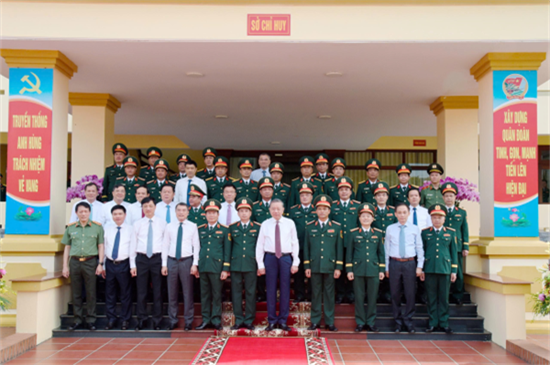 |
| Party General Secretary, State President, Secretary of the Central Military Commission To Lam visits the Corps |
Political and ideological education has been carried out in a regular, rigorous, continuously innovative manner, closely aligned with practical missions. Educational work has helped not only equip troops with knowledge of Marxism - Leninism, Ho Chi Minh Thought, and the Party’s defence and military lines and viewpoints, but also foster political thinking and “immunity” against negative social impacts, especially from cyberspace, among cadres and soldiers. The study and following of Ho Chi Minh’s ideology, morality, and lifestyle has been substantively promoted in tandem with cultivating the qualities of “Uncle Ho’s Soldiers” in the new era, thereby turning the noble values of revolutionary soldiers into an internal driving force within every officer and soldier.
Party and political work has been carried out proactively, flexibly, creatively and effectively, thus clearly demonstrating Party nature, class nature, and combativeness. Officers and soldiers have firmly grasped their tasks, possessing sound political awareness, a high sense of responsibility, aspirations for self-improvement, and a great desire to devote themselves; their political courage has been steadily tempered, while their faith in the Party’s leadership has been cemented. The Corps Party Organisation has been strengthened in terms of politics, ideology, morality, organisation, and personnel; the leadership capacity and combativeness of party organisations have considerably improved; the exemplary role of cadres and party members has been clearly promoted. Inspection and supervision work has been stepped up to contribute to maintaining Party discipline. Officers and soldiers have been capable of identifying, filtering, and refuting malicious information, thereby firmly safeguarding the Party’s ideological foundation. The cultural environment within the Corps has been preserved and developed in a healthy, humane direction; internal unity and military - civilian solidarity have been cemented; discipline has been strictly maintained as a solid basis for the Corps’ sustainable development. The political and spiritual strength of the Corps has been improved and reflected in a high degree of unity between awareness and action, between ideal and practical outcomes, and between absolute loyalty and brilliant task performance, as well as in troops’ readiness to undertake and accomplish all assigned tasks.
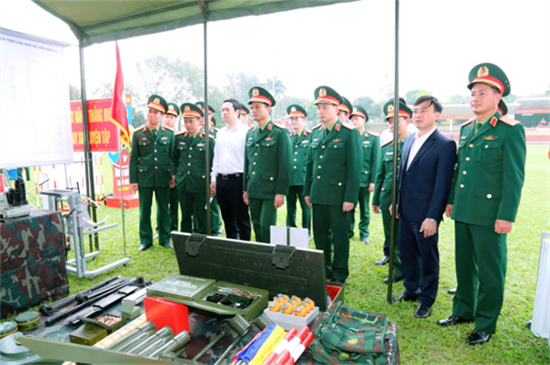 |
| The Corps Command inspects training models during the launch of a training season |
At present, the situation on global and regional scales continues to evolve rapidly, unpredictably, complicatedly; forms of war and conflict are undergoing major changes; hostile forces continue to intensify their sabotage efforts via various tactics, especially in cyberspace. The building of a revolutionary, regular, elite, modern VPA imposes urgent requirements of continuing to turn Army Corps 12 into a strong and politically elite force. To that end, it is necessary to well implement several main solutions as follows.
First, building a pure and typically strong Corps Party Organisation. This is the core issue and decisive factor in building a strong and politically elite Corps. Therefore, it is important to continue synchronously implementing tasks and solutions to build a pure and strong Party Organisation, with a focus on strictly maintaining the principles of party organisation and activities, working regulations and leadership regulations over key aspects of work to ensure that all activities are carried out in accordance with principles and discipline. Digital transformation and information technology should be applied in party member management and party operations. The effectiveness and efficiency of inspection, supervision, and Party discipline should be improved in line with the principle that “wherever there is leadership, there must be inspection and supervision”; “building” should be combined with “fighting”; preventive measures should be aligned with strict, timely handling of violations, while signs of oversimplification and irresponsibility should be completely removed.
Emphasis should be placed on improving the leadership capacity and combativeness of party committees and organisations at all levels, ensuring sound leadership over core issues, and promptly, effectively handling situations arising from practice. In particular, the principles of democratic centralism, self-criticism, and criticism must become regular and substantive; there should be mechanisms to foster collective knowledge, maintain unity, and opportunely identify and rectify shortcomings from within. The Corps should continue grasping and realising the “two-steadfastness, two-acceleration, two-prevention” principle and the “five-pillar” motto, raising the quality of party activities, especially “self-review” and “self-correction” to make party organisations and party members truly pure and steadfast both in thought and action.
Second, improving the quality and effectiveness of political and ideological education, focusing breakthroughs on new issues that directly affect troops’ awareness and political mettle. To that end, the Corps should continue renewing the content, forms, and methods of political and ideological education in a practical, concise, task-orientated manner, increasing dialogue and ideological orientation, and thoroughly overcoming formalistic and bureaucratic manifestations.
In addition to raising the quality of basic, regular political education, the Corps should focus on clarifying issues emerging from reality, such as rapid, complex global and regional changes, especially the impacts of armed conflicts and the situation in the Middle East to provide timely orientation for troops. Consideration should be given to identifying and combating malicious information, promptly preventing signs of declining determination, fear of hardship, “self-evolution”, and “self-transformation”.
Dissemination and education should be conducted to render officers and soldiers fully aware of the country’s outstanding achievements during the renewal process, the requirements of Fatherland construction and protection, as well as the missions of the VPA and the Corps in the new era. Troops should be educated on the spirit of “men first, guns later” and the motto “good training, strict discipline, high combat readiness”. Troops’ ideological situation should be tightly managed to maintain stability and unity across the Corps.
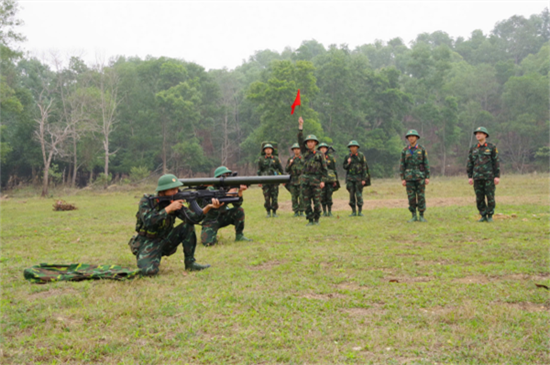 |
| A training session for troops of Regiment 141, Division 312 |
Third, building a contingent of “both red and expert” cadres as the core force in building a strong and politically elite Corps. It is essential to continue implementing regulations and procedures on personnel work in a democratic, rigorous, principled way, focusing on the current key goal of building a pool of cadres with political steadfastness, organisational capability, and the ability to transform the Party’s lines and resolutions into concrete results, thereby creating substantive changes in building a politically elite Corps.
Building the contingent of cadres at all levels is not only about ensuring their political and ideological steadfastness; it is also about fostering their scientific thinking, sharpness, long-term vision, and advisory, managerial, and commanding capability, as well as their ability to quickly adapt to changing situations and perform tasks under new conditions. Every cadre and party member, especially leaders, must truly become a centre of unity and a nucleus that gathers and spreads confidence; they must serve as exemplary models in discipline, responsibility, and resolve to surmount difficulties. Strong shifts should be made from “correct awareness” to “effective implementation” and from “great resolve” to “clear results”; direction and administration should be linked with inspection, supervision, and personal accountability. Cadres must clearly demonstrate the “seven dares” spirit, match words with action, and take practical effectiveness as the measure.
Fourth, developing a healthy, democratic, disciplined military cultural environment to create a sustainable foundation for enhancing political and spiritual strength. Inheriting and promoting the glorious traditions of its precursor units forged through revolutionary wars, training, and combat readiness, the Corps identifies this as an important internal source of strength for fostering the political mettle, determination, and faith of its officers and soldiers in the new era.
To that end, the Corps should continue renewing the work of traditional education in a practical, profound manner closely linked to current missions, strongly arousing revolutionary heroism and the pride and honour of officers and soldiers of an adept, compact, strong, modern Army Corps 12 - the VPA’s “iron fist” and a firm pillar for the people, thereby consolidating its troops’ resolve and readiness to undertake and successfully fulfil all assigned tasks. Emphasis should be placed on building a democratic, united, disciplined cultural environment to create high unity and consensus.
Furthermore, due regard should be paid to improving troops’ material and spiritual life, well implementing policies for military families, cementing a close-knit bond between units and troop families, strengthening military - civilian solidarity, creating a solid spiritual foundation for officers and soldiers to devote themselves to their duties and remain attached to their units, directly contributing to building a politically strong Corps with high determination to meet its mission requirements in the new situation.
Fifth, closely linking the building of a strong and politically elite Corps with improving the quality of training and combat readiness. Practical mission performance, especially training and combat readiness, is precisely the objective environment where political mettle is tested, tempered, and sustainably developed.
Therefore, alongside raising the quality of training under the motto of “basics, practicality, solidity”, in accordance with its operational areas and plans, the Corps should continue conducting training work under difficult, complex, and high-intensity conditions in tandem with discipline management and regularity building. Doing so will help not only improve troops’ combat readiness capacity, but also foster the willpower, courage against difficulties, sense of discipline, and close coordination among officers and soldiers. Political education should be integrated with combat training so that every training content embodies political requirements, and every training subject is an opportunity to consolidate troops’ resolve, faith, and responsibility. Doing so will make officers and soldiers not only professionally competent and proficient in techniques and tactics, but also politically and ideologically steadfast and ready to undertake and successfully accomplish all missions under all conditions and circumstances.
Building Army Corps 12 into a politically elite force is an objective, urgent, long-term requirement aimed at ensuring that the Corps will keep maintaining unity and determination, remaining ready to undertake and excellently fulfil all assigned tasks, contributing to building a revolutionary, regular, elite, modern VPA capable of firmly safeguarding the Fatherland early and from afar in the new situation.
Maj. Gen. TRAN DAI THANG
Political Commissar of Army Corps 12