Building an elite, modern Vietnam People’s Navy capable of meeting its task requirements in the new situation
Thoroughly grasping the Party’s military and defence lines, the Naval Service continues to promote the building of an “elite, modern” Vietnam People’s Navy (VPN) and improve its overall quality and combat strength to deserve to be the core force in firmly protecting national sovereignty over seas and islands.
Under the leadership and direction of the Central Military Commission (CMC) and the Ministry of National Defence (MND), in recent years, the Naval Service has upheld proactiveness and creativity, actively conducting research, proactively giving advice, closely maintaining coordination with other forces, and comprehensively, synchronously adopting solutions to build the VPN straight to modernity, thereby achieving many important results, worthy of the trust, regard, and investment of the Party, State, and people. Its overall quality and combat readiness capacity have been raised to meet the requirements of modern warfare and firmly protect national sovereignty over seas and islands.
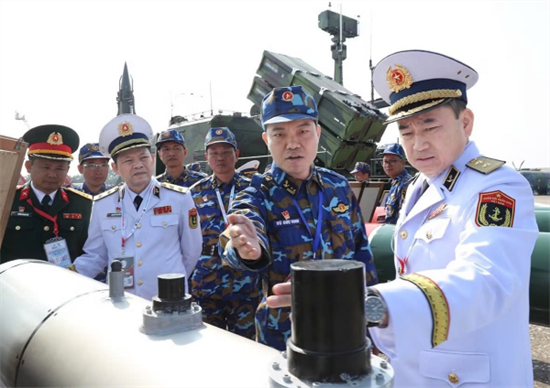 |
| Leaders of the Naval Service visit the exhibition area of Brigade 679 and Naval Region 2 at Vietnam International Defence Expo 2024 |
At present, the situation on global and regional scales continues to develop in a complex manner; strategic competition among major powers and disputes over sea and island sovereignty are becoming increasingly intense, posing many potential risks of instability. More demanding requirements are being imposed on the task of Fatherland protection in general, the protection of national sovereignty over seas and islands in particular. Notably, the entire armed forces are focusing on realising the policy of building a revolutionary, regular, elite, modern Vietnam People’s Army (VPA) under the 14th National Party Congress Resolution, with many strategic-level tasks. With its results and experience in the process of building itself towards modernity, the Service sets an urgent requirement of continuously promoting the building of a revolutionary, regular, elite, modern VPN, contributing to realising the goal of building a modern VPA. To achieve that goal, the Service will focus on well implementing several key solutions as follows.
First, building a politically strong VPN. This is the most important solution and the foundational factor enabling the VPN to readily undertake and successfully fulfil all assigned missions. Accordingly, the Service’s Party Committee and Command will direct agencies and units to seriously grasp, disseminate, and realise the Party’s lines and the State’s policies and laws on military and defence work, with a focus on new thinking regarding national defence and Fatherland protection set out in the Resolution of the 14th National Party Congress, the Resolution of the 12th Military Party Congress, and the Resolution of the 13th Party Central Committee’s 8th Plenum on the Strategy for Fatherland Protection in the New Situation. At the same time, agencies and units across the Service will be directed to seriously implement the directives of General Secretary, State President, Secretary of the CMC To Lam on the “two-steadfastness, two-promotion, two-prevention” principle and the “five-pillar” motto as well as improve the quality of political education and ideological leadership. Attention will be paid to building political steadfastness, a high sense of duty, and a deep understanding of missions, partners, adversaries, and hostile forces’ plots and tactics among all troops. Doing so will help foster a strong spirit of unity, confidence, self-reliance, self-strengthening, and national pride to overcome all difficulties and challenges and strive to fight and sacrifice for firmly protecting national sovereignty over seas and islands.
All-level party committees and party organisations will be regularly built to be strong in politics, ideology, ethics, organisation, and personnel, with comprehensive leadership capacity and high combat strength so that they will always serve as the nucleus of leadership and maintain correct orientation and combat objectives in all circumstances. The Service will continue to implement Resolution 05-NQ/TW (14th tenure), dated 7 April 2026, on renewing and improving inspection, supervision, and Party discipline work, the Politburo’s Conclusion 01-KL/TW, dated 18 May 2021, on continuing to implement Directive No.5 on studying and following Ho Chi Minh’s ideology, morality, and lifestyle, and the Campaign entitled “Promoting tradition, devoting talent, deserving to be Uncle Ho’s Soldiers - Naval Soldiers” in the new era. This contributes to building clean, strong, exemplary party organisations, “exemplarily, typically” comprehensively strong units, and excellently strong mass organisations. The exemplary role of cadres and party members, especially key leaders at all levels, will be promoted; good practices, innovative models, and typical examples will be multiplied to create a practical revolutionary action movement aimed at successfully accomplishing all tasks.
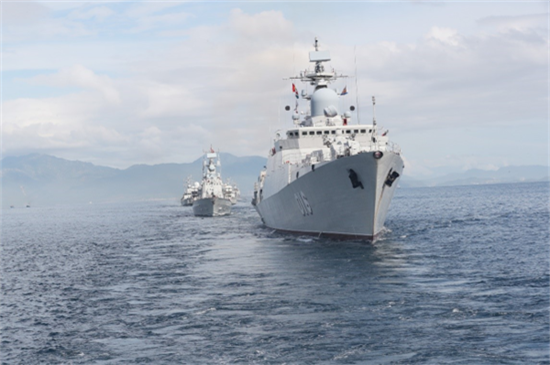 |
| Brigade 162, Naval Region 4 during a patrol at sea |
Second, continuing to review and establish an “adept, compact, strong, modern” organisational structure. This is both a task and a decisive solution in the policy of building a revolution, regular, elite, modern VPN. To that end, the Service’s Party Committee and Command will exercise their leadership and direction over organisational structure consolidation and the development of surface ship, submarine, naval air, coastal artillery - missile, naval infantry, and naval special forces, in accordance with the pre-set orientation and road map. Priority will be given to combat units and forces operating in main directions and key areas, capable of multi-directional defence from afar to near. Research will be conducted to adjust personnel towards reducing intermediate sections and manpower in support forces. A pool of high-quality, comprehensively developed naval cadres will be built, with proper quantity and structure, while a corps of commanding and managerial cadres at all levels, especially at operational level, will be developed on a par with their requirements.
Consideration will be given to attracting, recruiting, and utilising talents, and training high-quality human resources. First and foremost, the Naval Academy and the Naval Technical College shall further renew and improve education and training, while expanding domestic and international cooperation and promoting the training of cadres at all levels, especially at battalion level and below, to make them proficient in naval warfare art, deeply understand technology, possess teamwork skills, physical endurance, and a good command of foreign languages, and meet the requirements of international integration. Technical personnel will be trained to master and operate weapons and technical systems, especially modern ones in a professional manner.
Third, raising the quality of training, exercises, and combat readiness. Well implementing this fundamental solution will contribute to improving the VPN’s overall quality and combat strength. Therefore, agencies and units across the Service will continue to realise Resolution 1659-NQ/QUTW, dated 20 December 2022, by the CMC and Resolution 1378-NQ/ĐU, dated 30 March 2023, by the Service Party Committee on “raising the quality of training in the period of 2023 - 2030 and beyond”. Emphasis will be placed on improving training quality for all target groups under the motto of “basics, practicality, solidity” and organising synchronous, specialised training towards modernity. Training content and methods will be actively renewed, with the protection of national sovereignty over seas and islands and the building of a “revolutionary, regular, elite, modern” VPN as the objective. The quality of exercises, especially field drills and exercises under a short period of preparation or surprise situations, will be improved. All-level cadres will be trained in resilience, commanding methods and styles, and joint combat capability. Besides, troops will be trained in combat techniques, tactics, independent combat, and endurance in prolonged operations under complex maritime weather conditions.
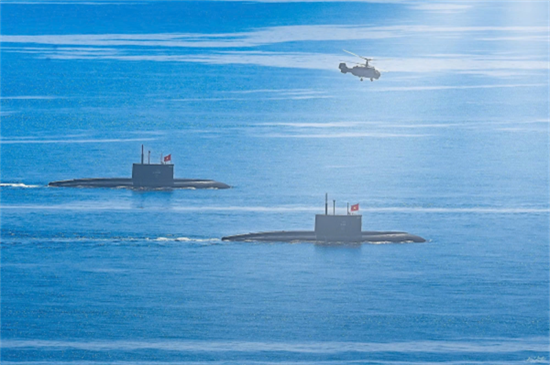 |
| Joint training and patrol between submarines and helicopters at sea |
In addition, close coordination with other forces will be maintained to regularly research, monitor, forecast, and correctly assess situational developments, and proactively give advice to higher echelons on promptly handling situations to avoid passivity or surprise. Combat readiness regimes form Service Command to unit levels will be strictly maintained. Legal documents will be reviewed, supplemented, and completed to create a legal framework and mechanisms for coordination with other forces, especially the Air Defence - Air Force Service, the Coast Guard, and the Border Guard Force.
Close coordination with localities will be strengthened to build strong reserve and maritime militia and self-defence forces and develop projects for engaging relevant forces and means in safeguarding national sovereignty over seas and islands, thereby providing support for fishermen to reach out to the sea, contributing to building firm “people’s hearts and minds” and all-people national defence postures at sea.
Fourth, emphasising research and development of military science and art and modernisation of weapons and technical equipment. Being imbued with Uncle Ho’s teachings: “Our Navy must learn from modern combat experience but must not forget our ancestors’ tradition of fighting foreign invaders”, the Service will continue to research and apply lessons from the country’s maritime warfare tradition and the VPN’s campaigns, battles, and combat activities during the national liberation wars and valuable practical experience in safeguarding maritime sovereignty to supplement and develop naval military art theory appropriate to its current missions, organisational structure, and available weapons and equipment.
The Service will continue advising the Party, State, CMC, and MND to promote investment and procurement of modern weapons and technical equipment suitable to combat methods and the country’s economic, scientific, and technological capacity, ensuring flexibility and high adaptability in maritime sovereignty defence operations. Moreover, international cooperation in scientific research, technology transfer, professional training, and experience sharing will be encouraged to step by step master science and technology as well as the research, design, and manufacturing of modern naval weapons and equipment, especially strategic weapon systems as the basis for the VPN to meet its task requirements in the new situation.
Vice Admiral TRAN THANH NGHIEM
Member of the Party Central Committee
Member of the CMC
Commander of the Naval Service