Building a contingent of cadres in the new era - from thinking development to implementation process
The 14th National Party Congress continues to affirm that developing a corps of cadres with sufficient qualities, capabilities, and prestige on a par with their task requirements is a central focus of Party building work and the “key of keys”; the Congress stresses that this is a breakthrough, decisive stage aimed at improving the Party’s leadership capacity and combativeness in the new period. That represents a new development in both thinking and implementation.
In the process of leadership over the Vietnamese revolution, especially during 40 years of national renovation (Đổi Mới), the Party’s awareness of the position and role of cadre work and its guiding viewpoints on building a pool of cadres have undergone significant innovations and developments.
The 14th National Party Congress takes place when our country is entering a pivotal stage of development; the goal of becoming a developed, high-income country by the mid-21st century is no longer a distant aspiration but a strategic task that must be concretised via resolute, synchronous, effective strategic decisions. In this overall framework, the building of a contingent of cadres is given special attention, with increasingly high requirements. The 14th National Party Congress confirms: “Cadres are the decisive factor in the success or failure of the revolution; cadre work is the ‘key’ stage of Party and political system building. Developing a corps of cadres, especially at strategic level, is a top priority task and a matter of vital importance of the Party; this task must be carried out regularly, carefully, scientifically, strictly, effectively”.
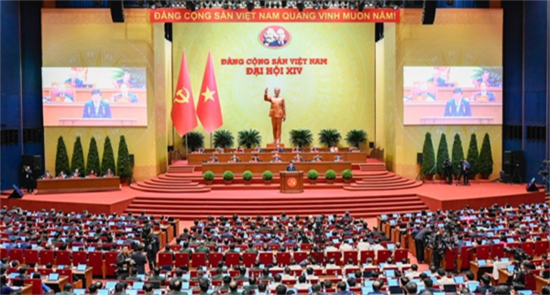 |
| The 14th National Party Congress continues to identify cadre work as the key stage of Party and political system building (photo: baochinhphu.vn) |
If Resolution 26-NQ/TW, dated 19 May 2018, by the 12th Party Central Committee’s 7th Plenum on building a contingent of cadres at all levels, especially at strategic level, with sufficient qualities, capabilities, and prestige on a par with their tasks, laid an important foundation for renewing cadre work in the period of accelerated industrialisation, modernisation, and international integration, then the 14th National Party Congress documents continue to inherit and develop the above Resolution and also set new requirements for cadre work amid a transformation in the country’s development model and comprehensive digital transformation, the emergence of the knowledge economy, and increasingly intense strategic competition. This is a development in theoretical awareness closely linked to the summarisation of 40 years of Đổi Mới and especially the five-year implementation of the Resolution of the 13th National Party Congress.
The 14th National Party Congress places cadre work within the overall framework of building a ruling Party under the conditions of a socialist-orientated market economy and extensive and intensive international integration. Cadre work is aimed at not only ensuring the smooth operation of the political system’s apparatus, but also developing a leadership and management team with strategic thinking and great capabilities in formulating and realising policies amid rapid, complex, unpredictable changes. From the foundational requirements that cadres must have “sufficient qualities, capabilities, and prestige”, the 14th National Party Congress attaches greater importance to cadres’ capabilities and skills in modern national governance, leadership over digital transformation and innovation, risk management, and crisis response, as well as their capacity to promote dialogue and achieve social consensus. This is a qualitative development in our Party’s conception of building a contingent of cadres.
The 14th National Party Congress continues to concretise the Party’s standpoint on power control in cadre work based on the review of the implementation of regulations issued by the Party Central Committee, the Politburo, and the Secretariat in recent years, particularly Regulation 205-QĐ/TW, dated 23 September 2019, by the 12th Politburo on controlling power in cadre work and combating bribery for positions and power, Regulation 37-QĐ/TW, dated 25 October 2021, by the 13th Party Central Committee on things that Party members must not do, Regulation 114-QĐ/TW, dated 11 July 2023, by the 13th Politburo on controlling power and preventing corruption and negative practices in cadre work, and the 13th Politburo’s Conclusion 14-KL/TW, dated 22 September 2021, on encouraging and protecting dynamic, innovative cadres for the common good. Based on those documents, the 14th National Party Congress underlines the requirements to closely link authority with responsibility and uphold individual accountability, especially among leaders, in cadre evaluation, planning, training, and appointment, while demanding to resolutely deal with acts of abusing power to interfere with or manipulate cadre work. The 14th National Party Congress advocates “enhancing substantive, effective control of power in cadre work… strictly handling violations of the Party’s regulations and principles in cadre work committed by party committee members and leaders, taking decisive, effective action against bribery for positions and power, attaching importance to political, ideological, ethical education, raising a sense of responsibility, self-respect, and honour among cadres”. These are not only discipline-related requirements, but also serve as a prerequisite for building political trust and system integrity.
In the field of cadre training and development, the 14th National Party Congress clearly demonstrates a shift from training heavily focused on formal qualifications and certificates to developing practical competence and leadership qualities. Training work is no longer merely for completing administrative files, but must equip cadres with strategic thinking, policy-making skills based on scientific foundations, leadership over transformations, and management skills in digital environments. Hence, the continued implementation of Regulation 164-QĐ/TW, dated 1 February 2013, by the 11th Politburo on knowledge update for leaders and managers at all levels must be placed in a new vision: training content must be practical, linked to job requirements, and updated with new knowledge on science, technology, digital economy, public governance, non-traditional security challenges, and international integration. This aligns with the requirements to build a socialist rule-of-law State and a professional, modern, people-serving public administration.
A notable new point, clearly reflecting the Party’s systemic thinking, is the requirement to synchronise all stages of cadre work: from assessment, planning, training, and rotation to appointment, use, inspection, and supervision. The 14th National Party Congress advocates linking training with planning; cadres included in personnel planning must have a training and professional development road map appropriate to their intended positions. To deal with scattered and unfocused training and facilitate proper deployment of cadres, our Party determines to “strengthen training and retraining courses so as to improve professional competence and skills among commune-level cadres and civil servants, especially young cadres, part-time cadres, and those in charge of information technology and digital transformation”. In addition, the requirement to promote job rotation among cadres for hands-on experience, especially at grass-roots level, in difficult areas and complex fields, is highlighted as a dynamic, effective method of training, with a view to shaping resilience, situational handling capacity, and policy implementation skills among cadres themselves.
Regarding cadre appointment and use, the 14th National Party Congress continues to require the specific improvement of job title standards linked to job positions and task requirements in the new context; in this regard, it is necessary to not only rely on seniority or career progression of a cadre, but place emphasis on their task performance, specific products, and level of trust among others, party members, and citizens. The 14th National Party Congress affirms an urgent need to synchronously, effectively implement an institutional framework on cadre work, particularly strictly realise newly issued regulations on cadre assessment, training, and use, ensure democracy, transparency, fairness, and objectivity in a continuous, multi-dimensional process with clear criteria, linked to outputs, job positions, and title standards, and value prestige within the Party and society. Our Party also sets out the policy to “opportunely replace cadres who show limited capacity, lack responsibility, have low prestige, or commit violations, as well as cadres in agencies, units, or localities with poor task performance, without waiting until the end of the term or appointment period”. Under this policy, recently, expanding the pilot competitive recruitment for certain leadership and management positions, attracting and utilising talents, including those from non-state sectors, have reflected an open, flexible mindset in using high-quality human resources in line with the requirements of national development in the new era.
In particular, from the implementation of Conclusion 14-KL/TW, dated 22 September 2021, by the Politburo, the 14th National Party Congress emphasises the need to improve mechanisms for protecting cadres who dare to think, dare to act, and dare to take responsibility for the common good. In response to the need for a strong reform, if there is no clear distinction between errors made in task performance and violations driven by self-interest, cadres will fall into hesitation and fear of making mistakes, which will lead to a decline in innovation. Hence, building a clear, transparent legal framework to encourage and protect dynamic, creative cadres is a necessary condition for fostering their innovation and dedication to the common good.
The 14th National Party Congress calls for stronger application of digital technology in cadre management, evaluation, and monitoring, and the development of a unified, interconnected cadre database that is regularly updated, accurate, and favourable for planning, training, and appointment. This is an important step towards professionalisation and transparency in cadre work, in tandem with the building of a digital government and digital society.
Overall, the new points in the 14th National Party Congress documents on building a contingent of cadres demonstrate a comprehensive development in both theory and practice: from awareness of the role of cadres in the new development era to the requirements of standardising, professionalising, and modernising cadre work, from controlling power and preventing negative practices to encouraging and protecting dynamic, innovative cadres, from training based on qualifications to developing cadres’ capabilities in task execution and governance. This reflects the Party’s strong political determination to build a corps of cadres at all levels, especially at strategic and grass-roots levels, who are truly “both red and expert”, exemplary in political steadfastness, with pure morality, prestige, modern governance capacity, and a spirit of dedication to the Fatherland and the people.
In the coming development journey, as our country both has opportunities and faces challenges, cadre work will play an even more decisive role. Therefore, grasping and seriously, synchronously, creatively implementing the viewpoints, tasks, and solutions set out by the 14th National Party Congress will greatly contribute to building a contingent of cadres on a par with their tasks, ensuring the Party’s sound and effective leadership, and laying a solid foundation for realising the “two centenary strategic goals”, enabling the country to move confidently into a new era of development.
Maj. Gen. VU PHU DUNG, PhD
Central Commission for Information, Education, and Mass Mobilisation