Air Defence–Air Force Technical Institute actively pursues research and development of strategic products
In recent years, in pursuit of the goal of building the Air Defence - Air Force Service directly towards modernisation, the Air Defence - Air Force Technical Institute has consistently adhered closely to its functions and tasks, proactively providing advice and effectively implementing scientific research activities. These efforts have promptly addressed issues within the fields of air defence and air force engineering, thereby effectively supporting training missions, combat readiness, and airspace management of the Service.
In particular, amid the rapid advances in science and technology, especially in the military sphere, which have given rise to new and modern methods and means of aerial attack, posing major challenges to air defence operations, the Institute’s Party Committee and leadership have thoroughly grasped Resolution No. 1953-NQ/ĐU, dated 28 February 2025, of the Party Committee of the Air Defence - Air Force Service on breakthroughs in the development of science and technology, innovation, and digital transformation within the Service. On that basis, they have proactively conducted research, put forward proposals, and, upon approval by the Ministry of National Defence and the Service, implemented tasks to develop strategic products aimed at enhancing air-defence combat capabilities under new conditions. This is a demanding and complex mission; its successful fulfilment requires the convergence of multiple factors, ranging from strong political resolve and a spirit of innovation, creativity, and commitment, daring to think, daring to act, and daring to take responsibility, to guaranteed resources, particularly high-quality human resources; modern research infrastructure and equipment; as well as support, cooperation, and technology transfer from domestic and international partners, and so forth.
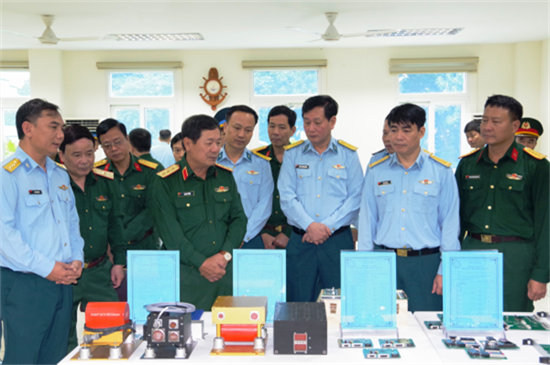 |
| Sr. Lt. Gen. Le Huy Vinh, Deputy Minister of National Defence checks sample products developed by the Institute |
To realise this objective, the Institute has first and foremost focused its leadership and direction on formulating and refining programmes and plans for the research and development of strategic products. Immediately upon being assigned the task, the Institute conducted a comprehensive review and assessment of the technological foundations it has already mastered, while proactively undertaking in-depth studies of the technical and tactical characteristics of various types of unmanned aerial vehicles (UAVs) that have been used in recent military conflicts around the world. This has provided the basis for designing strategic product configurations aligned with operational requirements and the practical conditions of our armed forces, which were then submitted to the competent authorities for appraisal and approval.
On that basis, the Institute has concentrated on developing implementation programmes and plans with clear roadmaps and specific steps for each stage, ensuring both continuity and development. Particular attention has been paid to harmonising product quantity, quality, and cost, while orienting upgrades and additional features and technical specifications for equipment already in production to ensure synchronisation with the defined strategic product configuration. At the same time, the Institute has researched and proposed investment plans to develop laboratories and modern research equipment; established and consolidated core task groups; and selected capable partners for coordinated research and implementation. Through these practical and effective measures, the Institute has to date completed detailed programmes and plans for the research and development of strategic products, including an “anti-UAV UAV system”. This provides an important foundation for the Institute to lead, direct, and manage implementation; monitor progress; and promptly assist units in resolving difficulties during execution, thereby creating solid conditions to accelerate progress and improve the quality of strategic product research and development.
Alongside these efforts, the Institute has proactively conducted research, provided recommendations, and directly implemented investment plans to strengthen its scientific and technological capacity, with particular emphasis on infrastructure systems, laboratories, and research equipment to meet the requirements for developing strategic products. Practice shows that research and development of strategic products, especially the “anti-UAV UAV system”, a highly integrated complex comprising radar, UAVs, and a central control system, among other components, demands modern laboratory facilities and high-precision measurement and calibration equipment capable of supporting testing, adjustment, and optimisation of technical parameters. This constitutes a critical prerequisite for shortening research cycles, reducing costs from design and manufacture to testing, and bringing products into practical use at an early stage.
To implement this task effectively, the Institute has established a Project Management Board for laboratory construction and investment to lead, direct, manage, and advise on investment and equipment procurement. During implementation, due attention has been paid to promoting the role and responsibility of departmental officers and experienced researchers in consolidating requirements and proposing upgrades to equipment items. On that basis, procurement lists have been developed and orders placed with reputable domestic and international manufacturers, ensuring synchronisation, modernity, and compatibility with technical requirements as well as available investment resources. At the same time, the Institute has promoted movements in scientific research, initiatives, and technical improvements, focusing on the design and manufacture of equipment serving research and testing directly, thereby conserving resources, while proactively addressing new and complex issues arising during task execution. To date, the Institute has basically completed investment items and upgrades to infrastructure and laboratory systems, including the installation of “semi-natural” simulation equipment along with numerous modern and synchronised measuring and calibration devices, which initially meet the requirements for research and development of strategic products in the coming period.
Alongside in-depth investment in the modernisation of infrastructure and research equipment, the Institute places particular emphasis on developing high-quality human resources, identifying this as the decisive and core factor determining the success not only of strategic product research and development tasks but also of the Institute’s future growth. Accordingly, the Institute has set the objective of building a contingent of cadres with firm political steadfastness, a rational structure, synchronised specialisations, standardised professional qualifications, and sufficient competence and intellect to independently conduct research and undertake scientific and technological projects in air defence and air force engineering. In recent years, the Institute has continuously consolidated, built, and developed its organisational structure and research forces in an elite, compact, and specialised direction, giving priority to fostering young scientific personnel, leading experts, and cadres in key and spearhead fields. At present, the Institute’s research staff have a rational and synchronised structure, with 95 per cent holding master’s degrees or higher, including nearly 20 per cent with doctorates. Many have received systematic training, possess practical experience, and have directly participated in research, design, production, and improvement of technical equipment for the Service and the Ministry of National Defence. With this core force, the Institute has gradually mastered the design, manufacture, and integration of numerous modern technical systems, notably medium-range surveillance radars, identification friend-or-foe systems, various UAV lines, and many other items of technical equipment and materials.
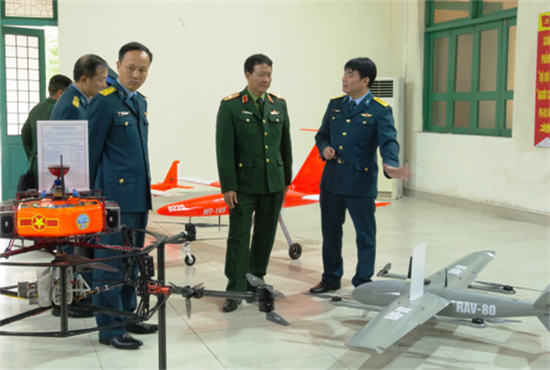 |
| Assessing the capacity to produce UAVs at the Institute |
To enhance implementation effectiveness, the Institute has focused its leadership and direction on assigning tasks aligned with the strengths of specialised research departments, with key roles played by the UAV Research Department, the Low-Altitude Air Defence Weapons Research Department, and the Radar Research Department, in order to research, integrate, upgrade, and add technical features to develop strategic products in accordance with the defined configurations. Priority has been given to accelerating the application of new and advanced technologies, particularly artificial intelligence (AI) and modern signal-processing algorithms, in control, detection, identification, and target assessment. These measures aim to extend detection ranges, improve target recognition and classification for radar systems, and enhance interception effectiveness, flexibility, accuracy, and coordinated operational capability of UAVs. At the same time, the Institute has selected and established one interdisciplinary research group and two specialised strong research teams focusing on AI technology and software development; it has also built close coordination mechanisms among departments and specialised research groups, creating synergistic strength, improving research quality, shortening development timelines, and progressively mastering core technologies to meet the requirements for research and development of strategic products under new conditions.
Research and development of strategic products is a new and complex task, requiring the integration of numerous advanced technologies. Therefore, alongside harnessing internal strengths, the Institute has stepped up scientific research cooperation and technology transfer, proactively drawing on and inheriting research achievements at home and abroad, and leveraging the technological capabilities, equipment, and experience of partners to generate combined strength in task implementation. Accordingly, in addition to receiving and transferring technologies from foreign partners through cooperation programmes of the State and the Ministry of National Defence, the Institute has focused on holding specialised scientific workshops to promote academic exchange, update new technological trends, and share experience in strategic product research and development. At the same time, it has actively expanded linkages and cooperation with research centres and defence factories possessing strengths in related fields, in order to share knowledge and make effective use of laboratory systems, simulation facilities, and modern research equipment directly serving mission requirements.
In recent years, the Institute has worked with the Military Industry–Telecommunications Group to study solutions for design and enhancement of reconnaissance radar capabilities; coordinated with the General Department of Defence Industry to implement tasks related to the design of combat vehicles, UAV launch and loading vehicles, fuses, and other technical support components; and collaborated with the Military Technical Academy to develop AI applications, automated command-and-control systems, and information processing and analysis solutions, and so forth. Through these efforts, the Institute has gradually accessed and mastered core technologies, while accumulating experience in organising research under an interdisciplinary model that links research, testing, and production. To date, it has mastered fundamental research contents and several key technologies, thereby creating a solid foundation for implementing the next phase of strategic product research and development on larger scale, higher levels of integration, and more demanding technical requirements.
Building on these achievements, in the coming period, the Air Defence - Air Force Technical Institute will continue to review, supplement, and refine its research programmes and plans for the next phase in close alignment with the Service’s technical support and equipment assurance requirements. At the same time, it will actively conduct research and advise higher authorities on guidelines and solutions to address difficulties and obstacles relating to mechanisms and policies, particularly specific regulations governing strategic product research and development and international cooperation, so as to create favourable conditions for implementing collaborative research programmes, technology transfer, information exchange, equipment procurement, and the effective utilisation of scientific and technological advances at home and abroad.
With strong determination and sound scientific solutions, the Institute strives to accelerate progress and improve the quality of strategic product research and development, affirming its position as a leading research centre of the Service and the Ministry of National Defence in the field of air defence and air force engineering, thereby contributing to building a revolutionary, regular, elite, and modern Service and military, and firmly safeguarding the Fatherland in the new era of development.
Senior Colonel, PhD. TRAN NGOC HA, Director of the Institute