Vietnam Military History Museum preserves and brings into play the value of military cultural heritage
Over the past 70 years of its establishment and development, the Vietnam Military History Museum has made tireless efforts and important contributions to preserving and promoting the value of Vietnam’s military cultural heritage, affirming its role as the leading institution within the military museum system - a multifunctional, comprehensive cultural institution of particular significance to both the Vietnam People’s Army (VPA) and the nation.
Following the Dien Bien Phu victory in 1954, the General Military Commission directed units throughout the VPA to collect documents and materials relating to feats of arms in preparation for establishing unit museums and a Military Museum to educate people on the nation’s tradition of fighting foreign invaders and defending the country, and enhance party and political work within the Military.
 |
|
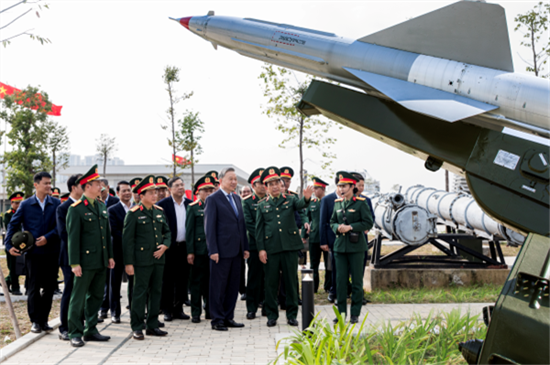
Party General Secretary To Lam during his visit to the Vietnam Military History Museum in December 2024
|
On 17 July 1956, the General Department of Politics issued Decision 14/QĐ on establishing the Board for Military Museum Construction1. After 3 years of construction, on 12 December 1959, the Museum had the honour of welcoming President Ho Chi Minh, together with leaders of the Party, State, and VPA, to inspect its exhibition content and approve its official opening. On this important occasion, President Ho Chi Minh instructed: “The Military Museum is a living history book, playing a crucial role in educating the Vietnamese people, especially the younger generation, on our nation’s fine tradition. The Military Museum also helps foreign visitors gain a clearer understanding of Vietnam and our people’s just struggle. Therefore, the Museum must create the best possible conditions for visitors to come and learn”. His teachings have always been remembered by the Museum’s officers, employees, and soldiers, serving as the guiding principle, purpose, and compass for all of the Museum’s operations.
During the resistance war against the US for national salvation, the Museum dispatched numerous groups of officers to battlefields in Military Region 5, Southern Vietnam, Route 9 - Southern Laos, and other areas to collect thousands of valuable artefacts. Despite extremely difficult, harsh, and dangerous conditions, these collections were scientifically preserved and remained intact. Public communication and educational activities were strengthened via touring exhibitions and the publication of photographic collections on various themes to serve combat units and support overseas publicity efforts. Between 1965 and 1975, the Museum welcomed nearly two million visitors, including hundreds of visitors from over 80 countries, practically contributing to spreading the nation’s military tradition and the justice of the resistance war against the US for national salvation.
After national reunification, while maintaining its operations in North Vietnam, the Museum established facilities in the South and actively collected artefacts both domestically and in the neighbouring countries of Laos and Cambodia. It promptly supplemented its collections with artefacts relating to the struggles to defend the South-western and Northern borders, as well as Vietnam’s international mission in Cambodia. After more than 6 decades of operation at the foot of the Hanoi Flag Tower historical site, the Vietnam Military History Museum truly became an attractive destination for both domestic and international visitors.
Notably, thanks to the due regard of the Party, the State, the Central Military Commission (CMC), and the Ministry of National Defence (MND), the new Museum complex - a large-scale, advanced, modern facility - officially came into operation in November 2024. It is one of the landmark projects celebrating the VPA’s 80th founding anniversary. Housing more than 150,000 artefacts of various types and materials, including numerous national treasures and other highly valuable exhibits, the Museum has become a multifunctional and comprehensive cultural institution of particular importance to both the VPA and the nation, comprehensively, profoundly, systematically, diversely, harmoniously, attractively presenting the military history of the Vietnamese nation throughout different historical periods, serving as a “red address” for revolutionary tradition education and a source of pride for the Military, meeting the cultural and spiritual needs of officers, soldiers, and citizens nationwide as well as international visitors to Vietnam. In recognition of its achievements over the past 70 years, it has been honoured by the State with numerous noble awards.
 |
|
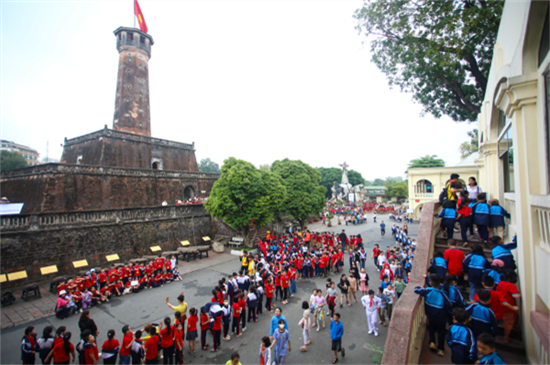
Visitors to the Vietnam Military History Museum at the foot of the Hanoi Flag Tower
|
In order to successfully fulfil its functions and tasks and develop itself into an institution of regional and international standing, a symbol of the nation’s spiritual strength, a modern centre for traditional education with wide-ranging influence, and a leading institution for preserving and promoting the value of Vietnam’s military cultural heritage, the Museum will focus on effectively implementing the following key tasks.
First, strictly grasping and realising the resolutions and directives of the Party Central Committee, CMC, and MND on preserving and promoting the value of military cultural heritage. The Museum will continue to effectively implement higher-level resolutions and directives on preserving and promoting Vietnam’s military cultural heritage, with emphasis on the Resolution of the 14th National Party Congress, the Resolution of the 12th Military Party Congress, and the 13th Politburo’s Resolution 80-NQ/TW, dated 7 January 2026, on the development of Vietnamese culture. In the process, it will proactively develop plans and closely work with relevant agencies both inside and outside the VPA to conduct research and give advice to the CMC, the MND, and the General Department of Politics on museum and preservation work across the Military. It will remain proactive, dynamic, objective, and steadfast in adhering to principles when making evaluations to ensure that all of its specialised activities are aligned with realities and meet the requirements of VPA building, defence consolidation, and Fatherland protection in the new situation.
Second, effectively giving professional guidance and enhancing the expertise of staff members. The Museum’s Party Committee and Board of Directors will focus on building a pool of officers and employees with political steadfastness and great military knowledge and professional expertise. The Museum will uphold the exemplary, pioneering role of its staff members in performing their assigned tasks, while fostering the “seven dares” spirit and the “five pillars” motto as a solid foundation for every officer, employee, and soldier to devote themselves wholeheartedly to preserving and passing on the glorious history of the Vietnamese nation. Building on its position as one of the country’s leading museums and the foremost institution within the military museum system, the Vietnam Military History Museum will continue giving professional guidance to museums and history halls across the VPA via training and professional development conferences. Besides, it will continue sending its staff members to visit and study at military museums in the region and around the world through defence diplomacy activities and within the framework of the International Council of Museums, while inviting museum and heritage education specialists to deliver topics in order to update its staff members on new knowledge.
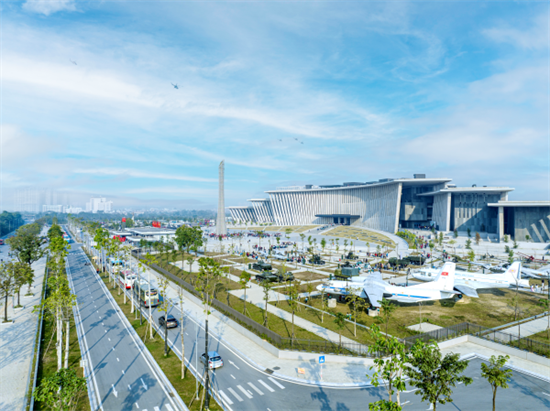 |
| New Museum complex in Xuan Phuong ward, Hanoi Capital |
Third, innovating exhibition content, formats, and methods. In response to the more demanding requirements of education and propagation, as well as the achievements of the 4th industrial revolution and national digital transformation, the Museum will keep renewing its museum and preservation work, creating clear improvements in the quality and effectiveness of this work. The Museum’s Party Committee and Board of Directors will direct subordinate party committees and commands to step up administrative reform, digital transformation, scientific and technological application, and the modernisation of exhibition in line with advanced international museum practices. The Museum will develop digital museums and interactive, experiential exhibitions incorporating virtual reality (VR), augmented reality (AR), and artificial intelligence (AI). As a result, each artefact will not only be displayed but also be able to “tell its own story”, interact with visitors, and reach both domestic and international visitors in a vivid, modern manner. Alongside these efforts, the Museum will expand exchanges and cooperation to bolster the image and military historical and cultural values of Vietnam to the world. It will actively participate in the activities of the International Council of Museums, promote the signing of cooperation agreements with military museums in other countries, organise touring exhibitions overseas, and host international exhibitions in Vietnam, thereby enhancing the prestige and position of the Vietnam Military History Museum internationally.
Fourth, strengthening history education and the fight against distortions of history. The Vietnam Military History Museum is not only a place for preserving artefacts but also a centre for educating people on patriotism and the determination to fight and win of the Vietnamese nation and the VPA. Therefore, history education will continue to be stepped up via diverse content and methods appropriate to target groups, with due attention paid to educating and nurturing younger generations, students, and soldiers. In the process, the Museum will combine fundamental education with heritage education programmes, direct education with online education, and traditional methods with modern approaches. It will coordinate with local party committees and authorities to develop heritage education programmes closely integrated with school and university curricula.
Additionally, the Museum will proactively develop and implement historical communication programmes and strategies with strong persuasive power across both traditional media and social media platforms. It will work closely with historical research institutions, educational establishments, military units, scholars, and veterans to develop documentary archives and scientific evidence capable of refuting all distorted and falsified interpretations of Vietnam’s military history and the VPA’s feats of arms. It will continue to fulfil its role as a “historical witness” by using its extensive collection of original artefacts and documents as irrefutable evidence of the nation’s glorious history. It will further intensify the release and dissemination of historical materials to the public both at home and abroad, thereby affirming historical truth and cementing the people’s faith in the Party, State, and VPA.
Sr. Col. LE VU HUY
Director of the Museum
______________________
1. Subsequently renamed the Military Museum Division, the Military Museum Institute, and the Vietnam Military History Museum.