Vietnam Coast Guard thoroughly grasps and effectively implements the “five pillars” motto
Thoroughly grasping the Resolution of the 14th National Party Congress and the directives of comrade To Lam, General Secretary of the Party, State President, and Secretary of the Central Military Commission (CMC), regarding the “five pillars” motto1, the Vietnam Coast Guard (VCG) has identified these documents as a strategic orientation of comprehensive and overarching significance in force building and realised these documents via numerous synchronised measures, thus laying a solid foundation for improving its overall quality and law enforcement capacity, firmly protecting national sovereignty, sovereign rights, and jurisdiction at sea under all circumstances.
Over the years, under the Party’s leadership and the State’s management, directly under the leadership and direction of the CMC and the Ministry of National Defence (MND), the VCG has continuously grown stronger, successfully fulfilling all assigned tasks, clearly affirming its core and specialised role in law enforcement and firmly safeguarding national sovereignty, sovereign rights, and jurisdiction at sea.
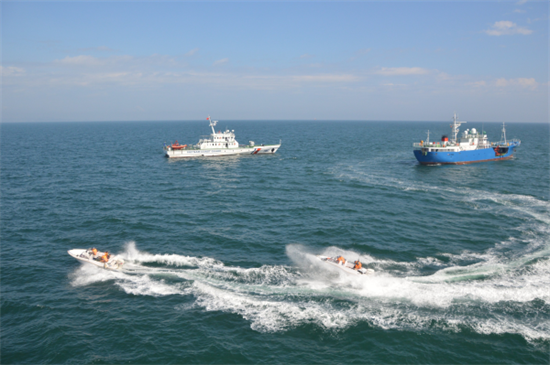 |
| Training at sea |
In particular, by thoroughly grasping and implementing the Resolution of the 14th National Party Congress and the “five pillars” motto, the VCG’s Party Committee and Command have focused their leadership and direction on study, education, and dissemination work, developing specific programmes, plans, and criteria for the entire force in line with the functions and tasks of each agency and unit. In this process, the “five pillars” motto has gradually permeated troops’ awareness and become routine actions and standards of training among every officer and soldier, producing important initial results and providing a solid foundation for the VCG’s development in the new period.
However, the task of building and defending the Fatherland in the new situation is imposing more demanding and complex requirements on the VCG. The situation in the East Sea continues to contain many unpredictable factors; strategic competition and sovereignty disputes remain complicated; crimes and violations of law at sea are becoming increasingly sophisticated. Besides, promoting international integration and digital transformation, mastering science and technology, and building a modern force are imposing new and higher requirements. Against that backdrop, the VCG continues to thoroughly grasp and effectively implement the “five pillars” motto, identifying this as a strategic orientation of foundational and overarching significance in building a revolutionary, regular, highly-skilled, modern force, thereby improving its overall quality and law enforcement capacity at sea. To that end, emphasis is placed on effectively carrying out several fundamental tasks and solutions as follows.
First, continuing to thoroughly grasp the Resolution of the 14th National Party Congress, particularly “political steadfastness”, as the foundation for building a politically strong VCG. The VCG’s Party Committee and Command and subordinate agencies and units of the VCG continue to concretise the “five pillars” motto into a system of programmes, plans, regulations and working criteria that are rigorous, synchronised, and closely aligned with their functions and tasks. In this regard, “political steadfastness” is manifested in unwavering political resolve and absolute loyalty to the Party, Fatherland, and people, resoluteness and persistence in maintaining the objectives and principles set for handling situations at sea, remaining undeterred by all impacts arising from the distinctive operational environment. At the same time, this is regarded as a consistent criterion for building pure, strong party committees and party organisations, as well as developing a contingent of cadres and party members with sufficient qualities, capability, and prestige, and the “seven dares” spirit as the leadership nucleus and centre of unity in every agency and unit.
On that basis, party committees and commands at all levels continue to organise study programmes and intensify dissemination and education in practical forms suited to the operational characteristics of each agency, unit, and target group, closely combining basic education with regular education, “building” with “combating”, and training with self-improvement, thus enabling all officers and soldiers to gain a profound, comprehensive understanding of the content, requirements, and measures of “political steadfastness”, fostering troops’ determination and readiness to undertake and successfully accomplish all assigned tasks.
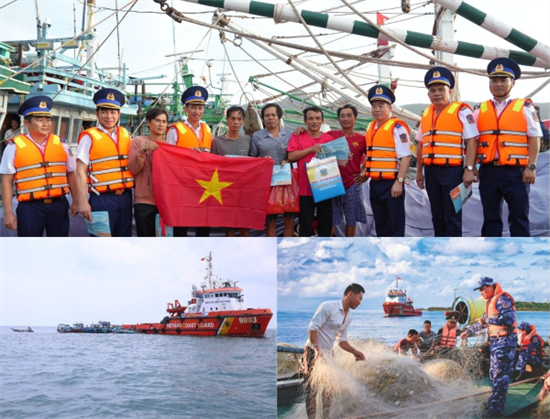 |
| Building a firm “posture of people’s hearts and minds” at sea |
Special attention is paid to building exemplary, pure, strong party organisations, enhancing the leadership capacity and combativeness of party committees and party organisations at all levels, maintaining the principle of democratic centralism, and promoting the role of grass-roots party organisations as the leadership nucleus. Thoroughly grasping and strictly implementing Resolution 05-NQ/TW, dated 7 April 2026, by the 14th Party Central Committee on renewing and improving inspection, supervision, and party discipline work, the force promptly detects and rectifies signs of misperception, formalism, lack of determination, and inconsistency between words and action, resolutely combating manifestations of degradation in political ideology as well as “self-evolution” and “self-transformation”. Through these efforts, the goal of “political steadfastness” will be concretised into resolve, willpower, and specific deeds of the entire VCG.
Second, building a VCG with “strict discipline” and “sound military art”, enhancing professionalism and the effectiveness of maritime law enforcement. This is both an urgent requirement and a foundational solution that must be implemented in a synchronised and rigorous manner, with priority given to raising the quality of training, education, professional development, regularity building, and discipline management. Grasping and realising the CMC’s Resolution 1659-NQ/QUTW, dated 20 December 2022, on “Improving training quality in the 2023 - 2030 period and beyond”, and Directive 79/CT-BQP, dated 22 July 2022, by the Minister of National Defence on building “exemplarily, typically” comprehensively strong units, the VCG’s Party Committee and Command promote innovative thinking in their leadership and direction over training, regularity building, and discipline management, reviewing and supplementing targets and measures in action programmes and plans to ensure practicality and close alignment with operational realities. In the process, emphasis is placed on closely combining training with regularity building, discipline management, and task performance at sea, strictly maintaining training regimes, closely managing personnel, weapons, and equipment, especially during exercises, law-enforcement operations, and participation in disaster prevention and mitigation and search and rescue. At the same time, inheriting the Vietnamese military art, the force continues to research and develop coast guard operational art towards a harmonious, flexible integration of military, political, legal, and diplomatic elements - flexible yet resolute, adaptable yet rigorous - proactively preventing risks early and from afar, gradually applying these approaches in training, education, and professional development.
Furthermore, VCG agencies and units actively innovate training content, forms, and methods in a modern, flexible, practical direction suited to the maritime environment, taking the objective of “firmly safeguarding sovereignty, enforcing the law, and building a regular, elite, modern VCG” as the focus of training. For officers, great weight is added to improving their skills in collecting, assessing, and analysing information, grasping hostile forces’ plots, tactics, and operational methods, making operational decisions and handling situations, and commanding both independent and coordinated operations with other forces under all weather conditions, day and night. Consideration is given to improving their professional and legal knowledge and their skills and experience in handling maritime situations and foreign affairs operations. For professional servicemen, emphasis is placed on rendering them fully aware of their responsibilities, tasks, and specialities and training them to proficiently use technical equipment in service and master legal regulations and professional procedures. In particular, the Project “Foreign language training for the VCG in the 2022 - 2030 period” continues to be promoted in order to improve the foreign-language proficiency among officers and technical personnel, thus meeting the requirements of maritime law enforcement and international integration.
Third, applying science, technology, and digital transformation, turning “strong technological capability” into a driving force for building a modern VCG. Amid increasingly complicated developments in the East Sea, with the emergence of many new factors such as strategic competition, transnational crime, sovereignty violations and illegal exploitation of marine resources and fisheries, enhancing technological capability becomes an urgent requirement of decisive significance to the VCG’s overall quality, combat strength, and law enforcement capacity.
To concretise this guiding principle, the VCG continues to give advice to the CMC and MND on acquiring and building modern long-range patrol vessels integrated with radar and positioning systems, unmanned platforms (UAVs, UUVs, and USVs), next-generation electronic reconnaissance technology, and advanced communication equipment, thereby ensuring the force’s capability to monitor, analyse, and handle all situations at sea in a timely manner without falling into passivity or surprise. The force continues to thoroughly grasp and execute the CMC’s Resolution 3488-NQ/QUTW, dated 29 January 2025, on breakthroughs in science and technology development, innovation, and digital transformation within the Military. Due regard is paid to comprehensive digital transformation in management, command, supervision, and handling of maritime situations, building maritime databases and digital operational command centres, developing an integrated information management system capable of collecting data from multiple sources.
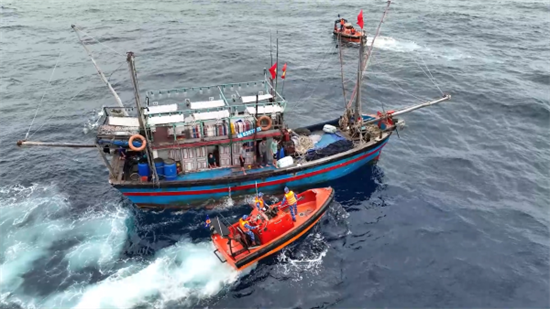 |
| Law enforcement at sea |
Importance is attached to promoting the “Digital Literacy” movement and building a contingent of “digital soldiers” to create a solid foundation for effective comprehensive digital transformation. Application of artificial intelligence and digital platforms is encouraged to support leadership, command, management, and handling of maritime situations and achieve breakthroughs in maritime domain awareness and control, especially in remote offshore and hard-to-access waters. Early-warning mechanisms are established to connect vessels at sea with coastal stations, command centres, and other forces such as the Navy, the Border Guard Force, fishermen, and fishery enterprises in order to improve the VCG’s maritime management capability and build a smart, flexible, internationally standardised maritime governance system.
Fourth, raising the quality of logistics and technical support, ensuring “stable troop welfare” as the basis for enhancing mobility and long-duration operations at sea under all conditions. The VCG Logistics and Technical Department maintains coordination to monitor situational developments and proactively give advice to the VCG Command on adjusting and supplementing targets and norms of logistics and technical support, while perfecting support plans in line with the practical operational requirements of agencies and units in the direction of “timely, sufficient, synchronised” support from shore to sea, with priority given to forces operating in distant waters for extended periods. On that basis, VCG agencies and units focus on raising the quality of troop welfare in a practical, effective, sustainable way, improving standards and conditions relating to food, accommodation, daily life, health care, epidemic prevention, and military medical support to meet the requirements of operations in rough seas, harsh environments, and areas far from the mainland. Efforts are devoted to promote crop/animal husbandry, apply scientific and technological advances in food preservation, processing, and storage, and develop flexible, mobile logistics support models suited to each area and mission. Policies regarding military families are well implemented to motivate officers and soldiers to remain devoted to their duties.
Additionally, the force continues to modernise and improve the work of managing, operating, utilising, preserving, maintaining, and repairing weapons and technical equipment, especially modern vessels, boats, and communication, reconnaissance, and maritime surveillance systems. Proactive stockpiling of supplies, fuel, and spare parts are maintained to ensure sufficient quantity and high quality for both routine and unexpected missions. Significance is attached to building strong on-site logistics and technical potential, developing logistics and technical service stations in key maritime directions and areas, and enhancing the capability in mobility, supply, transport, search and rescue to ensure the force’s ability to sustain continuous and long-duration operations at sea.
Thoroughly grasping and implementing the “five pillars” motto is a fundamental and overarching solution to ensuring that the VCG will always maintain its political orientation, improve its overall strength, and effectively perform its role as the core and specialised force in law enforcement and safeguarding national security and order at sea, thereby firmly protecting the sacred maritime sovereignty of the Fatherland and maintaining a peaceful, stable environment for national development in the new era.
Maj. Gen. LE DINH CUONG, Commander of the VCG
_____________________
1 - “Five pillars” motto: (1) Political steadfastness, (2) Strict discipline, (3) Strong technological capability, (4) Sound military art, (5) Stable troop welfare.