Promoting the application of science and technology and digital transformation to enhance the quality of border gate management
As the core and specialised force responsible for safeguarding territorial sovereignty and national border security, and for managing and controlling entry and exit activities in accordance with the law, the Border Guard has, alongside the vigorous and synchronised implementation of professional operational measures, been actively promoting the application of science and technology and digital transformation under the leadership and direction of its Party Committee and High Command. These efforts are aimed at improving the quality and effectiveness of border gate management.
Border gates are venues where entry and exit, import and export, international exchanges, and international cooperation take place. They also constitute areas of special importance for national defence, security, and foreign affairs. At present, the Border Gates Department is responsible for advising on, directing, and overseeing operations at 151 border gates nationwide. In the context of international integration and digital transformation, border gate management faces increasingly demanding requirements, while presenting both significant opportunities and complex challenges.
Against this backdrop, the Party Committee of the Border Guard promulgated Resolution No.387-NQ/ĐU dated 13 March 2022 on “Leading the improvement of border gate management and building a strong, standardised, professional, and modern border gate force to meet the requirements of the Fourth Industrial Revolution.” Accordingly, the Border Gates Department has focused on implementing a range of fundamental and synchronised measures that ensure stringent security while maintaining flexibility in administrative reform, closely linked with digital transformation. These efforts are aimed at simplifying border control procedures, facilitating cross-border movement, and contributing to the country’s socio-economic development and international integration.
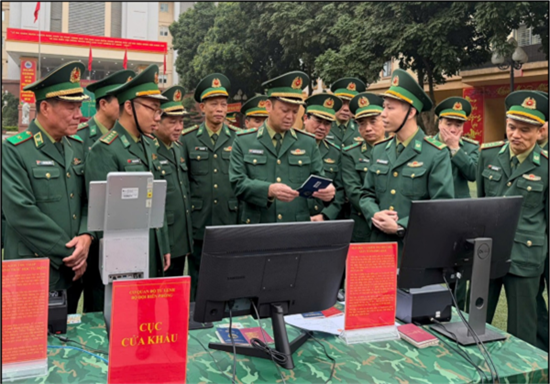 |
| Lt. Gen. Nguyen Anh Tuan, Political Commissar of the Border Guard visits exhibition of the Department of Border Gates at the launch of training season 2026 |
On the basis of thoroughly implementing and concretising the guidelines and resolutions of the Party, the Central Military Commission, the Ministry of National Defence, and the Party Committee of the Border Guard, the Department has proactively advised on the improvement of institutional mechanisms, policies, and legislation, thereby establishing a solid legal foundation for accelerating digital transformation in border gate management. Priority has been given to reviewing, amending, and supplementing relevant legal normative documents to ensure consistency with the development of digital government, the digital economy, and the two-tier local government model. Efforts have also focused on completing the legal framework for the implementation of electronic border control procedures under the National Single Window mechanism; the “One-Stop, One-Inspection” model; the application of biometric identification technologies at automated immigration control gates; and the development of a centralised surveillance camera system linked to the Border Guard Force’s Immigration Management Centre.
At the same time, the Department has proactively advised on the development and refinement of the legal and institutional framework governing entry and exit management. It has coordinated the pilot implementation of the “Smart Border Gate” model and the “Digital Border Gate” platform at the Huu Nghi and Tan Thanh Border Gates (Lang Son Province), Kim Thanh Border Gate (Lao Cai Province), and several other key border crossings. Concurrently, emphasis has been placed on advising on mechanisms to prioritise resources for research, application, and transfer of advanced technologies; strengthening connectivity with, and effective utilisation of, national and sector-specific databases for immigration management and control; and establishing a digital foundation for the comprehensive digitisation of operational procedures, thereby enhancing forecasting, command, and management capabilities. The Department has also coordinated the review and refinement of regulations relating to the ASEAN Single Window mechanism and cross-border trade, while proactively advising on the negotiation, revision, and supplementation of international treaties and agreements concerning borders and border gates in line with operational requirements.
In 2025 alone, the Border Gates Department advised the competent authorities on the promulgation of two Government decrees, one Prime Ministerial decision, two ministerial circulars issued by the Minister of National Defence, and seven internal regulatory documents of the Border Guard High Command. In addition, it advised the Border Guard High Command in reporting to the Ministry of National Defence for submission to the Government, leading to the promulgation of Government Resolution No.02/NQ-CP dated 3 January 2025, permitting designated categories of travellers to enter and exit through customs clearance points in Quang Ninh and Lang Son provinces. The Department also participated in drafting Government Decree No. 234/2025/NĐ-CP dated 27 August 2025 and the accompanying Circular governing foreign military vessels visiting Vietnam and Vietnamese military vessels travelling abroad, thereby contributing to the gradual completion of the legal framework and enhancing the effectiveness and efficiency of border gate management.
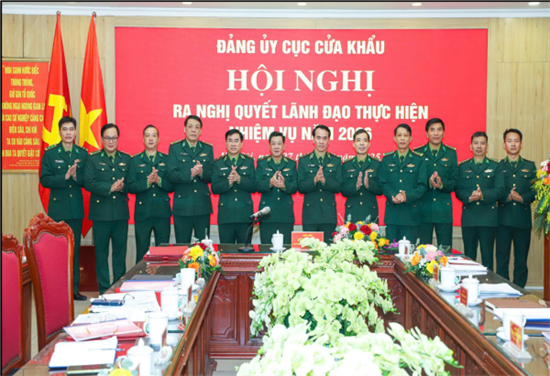 |
| The Party Committee of the Department of Border Gates issue leadership resolution for 2026 |
In response to the increasingly demanding requirements of immigration management, border control, and international integration, and in implementing Politburo Resolution No.57-NQ/TW dated 22 December 2024 and Central Military Commission Resolution No. 3488-NQ/QUTW dated 29 January 2025 on the development of science and technology, innovation, and digital transformation, the Border Gates Department has taken the lead in advising the Border Guard High Command to invest comprehensively in digital infrastructure, establish a centralised database system, and modernise the national border gate management system. Accordingly, the Department has focused on directing the deployment of digital platforms supporting immigration management and control, ensuring seamless connectivity from the Border Guard High Command to border gates nationwide and interoperability with specialised databases managed by relevant ministries and sectors. At the same time, it has accelerated the application of electronic identity verification platforms, advanced digital technologies, and the automation of operational procedures, while progressively improving digital governance platforms to enhance the quality of data management, utilisation, and information sharing.
In addition, the Department has deployed an immigration management and control software system based on a centralised data model, linking the Border Guard High Command with border gates nationwide and synchronising it with the database of the Immigration Department under the Ministry of Public Security. This system ensures real-time data updates, effectively supports command and management activities, and simultaneously reduces system investment and operating costs. Alongside this, 19 electronic border control systems have been deployed at international border gates, principal land border crossings, and seaport border gates. The Electronic Border Procedures Portal has been integrated with the National Single Window Portal, while digital signatures have been applied to administrative procedures and the online issuance of permits.
To date, the Border Guard Force has put into operation 19 automated border control gates incorporating biometric identification technology and connected to the National Population Database and the National Identity Database. This has reduced immigration processing time from approximately 60 seconds to 15-20 seconds per person. During the period 2021-2025, the system processed more than 2.4 million entries and exits, significantly improving accuracy, professionalism, and the quality of services provided to citizens and businesses.
Recognising that human resources are the decisive factor in determining the effectiveness of science and technology application and digital transformation in border gate management, the Department has focused on building a contingent of border management officers with firm political commitment, high professional competence, sound legal knowledge, strong operational expertise, and the capability to master modern technologies. In implementing Ministry of National Defence Circular No.30/2023/TT-BQP dated 12 April 2023, which prescribes standards and position rotation for immigration control officers and personnel at border gates under the Ministry’s management, the Department has proactively advised on consolidating organisational structures and effectively carrying out personnel planning, recruitment, training, professional development, deployment, and rotation in a specialised manner, tailored to the requirements of each position and the characteristics of different categories of border gates.
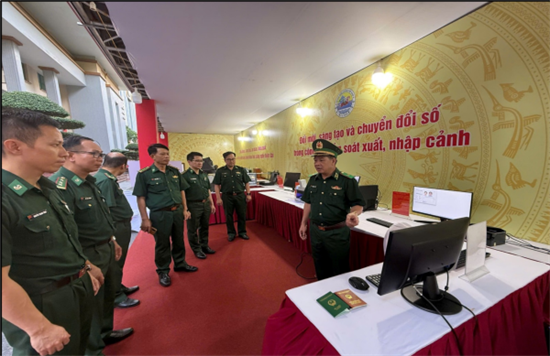 |
| Exhibition of innovation and digital transformation in border gate management at the 16th Party Congress of the Border Guard |
In parallel with workforce development, the Department has placed particular emphasis on improving the quality of human resources to meet the demands of digital transformation. Priority has been given to training and developing personnel with expertise in information technology, cybersecurity, systems administration, and data analytics, while building a core cadre capable of mastering and effectively applying emerging technologies to immigration management and border control. At the same time, cooperation has been strengthened with educational and training institutions both within and outside the military to organise specialised courses on immigration control, foreign languages, international law, inter-agency coordination, and professional skills for operating in a digital environment.
To maximise the effectiveness of the digital platforms already deployed, the Department has focused on equipping its personnel with the skills required to operate specialised software applications, database systems, modern border control equipment, and digital management platforms. At the same time, priority has been given to strengthening capabilities in data analysis, processing, and utilisation to support forecasting, strategic advice, command and control, and the handling of situations arising at border gates. Through these efforts, the Department is progressively developing a cadre corps with a digital mindset and a professional working style, capable of meeting the requirements of safeguarding territorial sovereignty, national border security, and international integration.
The Border Gates Department has also strengthened inter-agency coordination and expanded international cooperation in order to enhance the effectiveness of border gate management in the context of international integration and digital transformation. In recent years, the Department has proactively coordinated with the Immigration Department under the Ministry of Public Security in directing and guiding immigration control activities at border gates administered by both the Ministry of National Defence and the Ministry of Public Security. It has also advised the Border Guard High Command in coordinating with the Customs Department to review the implementation of the Coordination Regulations for the period 2019-2024 and to formulate and sign a new coordination framework better aligned with current operational requirements.
At the same time, close cooperation has been maintained with the Consular Department of the Ministry of Foreign Affairs in exchanging information on consular protection and advising on the handling of sensitive immigration cases involving foreign nationals. The Department has also worked closely with relevant agencies of the Ministry of Foreign Affairs in developing the Master Plan for the Land Border Gate System, while carrying out procedures for the establishment and upgrading of border gates and border crossing points in accordance with applicable regulations. In addition, effective coordination has been maintained with competent authorities under the Ministry of Construction, the Ministry of Industry and Trade, the Ministry of Culture, Sports and Tourism, and border localities to facilitate transportation, trade, tourism, and international exchanges.
In the field of international cooperation, the Department has actively advised on the effective implementation of cooperation mechanisms under the Viet Nam-China Land Border Gate Management Cooperation Committee. It has also proactively advised the Border Guard High Command in coordinating with the National Immigration Administration of China (Ministry of Public Security), the General Administration of Customs of China, the General Department of Security (Ministry of Public Security of Laos), and the General Department of Immigration (Ministry of Interior of Cambodia) in implementing international treaties relating to borders and border gates, while jointly upgrading border gate infrastructure to facilitate the movement of people and cross-border trade. Furthermore, cooperation has continued to expand with the Embassies of Australia, the United States, and the United Kingdom, as well as with international organisations such as the International Organisation for Migration (IOM) and the United Nations Office on Drugs and Crime (UNODC), in areas including experience sharing, professional training, technical assistance, and capacity building for border gate management and border security. These efforts have progressively strengthened coordination mechanisms for border gate management, improved information exchange and data sharing, facilitated cross-border movement, and contributed to firmly safeguarding territorial sovereignty and national border security while meeting the requirements of international integration and digital transformation.
Against the backdrop of increasingly deep international integration and the rapid advancement of digital transformation, the Border Gates Department will continue to play its core role by proactively advising, guiding, and directing the expanded application of science and technology, innovation, and digital transformation across all aspects of its work. Through these efforts, it aims to progressively modernise border gate management, thereby contributing to the firm protection of territorial sovereignty and national border security.
Major General DO NGOC TOAN, Director of the Border Gates Department, Border Guard High Command