Corps 16 promotes socio-economic development in conjunction with defence and security consolidation
Grasping and implementing the Party’s lines, Corps 16 has fostered socio-economic development in tandem with defence and security consolidation in its project areas, contributing to maintaining political stability, social order and safety, as well as territorial sovereignty and national border security under the new context.
Corps 16 is tasked with developing defence - economic zones and residential areas in remote, isolated, ethnic minority regions along the border with Cambodia, covering Dong Nai city and the provinces of Lam Dong and Dak Lak.
 |
|
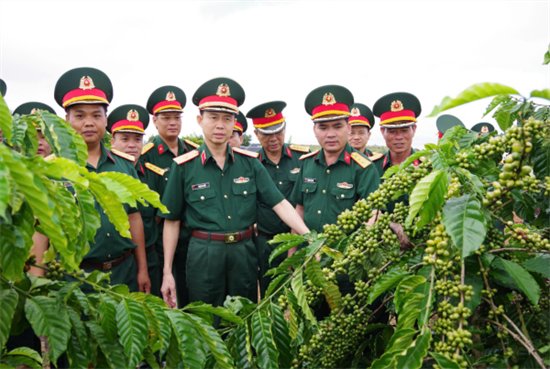
Corps Command inspects a coffee plantation
|
Over the years, challenges arising from the characteristics of the operational areas, natural disasters, epidemics, and fluctuations in agricultural commodity prices have significantly affected the Corps’ task performance. However, with its strong determination, the Corps has remained steadfast in staying close to the land and the people, continuously developing increasingly prosperous and resilient defence - economic zones. From once-barren lands with sparse populations and poor infrastructure, dozens of thriving residential communities have emerged. The people’s material and spiritual life has steadily improved; the grass-roots political system has grown stronger; defence and security have been reinforced. The project areas of Corps 16 have undergone remarkable transformations, developing in a more standardised, modern, sustainable way.
Corps 16 has developed increasingly well-established defence - economic zones with well-integrated infrastructure systems to facilitate its production and the people’s daily lives. Production and business development has consistently been combined with poverty reduction and improvements in the people's living standards, particularly among ethnic minority communities in the project areas. At the same time, the posture of all-people national defence has been strengthened to contribute to maintaining political stability and social order and safety. These achievements have given Corps 16 a new image that is dynamic, vibrant, and full of vitality. Tens of thousands of jobs have been created, mainly for ethnic minorities, providing them with stable incomes. Thousands of houses have been built, repaired, and handed to locals. Every year, the people have been provided with medical examination and treatment. Numerous schools, public welfare facilities, hundreds of kilometres of roads, electricity networks, and irrigation dams supporting both local livelihoods and production have been constructed, fundamentally transforming the appearance of the “frontier areas” of the Fatherland.
To achieve these results, the Corps’ Party Committee and Command have introduced various solutions aimed at fostering socio-economic development in line with defence and security consolidation.
First, strengthening the leadership and direction of party committees and commands at all levels in carrying out the Corps’ central political task. Identifying this as the fundamental and overarching solution, the Corps has thoroughly grasped the 13th Politburo’s Resolution 23-NQ/TW, dated 6 October 2022, on orientations for socio-economic development and defence and security consolidation in the Central Highlands to 2030, with a vision to 2045, Resolution 820-NQ/QUTW, dated 17 December 2021, by the Central Military Commission (CMC) and Plan 763/KH-BQP, dated 17 March 2022, by the Ministry of National Defence (MND) on leading the Military’s production activities and integration of economic development and national defence through 2030. Doing so has enabled party committees and commands at all levels to gain a profound understanding of the policy on combining socio-economic development with defence and security. They have attached importance to renewing methods of leadership and command in a proactive, flexible direction closely aligned with practical conditions, raising the quality of their staff work and their task performance.
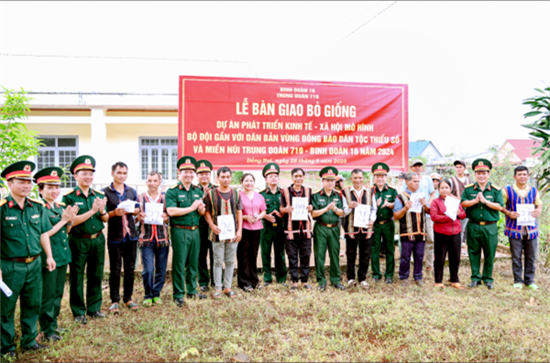 |
| Handing over breeding cattle to ethnic minorities |
In the process, party committees and commands at all levels have displayed a strong sense of responsibility, renewing their thinking and working methods. Attention has been paid to monitoring market developments, investing in and applying science and technology to breeding, cultivation, and harvesting, especially in industrial crop projects (rubber, coffee, and cashew), thereby achieving high yields and good-quality products. Mass mobilisation has been stepped up via practical improvements in the people’s material and spiritual life. The Corps has proactively coordinated with local authorities and relevant forces to maintain political stability and social order and safety, while performing the dual tasks of fostering socio-economic development and consolidating defence and security potential and posture across the project areas.
Second, promoting economic development, helping the people eradicate hunger and reduce poverty, laying a foundation for strengthening defence and security. This is one of the key objectives of the defence - economic zone projects. Accordingly, the Corps has attached significance to coordinating with local authorities in resettling population and establishing new-style rural residential clusters along the border, raising the quality of production and business activities, formulating and realising its development strategy in line with the master plans and strategies of the Central Highlands and the Southeast Region, implementing sustainable poverty reduction programmes, improving the people’s living standards, ensuring social stability across the project areas.
The Corps has strictly adopted technical procedures and investment standards for cultivating, harvesting, and protecting its plantations, applying science and technology to reduce production and business costs and promote sustainable environmental protection, providing agricultural inputs and fertilisers, purchasing agricultural produce from local ethnic communities and contracted farming households. Over the past five years, it has created employment and stable incomes for workers, stabilising the livelihoods of people in 43 residential clusters with 11,200 households centred around its production teams. These efforts have contributed to developing strong local socio-political foundations, building the posture of all-people national defence associated with the people's security posture, generating the combined strength of defensive zones. In 2025 alone, the Corps generated revenue of VND 4.8 trillion, achieving 101% of its target, while the average monthly income of its employees exceeded VND 10 million.
 |
|
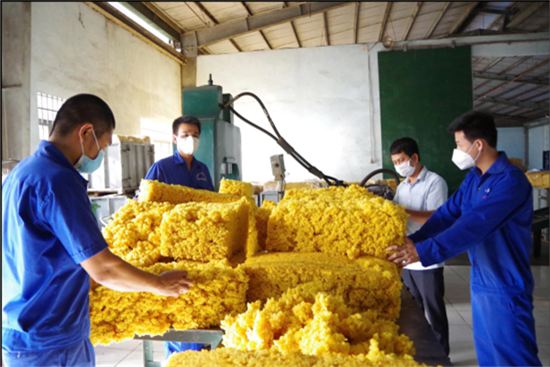
Product quality control
|
Third, effectively carrying out mass mobilisation work and building a strong grass-roots political system, contributing to developing stronger political and spiritual potential and a firm “posture of people's hearts and minds”. The Corps has actively implemented the National Target Programme on socio-economic development in ethnic minority and mountainous areas and the movement entitled “The Corps joins hands in building new-style rural areas”, expanding twinning models between production teams and villages, as well as between workers’ households and ethnic minority households.
In the process, the Corps and its defence - economic units have focused on poverty reduction projects, especially on agricultural and forestry extension services, the transfer of science and technology, production support, and vocational training for local labourers, especially ethnic minority people. Over the past 5 years, it has given 1,444 breeding buffaloes, cattle, and goats to 1,411 poor, near-poor, newly escaped-poverty, and ethnic minority households in the project areas. It has worked with localities to provide training for 62 grass-roots ethnic minority officials, financing the construction of 111 Great Unity Houses, 114 Comradeship Houses, 3 clean-water supply facilities, more than 37 kilometres of internal roads, 17.6 kilometres of medium- and low-voltage power lines, 9 transformer stations, 5 reservoirs for agricultural production, and 14 water filtration systems for nursery schools.
In addition, the Corps has directed its working groups and teams to strengthen their presence at grass-roots level, stay close to local communities, encourage the people to comply with the Party’s lines and the State’s laws and policies, raise public awareness of hostile forces’ attempts to exploit ethnic and religious issues to undermine the great national unity bloc, and promote a sense of responsibility among the people for building a civilised way of life and eliminating outdated customs, superstitions, and social evils. Its defence - economic units have worked closely with local military agencies to give advice to local authorities on strengthening party committees and authorities at all levels and raising the effectiveness of mass organisations. They have actively executed the joint military - civilian health care programme by providing free medical examinations, medicines, and treatment for thousands of locals. These efforts have helped spread the noble image of “Uncle Ho’s Soldiers” in the new era, enhance military - civilian solidarity, and build a firm “posture of people's hearts and minds” in this strategic region.
Fourth, placing emphasis on improving the quality of combat training, regularity building, and discipline management. Stable socio-economic development provides a solid foundation for strengthening defence and security; conversely, stronger defence and security create favourable conditions for socio-economic development. Based on this understanding, while fostering socio-economic development, the Corps’ Party Committee and Command have intensified their leadership and direction over military and defence tasks. To that end, the Corps has focused on building a comprehensively strong standing force, improving the quality of its self-defence force, proactively developing and refining combat plans and projects for disaster prevention and response, strictly maintaining training and combat readiness from its headquarters down to production teams. It has closely integrated training with discipline, regularity building, and the development of “exemplarily, typically” comprehensively strong agencies and units.
In recent years, the Corps has well performed the work of organisational restructuring under regulations. It has strengthened coordination with local authorities, the Public Security Force, and the Border Guard Force in sharing information, monitoring situational developments, and formulating plans and projects for defence and security tasks. These efforts have helped ensure the timely prevention and effective handling of situations, maintain political stability and social order and safety, particularly in the face of increasingly complex, sensitive issues, and build safe localities and a border of peace, friendship, cooperation, and development.
Building upon its achievements, in the coming period, Corps 16 will continue to thoroughly grasp and effectively implement the Party’s lines and orientations, particularly the Resolution of the 14th National Party Congress and the Resolution of the 12th Military Party Congress. On that basis, it will strive to develop its defence - economic project areas into key economic regions, stabilise residential communities, eliminate hunger, reduce poverty, gradually improve the people's living standards, and contribute to strengthening defence and security potential and posture, maintaining political stability, and ensuring social order and safety across the strategic border area of the Central Highlands and the Southeast Region.
Maj. Gen. PHAM BA HIEN
Commander of Corps 16