In response to the more sophisticated, reckless tactics employed by drug criminals along the North-western border, the Provincial Border Guard (PBG) of Dien Bien has adopted a wide range of border defence measures, proactively maintaining a firm grasp of situational developments, effectively conducting numerous major cases, thereby preventing “white death”, contributing to ensuring security and social order and safety within the province.
Dien Bien province occupies a strategic position in terms of defence and security in the North-western region of the Fatherland. It shares nearly 456 kilometres of border with China and Laos. Owing to its proximity to the “Golden Triangle” - one of the world’s major centres for drug production and trafficking - the province has become a key transit area through which drugs are smuggled into the interior of our country.
In recent years, drug trafficking networks have employed new, aggressive, reckless, dangerous tactics via large-scale, closed, transnational operations. Drug-related activities in areas beyond the border, especially around the “Golden Triangle”, have had signs of complexity associated with terrorist financing, money transfer, and other forms of organised transnational crime. The cultivation of narcotic plants in areas beyond the border continues on a large scale, thus posing significant challenges for law enforcement and control efforts.
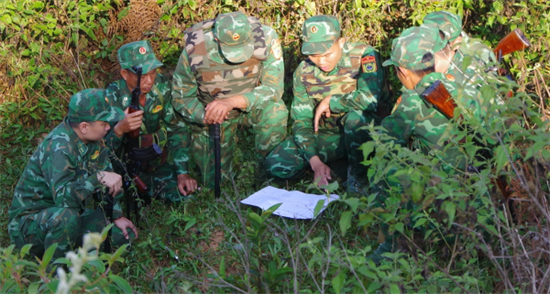 |
| Discussing operational measures against crime along the border |
Against that backdrop, while effectively carrying out the task of safeguarding national sovereignty and border security, the PBG has fully promoted its role as the core, specialised force, adopting synchronised, resolute measures to combat drug-related crime, thereby contributing to maintaining political security and social order and safety in the province’s border areas.
Strengthening leadership and direction and maintaining a proactive grasp of situational developments to avoid passivity or surprise
With the rugged terrain, difficult living conditions, and complex ties of kinship across the border, drug criminals have exploited these factors to establish closed transnational trafficking and transport networks. Meanwhile, our border management and protection forces are thinly spread and face numerous difficulties in combating drug crime. Grasping and implementing resolutions and decisions issued by higher authorities, especially Resolution 669-NQ/ĐU, dated 4 September 2018, by the Border Guard Force (BGF) Party Committee on raising the quality and effectiveness of anti-drug and anti-crime work and building a comprehensively strong specialised anti-drug and anti-crime force in the new situation, Decision 946/QĐ-BQP, dated 3 March 2026, by the Minister of National Defence on the functions, tasks, power, and working relationships of provincial-level Border Guard Commands, and Circular 19/2026/TT-BQP, dated 10 March 2026, by the Ministry of National Defence, promulgating regulations on coordination between the BGF Command and Military Region Commands in commanding and directing military, defence, and border protection tasks and building the BGF, the PBG Party Committee and Command have focused on directing agencies and units to remain constantly present in localities, closely monitor suspects, correctly assess developments, and promptly identify potential complex factors relating to drugs, particularly along the Vietnam - Laos border. On that basis, practical operational plans and projects have been developed, with clear key areas, targets, and methods. Specific tasks have been assigned to each section and force under the “six-clear” principle to ensure close coordination and timely, effective handling of emerging situations. At the same time, inspection, supervision, and preliminary reviews have been strengthened to draw lessons, promptly overcome shortcomings, and successfully fulfil the task of drug crime prevention and combat.
Comprehensively taking professional measures to effectively dismantle drug trafficking networks
Given the characteristics of a long border line with numerous trails and unofficial crossings, as well as the fact that criminal elements constantly alter their methods and tactics, the PBG has directed its affiliates to intensify reconnaissance and basic investigation work, maintain close control over key areas and suspects, and regularly review and update operational dossiers. Efforts have been devoted to identifying patterns and methods of transporting, storing, and transferring drugs used by trafficking networks along the border. Based on Regulation 7804/QyĐ-BQP, dated 1 December 2025, by the Minister of National Defence on operational measures within the BGF, together with guiding documents issued by the BGF Command, units across the PBG have adhered to the principle of “maintaining a firm grasp of the internal situation and proactively extending operations beyond the border”, gathering intelligence from both inside and outside border areas, combining overt and covert measures, integrating specialised struggle with border management and control activities.
In the process, importance has been attached to basic professional work, developing confidential informant networks, encouraging the role of local people as the “eyes and ears” of the BGF in detecting and reporting drug-related activities. Covert surveillance measures have been intensified to monitor the movements of suspects. Patrol and control operations have been strictly maintained at border areas, border gates, trails, and unofficial crossings. Fixed and mobile checkpoints have been organised, while administrative inspection has been combined with professional control measures to detect unusual signs.
Based on intelligence assessments and operational information collected, the PBG has proactively established specialised cases tailored to each area and locality. Thanks to the comprehensive, resolute adoption of professional measures, anti-drug operations have achieved significant results. Since 2025, the PBG, acting independently and in coordination with other forces, has detected and cracked 128 cases involving 146 suspects, seizing more than 22 kilograms of heroin, over 300,000 synthetic drug tablets, more than 11 kilograms of opium, and numerous other related exhibits, contributing to maintaining political security and social order and safety along the North-western border region of the Fatherland.
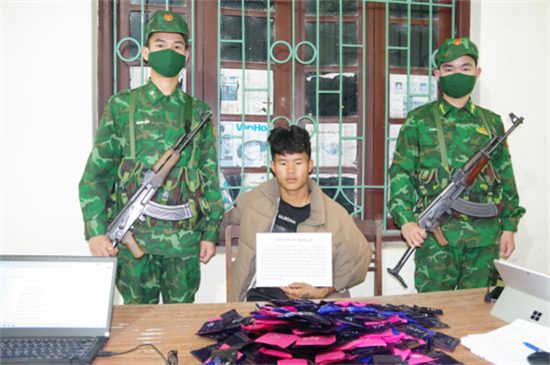 |
| Special case ĐB326.3p cracked by the PBG |
Closely coordinating with local party committees, authorities, and relevant forces to build a strong drug crime prevention and control posture
Practical experience in combating drug crime in Dien Bien proves that, in order to effectively prevent transnational trafficking networks, it is essential to promote the BGF’s role as the specialised, core force, establish a mechanism for close coordination among competent agencies, and harness the combined strength of the entire political system and people living in border areas. Hence, the PBG has strictly maintained mechanisms and procedures for coordination with other forces in accordance with the Government’s Decree 03/2019/NĐ-CP, dated 5 September 2019. Operational information has been regularly exchanged, while investigations, verifications, case establishment, and operations have been conducted in close cooperation with the Public Security Force, the Customs, and other relevant ones. In the process, patrol and area management activities have been combined with professional operations to create a seamless posture for dismantling inter-provincial and transnational drug trafficking networks.
Along the border, the PBG has regularly organised meetings, exchanged information, and carried out bilateral patrols with the border protection forces of neighbouring countries, thereby promptly detecting and preventing cross-border drug trafficking activities from areas beyond the border. Besides, material assistance, equipment, and experience sharing in border management and protection have been actively provided to Lao competent forces. These efforts have contributed to building an interconnected, closed posture linking the two sides of the border, improving anti-drug cooperation, and strengthening the special friendship and solidarity between the border protection forces of the two countries.
In addition, the PBG has placed special emphasis on building a firm “people’s hearts and minds posture” in border areas. Agencies and units across the PBG have intensified mass mobilisation work and coordinated with local party committees and authorities to build strong political bases. Numerous initiatives have been implemented to help local people develop their livelihoods and improve their living standards, thus gradually eliminating the root causes of drug-related crime. Many practical, effective models have been introduced, including “Border Guard Orchard” by A Pa Chai Border Guard Post and the model of cardamom cultivation by Nam Ke Border Guard Post. These activities have contributed to cementing public faith in local party committees and authorities and the BGF.
Furthermore, units of the PBG have effectively maintained online propagation work through Facebook pages and groups such as “Mien Hoa Ban”, “Dien Bien Provincial Border Guard Youth”, and “A Pa Chai Border Guard Post”. Through these platforms, the Party’s lines and the State’s policies and laws have been disseminated; public awareness regarding the harmful effects of drugs have been raised; local people have been encouraged to engage actively in movements such as “All people participate in border security protection” and “People take part in crime prevention, detection, and reporting”. The people have been encouraged to commit themselves not to cultivating opium poppies, trafficking, transporting, or using narcotics; they have been also encouraged to proactively provide information to assist the PBG in combating drug crime and maintaining peace and security in their villages and hamlets.
Building a specialised force with political resolve, professional expertise, resourcefulness, and courage
Fully aware that personnel are the decisive factor in the quality and effectiveness of anti-drug operations, following the policy on building “adept, compact, strong” local military agencies under Resolution 866-NQ/QUTW, dated 14 May 2025, by the Central Military Commission, the PBG’s Party Committee and Command have attached significance to developing a comprehensively strong specialised force with political steadfastness and great professional competence to meet their task requirements under new conditions. Accordingly, anti-drug and anti-crime units have been strengthened in terms of personnel, with priority given to key areas, political reliability, and professional capability. Adhering to the principle of “selecting the right people and assigning them to the right jobs”, agencies and units across the PBG have rigorously assessed their cadres’ capabilities, selecting those with political steadfastness, hands-on experience, and a deep understanding of local customs and terrain for assignment to anti-drug operations. Moreover, specialised training in reconnaissance, investigation, and verification has been intensified. Skills in collecting, analysing, and processing operational information as well as in forecasting situational developments and identifying the methods and tactics employed by transnational drug criminals have been improved.
Additionally, the PBG has directed its units to focus on improving troops’ knowledge of Vietnamese laws, Lao laws, and international legal provisions related to drug crime prevention and combat in border areas. Officers and soldiers have been trained to stay close to border areas, local communities, and key targets. As a result, anti-drug operations have produced many positive outcomes, affirming the PBG’s role as the specialised, core force on this dangerous front, contributing to maintaining security, social order and safety, and the people’s peaceful lives.
Sr. Col. PHAN VAN HOA
Deputy Commander of the Provincial Military Command and Commander of the PBG Command