The Resolution of the 14th National Party Congress affirms: “Develop a profound and comprehensive understanding of and consistently implement the perspective that education and training constitute a top national priority, one that determines the future of the nation”. Consequently, maintaining the socialist orientation in education and training plays a strategic role in the cause of national rejuvenation and development in this new era, while countering and refuting the fallacious arguments of hostile forces regarding this crucial sector.
Unveiling subversive schemes and tactics, and the risk of socialist derailment in education and training
Amidst globalisation, international integration, and the rapid advancement of the Fourth Industrial Revolution, Vietnam’s education sector faces numerous opportunities for reform, allowing for the adoption of global scientific and technological achievements, as well as advanced educational practices, to build a strong and prosperous nation.
However, education and training is also frequently targeted by hostile forces. They employ tactics such as promoting the “depoliticisation” of education, denying the essential role of political and ideological orientation in education while distorting history, disparaging revolutionary achievements, and undermining the leadership of the Party and the governance of the State. Simultaneously, they propagate a pragmatic and egoistic lifestyle that prioritises individual interests, while downplaying citizen responsibilities toward the community and the Fatherland. If these narratives permeate the younger generation, they could erode trust, cause a fading of revolutionary goals and ideals, and lead to a distorted understanding of history, national traditions, and the sacrifices and contributions of previous generations, manifesting as a growing detachment from the Party and the Youth Union.
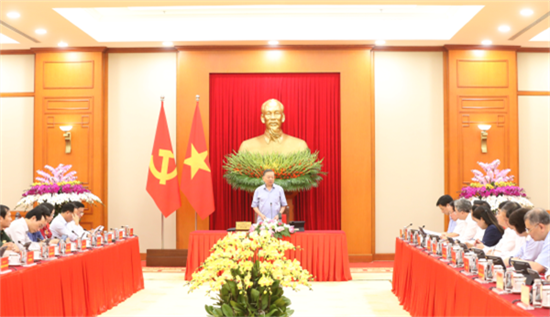 |
| General Secretary and President To Lam works with the Education and training sector in June 2026 (Photo: dangcongsan.org.vn) |
Exploiting the Party’s policies on university autonomy, the privatisation of education, and the diversification of resources, certain groups harbouring misguided or even extremist views are trying to promote an absolute reliance on market mechanisms. They consider education merely as a service, where grades and degrees can be traded to satisfy individual needs. If left unattended and poorly managed, this trend could foster a profit-driven mentality, diminish social responsibility, disregard character education, and undermine the humanistic essence of the nation’s educational system.
Furthermore, the risk of socialist derailment also stems from internal limitations and shortcomings within the education and training sector, such as: the prevalence of negative practices, an obsession with superficial achievements, flaws in curricula and content, and the declined responsibility and professional ethics of some administrators, educators, and students. If these issues are not promptly rectified, they will erode the trust of the public, students, and learners, while providing room for subversive distortions of hostile forces regarding the nature and achievements of our country’s educational system.
Proper understanding of the socialist orientation in education and training in Vietnam
The socialist orientation in education and training in Vietnam is primarily reflected in the educational goals and perspectives of the Party. Education must aim to develop “new socialist citizens” comprehensively in terms of morality, knowledge, culture, physical health, aesthetics, and professional skills. Besides, it should also foster patriotism, civic consciousness, national pride and self-respect, communal responsibility, and the adaptability to rapid changes in socio-political life. In this process, political and ideological education is closely integrated with the development of knowledge, skills, and professional expertise to produce both “red and expert” citizens who possess deep professional competence, firm political conviction, high moral standards, and a strong sense of social responsibility, all while contributing to social progress.
The socialist-oriented education system in Vietnam must contribute to the cultivation of citizens who are responsible toward themselves, their families, their communities, and the nation. They are expected to uphold the rule of law, respect the legitimate rights and interests of others, and prioritise the collective interest over personal gain. In particular, the ideal of national independence linked to socialism and patriotism, alongside a spirit of autonomy, self-reliance, and the aspiration to build a prosperous, civilised, and happy nation must be nurtured at every educational level and for every target group through persuasive, practical, and effective methods.
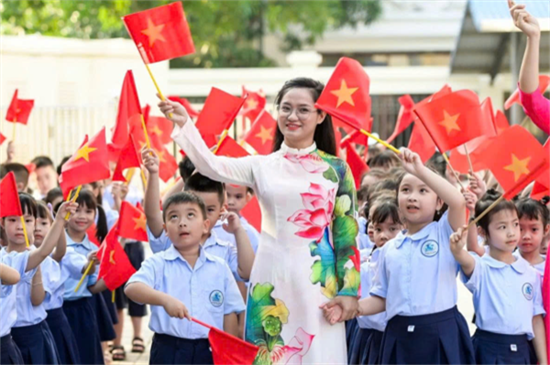 |
| Children expresses happiness at the beginning of new academic year |
Furthermore, the socialist orientation in education and training also entails a steadfast commitment to Marxism-Leninism, Ho Chi Minh thought, and the Party’s renewal theory. Upholding this foundation does not necessarily imply a dogmatic, willful, or insular approach that isolate itself from human knowledge. It is essential to utilise these theoretical values as a foundation to help learners develop a scientific and revolutionary worldview, as well as their capacity to analyse, evaluate, and make well-founded choices regarding information, thereby enhancing their cognitive autonomy and sense of social responsibility.
Moreover, the socialist orientation is reflected in the people-centred, national, scientific, modern, and accessible nature of Vietnam’s education system, which operates under the leadership of the Communist Party and the management of the State. Education must serve the people, ensure increasingly equal learning opportunities for all, and pay special attention to learners in disadvantaged areas and those from vulnerable groups. At the same time, education and training must remain rooted in the nation’s historical traditions, culture, moral values, and noble heritage, while proactively incorporating scientific and technological achievements as well as the best of human culture to meet the country’s development needs in the new context.
Within the framework of a socialist-oriented market economy, the privatisation and autonomy of education are key policy directives from the Party aimed at mobilising resources and improving the quality of training. However, the privatisation of education is not synonymous with commercialisation; nor does autonomy imply a relaxation of state oversight or a departure from the core objectives of serving society, fostering human development, and advancing the national interest. The effectiveness of educational reform must be measured by the quality of human resources, as well as by contributions to the nation’s sustainable development while ensuring strict adherence to the socialist orientation.
Fundamental measures to uphold the socialist orientation in education and training
First, it is essential to strengthen the Party’s leadership and the State’s management of education and training. This is a matter of principle, ensuring that education and training develop in alignment with the goals, policies, and guidelines established by the Party as set forth in the Resolution of the 14th National Party Congress, and specifically in Resolution No. 71-NQ/TW, dated 22 August 2025, of the Politburo (13th tenure) on “Breakthroughs in the development of education and training”. Accordingly, Party committees and organisations within academies and schools must serve as the core of leadership. They must also innovate their leadership and directive methods in a practical and democratic manner, while respecting the inherent laws of education and fostering the proactiveness and creativity of educators, administrators, learners, and the families of students. Regarding non-public educational institutions, it is necessary to ensure State oversight, provide political and ideological guidance, and enforce compliance with the law, while simultaneously creating conditions for these institutions to leverage social resources for the advancement of education and training.
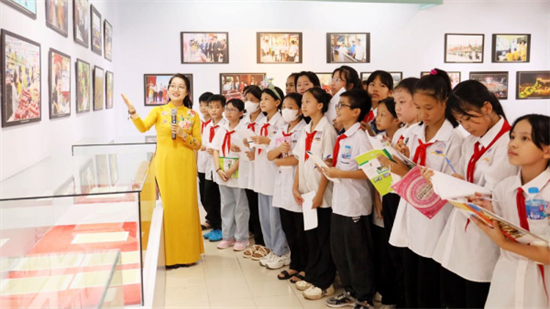 |
| Students of Tran Phu Junior High School of Bac Ninh city study at the meusum (Photo: baobacninhtv.vn) |
Second, enhancing the quality of education in political theory, history, morality, law, and national traditions for students. Education in political theory, particularly regarding Marxism-Leninism, Ho Chi Minh thought, and the theory on the Party’s renewal policy should avoid rigid, prescriptive, or impositional approaches. Instead, it should be integrated with the vivid, practical realities of the nation, specific historical narratives, and issues that interest the younger generation to foster right attitudes and beliefs for them.
Third, building a contingent of educators and educational administrators who are both “red and expert”. Teachers have a profound influence on the formation of a learner’s character; excellent teachers cultivate excellent students. Therefore, each educator must serve as an exemplary model of morality, responsibility, compassion, a scientific mind, and a commitment to serving the Fatherland and the People. Alongside enhancing professional levels, there should be a strong emphasis on cultivating political steadfastness, professional ethics, pedagogical skills, and technological proficiency. A high-quality education system cannot be achieved without a contingent of high skill educators. In this regard, we must adhere to the teaching of Uncle Ho that: “A good teacher, one who is truly worthy of the title, is the most honourable of all. Even if their names never appear in the press and they receive no medals, good teachers are unsung heroes. This is a truly glorious calling”.
Fourth, ensure close coordination among schools, families, and society in education. An individual’s personality is shaped by the combined educational influences from their family, the schools, the communities, and the digital space. Schools should maintain regular collaboration with families in the management and education of students. Simultaneously, the roles of the Ho Chi Minh Communist Youth Union, the Vietnamese Students’ Association, and other socio-political organisations should be leveraged to foster a healthy school culture. It is necessary to cultivate a culture of conduct, a spirit of respect for teachers, solidarity among peers, and a sense of responsibility toward the community and the nation.
Fifth, proactively combat and refute erroneous or hostile viewpoints in the cyberspace. The cyberspace has become an environment that exerts a powerful influence on the mindset, emotions, and lifestyles of the younger generation. Consequently, it is essential to enhance the ability to identify false, distorted, or inflammatory information. Students should be equipped with the “soft skills” necessary to verify the authenticity of information, while developing the capacity for scientific, evidence-based critical thinking. It is also crucial to actively disseminate official, authoritative content presented in an engaging and persuasive manner regarding Vietnam’s history, traditions, culture, its people, and the achievements of the revolution. Combating negative influences in the cyberspace is not merely about refuting falsehoods, but more importantly, it involves “overcoming the bad with the good” promoting what is right, virtuous, and beautiful, as well as humanistic values, through methods tailored to the psychological development and age-appropriate needs of the younger generation.
Maintaining the socialist orientation in education and training is a requirement of strategic significance, contributing to keep the cause of national construction and defence on the right track in this new era. In the face of rapid and complex global developments, it is of more importance to remain steadfast in the pursuit of national independence and socialism, while simultaneously pursuing continuous innovation to enhance the quality and effectiveness of education and training. This enables us to foster the comprehensive development of the Vietnamese citizens, improve the quality of human resources, preserve our national cultural identity, and establish a solid foundation for the country’s rapid and sustainable development.
Major General, Associate Professor, Ph.D., People’s Teacher NGUYEN BA DUONG, Former Member of the Central Theoretical Council