Integrating the performance of state management functions with the advancement of national defence and military-related tasks is an objective requirement and a vital mission. The Party Committee, the Ministry’s leadership, and the Ministry of Home Affairs’ Military Command have prioritised the oversight, direction, and implementation of this mission through a range of synchronised and effective measures.
As a government body, the Ministry of Home Affairs (MOHA) is tasked with state management in the fields of: the organisation of state administrative and public service entities; the structure of local governments; the management of civil servants, public employees, and the civil service; labour, wages, and social insurance, among others. These areas are of significant importance to socio-economic and cultural development. Furthermore, they provide the essential conditions and resources required to bolster political, economic, and social capabilities, while building the “all-people’s national defence” posture integrated with the “people’s security” posture, contributing to strengthening the nation’s overall power and establishing a solid foundation for the cause of national construction and defence.
Fully recognising the critical role that defence and military affairs play in the operation and development of other sectors as well as in the country’s rapid and sustainable growth, the firm defence of the Fatherland, and the assurance of a peaceful and improved life for the People, over the years, MOHA’s Party Committee, leadership, and Military Command have consistently and thoroughly grasped the Party’s guidelines and policies, the State’s laws, and the directives from the Central Military Commission and the Ministry of National Defence on military and defence affairs and translated them into concrete strategies, solutions, and actionable plans, thereby achieving numerous positive outcomes.
As the country enters a new era of development, the 14th National Party Congress has agreed on the objectives: “...to strengthen all-people national defence and proactive defence; to prevent and push back any factors that could undermine internal political stability early; to safeguard political security, social order, and public safety; and to maintain and consolidate a peaceful environment conducive to national construction and development”. This is a critical task, requiring the entire political system at all levels and across all sectors to demonstrate strong political resolve, promote initiative and creativity, and carry out national defence and military affairs in a determined and effective manner. Imbued with these requirements, MOHA has identified national defence and military work as a regular political task, demanding focused leadership, guidance, and comprehensive, well-coordinated implementation.
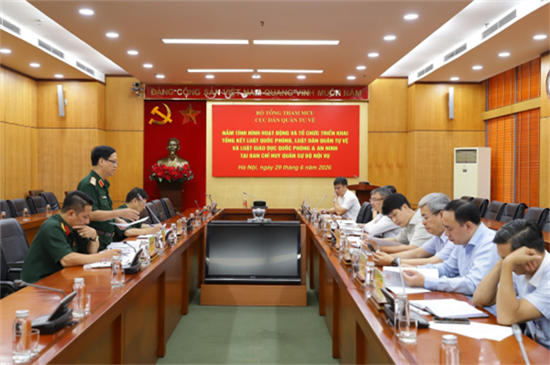 |
| The working group of the Ministry of National Defence works with MOHA's Military Command |
First and foremost, strengthen the leadership and guidance of MOHA’s Party Committee and leadership, as well as Party committees, and the heads of its subordinate agencies and units; foster a change in mindset and enhance the awareness and responsibility among officials, Party members, and employees regarding national defence and military affairs. In this regard, MOHA’s Military Command shall continue to advise and assist its Party Committee and leadership in guiding Party committees, Party organisations, and the heads of agencies and units to thoroughly grasp and strictly implement the resolutions and directives of the Party and the State, as well as the guidelines issued by the Ministry of National Defence concerning military, defence, and Fatherland protection tasks. Based on their assigned functions, duties, and practical circumstances, these entities are required to translate policies and requirements into concrete leadership resolutions and implementation plans that are scientific, appropriate, and feasible.
MOHA’s Party Committee shall coordinate closely with provincial and municipal Party committees to provide leadership, guidance, and direction to Departments of Home Affairs regarding national defence and military matters. Simultaneously, it should strengthen collaboration with various central-level commissions, ministries, sectors, the Vietnam Fatherland Front, and socio-political organisations, most notably the Ministry of National Defence and the Hanoi Capital High Command. Furthermore, operational regulations must be regularly reviewed, supplemented, and refined to clearly define the functions, duties, and working relationships of its military command vis-à-vis other agencies, ensuring a clear delineation of responsibilities and preventing both the overlap of duties and the omission of tasks. It is also necessary to bolster inspection and oversight, linking the responsibilities of key officials and heads of units to the outcomes of national defence and military tasks. These outcomes shall serve as a criterion for evaluating and classifying Party organisations, agencies, entities, officials, and Party members. Conduct timely reviews, summaries, and commendations, while diversifying methods to encourage, motivate, and honour organisations and individuals that excel in carrying out national defence and military tasks.
Second, enhance the capacity and quality of advisory work, as well as the leadership in implementing national defence and military tasks of MOHA’s Military Command and its junior levels. Given that these roles are held concurrently with other primary duties, the personnel involved are subject to frequent turnover, and many of them lack specialised training in military and defence affairs. Furthermore, following recent merger and acquisition, some newly designated personnel still show limited experience and capacity regarding advisory functions and the execution of assigned tasks. Consequently, the Ministry will continue to review and strengthen its Military Command Committee, both at the ministerial level and within individual agencies and units, ensuring that their structures and strength align with established regulations. Priority will be given to selecting individuals who possess strong political conviction, high sense of responsibility, proven professional competence, deep knowledge in military and defence matters, and the stability in their primary roles to undertake these additional responsibilities.
In parallel with organisational restructuring, MOHA will continue to coordinate with relevant authorities under the Ministry of National Defence to conduct training, professional development, and knowledge updates. This initiative aims to improve the advisory, managerial, and operational capacity for personnel serving in concurrent military roles, with a particular focus on the newly designated ones following recent structural adjustments. At the same time, it will enforce rigorous operational routines and protocols, ensuring consistent adherence to established procedures for briefings, meetings, and reporting, while fostering stronger coordination between the Military Command and other relevant agencies, units, and organisations. Additionally, the Ministry will accelerate administrative reform, the application of information technology, and digital transformation in management and operations, thereby enhancing the overall quality and effectiveness of implementing national defence and military tasks. Regular attention will be paid to researching and proposing appropriate policies, incentives, and benefits for members of the military command and those holding concurrent military-related responsibilities so that they are enthusiastic and do their best at work.
Third, closely integrate MOHA’s state management functions with the requirements for strengthening and consolidating national defence. The Ministry’s Military Command shall fulfill its advisory role and coordinate with relevant functional agencies to assist the MOHA’s leadership in reviewing, supplementing, and either directly or through submission to competent authorities issuing mechanisms, policies, and regulations within its scope of management. This is to ensure that the requirements for socio-economic and cultural development are aligned with the tasks of strengthening national defence and protecting the Fatherland.
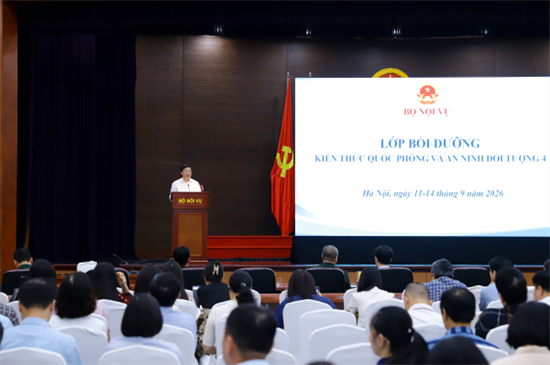 |
| Comrade Truong Hai Long speaks at the launch of a defence and security training for MOHA's cadres |
Emphasis must be placed on ensuring synchronisation between the organisation of administrative space and defence space, as well as between organisational structures, staffing levels, and the requirements for building defence forces and the capacity for mobilising resources, particularly in strategic areas, border regions, islands, and remote or far-flung areas. Closely coordinate with the relevant agencies of the Ministry of National Defence and other concerned forces to refine the regulatory framework governing the organisation, operations, standards, regimes, and policies for commune-level military command, the militia and self-defence forces, reserve forces, and other entities conducting national defence and security duties at the grassroots level. This must be aligned with the local government organisational model and the operational requirements for the new situation. Doing so will help ensure that local governments at all levels function seamlessly, fully exercise their state management responsibilities, and possess the necessary capacity to lead, command, manage, and mobilise resources within their respective authority across various defence readiness states without disruptions or gaps in the execution of national defence and military tasks.
Priority should be given to refining regulations on job positions, as well as innovating the processes for competency assessment, placement, utilisation, training, and professional development of cadres, civil servants, and public employees. Develop plans to supplement high-calibre human resources, meeting the requirements of state management during peacetime while ensuring readiness to undertake national defence tasks should the need arise. Accelerate the reform of salary structures, benefits, and policies for the armed forces within its scope of authority; revitalise emulation and commendation efforts to ensure they are substantive, timely, and accurately targeted, thereby fostering motivation in the execution of duties, particularly in training, combat readiness, combat support, disaster prevention and response, and search and rescue operations. Effectively implement policies for those who have rendered meritorious services to the nation, and intensify efforts to search, recover, and identify the remains of fallen soldiers to strengthen public trust, enhance social consensus, and build a solid “people’s hearts and minds posture”. Simultaneously, MOHA shall leverage its role of providing counsel and leading the implementation of administrative reforms, including the development of e-government and digital government to enhance governance capacity, data connectivity and sharing, and operational management in the digital environment. This will effectively support the direction, command, and handling of national defence and security contingencies in the new context.
Last but not least, build a robust self-defence force and enhance the quality of education and training in national defence and security. To make the self-defence force truly be the core in executing national defence and military tasks within agencies and units, MOHA continues to direct military commands at all levels to advise and assist the leadership of these entities in strictly managing personnel who fall within the age range for military service; review and refine the organisational structure and staffing of self-defence units to align with operational requirements. Emphasis is placed on strengthening Party organisations, enhancing leadership capacity and combat effectiveness, and ensuring the Party’s absolute and direct leadership over the self-defence force in all respects.
Concurrently, it will coordinate closely with local military authorities to conduct training thoroughly and in full compliance with established curricula. Emphasis should be placed on cultivating professional resolve, proficiency in the use of assigned weapons, equipment, and support tools, as well as the ability to coordinate and collaborate in protecting agencies and units, and addressing national defence and security contingencies in accordance with designated functions and duties. Furthermore, it is necessary to accelerate the application of scientific and technological advancements, particularly artificial intelligence and digital transformation, to support the leadership, command, and organisation of the self-defence force. Combat plans for the protection of agencies and units must be regularly reviewed and updated, with a strict maintenance of combat readiness protocols. Additionally, efforts should be directed toward mobilising and allocating resources to better meet standards, policies, and requirements, together with the procurement of equipment and support tools, thereby providing the necessary conditions and motivating the self-defence forces to effectively fulfill their assigned missions.
Regarding the education and training of knowledge on national defence and security, MOHA continues to direct the innovation of content, formats, and methods to ensure they are practical and tailored to specific target groups. It will direct the University of Labour and Social Affairs to innovate and enhance the quality of teaching and learning for the “National Defence and Security Education” curriculum. In light of organisational and personnel changes following the recent merger, the Ministry directs its agencies and units to focus on reviewing and classifying personnel, identifying specific training needs, and developing plans to organise training courses that are well-structured, appropriately targeted, and fully compliant with established content.
Driven by an innovative mindset, a strong political commitment, close guidance and leadership from MOHA’s Party Committee and leadership, and the proactive, responsible spirit of its agencies and units, especially its Military Command, it is expected that MOHA’s national defence and military affairs will become increasingly systematic and effective, contributing to strengthening the potential and posture of the all-people national defence and people’s security, while joining the entire Party, military, and nation in successfully fulfilling the mission of building and defending the Fatherland in this new era.
TRUONG HAI LONG, Deputy Minister of Home Affairs, Commander of the Ministry’s Military Command