Legal Affairs Authority and Military Legal Affairs Sector uphold tradition and build defence institutions in the new era of development
Over 50 years of establishment and development (25 September 1976 - 25 September 2026), the Legal Affairs Authority and the Military Legal Affairs Sector have gradually affirmed their strategic advisory role in the formulation, improvement, and enforcement of laws on military and defence affairs, contributing to raising the effectiveness of State management and maintaining discipline within the Vietnam People’s Army (VPA). As the country enters a new era of development, it is necessary to continue renewing thinking on legal affairs, improving the quality of staff work, and actively building defence institutions to meet the requirements of building a modern VPA and firmly safeguarding the Fatherland.
Alongside the process of building the VPA, strengthening national defence, and improving the State's legal system in the military and defence fields, the need to give advice and assistance to leaders of the Ministry of National Defence (MND) in exercising State management through law has become increasingly urgent. As early as 1948, within the Office of the MND, there was a section tasked with studying organisational principles from the legal affairs perspective. Since then, the legal affairs organisation within the VPA has been gradually established, consolidated, and developed to better meet the requirements of leadership, command, and State management over military and defence affairs through law.
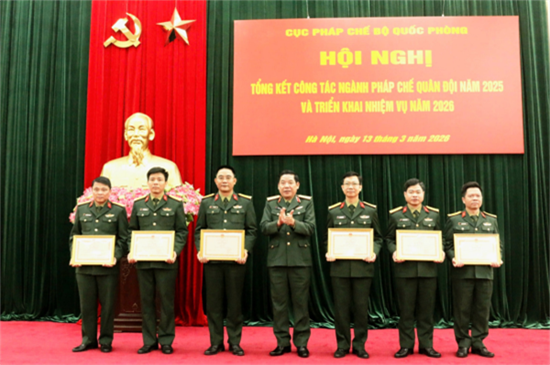 |
| Sr. Lt. Gen. Nguyen Van Gau, Deputy Defence Minister rewards individuals and organisations with brilliant achievements in building and perfecting laws on military and defence affairs in 2025 |
Half a century of establishment and development, affirming the strategic advisory role in military and defence law
On 25 September 1976, the Minister of National Defence signed Decision 284/QĐ-QP on founding the Legal Affairs Division under the Office of the MND. This marked the establishment of a specialised legal affairs organisation within the VPA, meeting the need to strengthen State management through law under the conditions of a newly reunified country and amid the new requirements of VPA building and defence consolidation. From its establishment, the Legal Affairs Division was assigned a range of important tasks, from proposing legal affairs plans and participating in drafting, amending, and supplementing legal documents, and systematising laws and regulations, to disseminating and popularising the law as well as monitoring law enforcement within the VPA.
The Legal Affairs Division, which initially had only five officers, took part in a comprehensive review and systematisation of laws and regulations on national defence and the armed forces issued between 1954 and 1976, proposing the amendment, supplementation, or repeal of inappropriate provisions, giving advice on the development of resolutions of the Central Military Commission (CMC) on strengthening discipline and socialist legality within the VPA, participating in drafting Chapter IV (Fatherland Protection) of the 1980 Constitution, and providing advice on compiling the volume “Law - Legal Affairs”, the first document used for legal education and teaching in the Military. These activities demonstrated that, from its early years, military legal affairs had gradually formed a method of providing legal advice closely linked to building the VPA, strengthening discipline, and institutionalising the requirements of Fatherland protection.
Together with the country's renewal process, the building of a socialist rule-of-law State, and more demanding requirements for State management through law, military legal affairs expanded in scope, gradually becoming more deeply involved in various stages of the law-making and law-enforcement process, from researching, reviewing, and systematising legal documents to participating in the drafting, appraisal, inspection, and enforcement of laws, carrying out legal dissemination and education, providing legal assistance, giving advice on the handling of legal issues arising in practice. As a result, the function of assisting the Minister of National Defence in exercising State management through law has become increasingly evident via direct, active participation in the process of policy formulation, legal improvement, and law enforcement in the military and defence fields.
Grounded on the Government's Decree 30/2004/NĐ-CP, dated 16 January 2004 stipulating the functions, tasks, powers, and organisational structure of the MND, on 9 August 2004, the Minister of National Defence signed Decision 110/2004/QĐ-BQP on the establishment of the Department of Legal Affairs of the MND on the basis of the Legal Affairs Division under the Office of the MND. This marked an important milestone in the development of the organisation, position, and functions of legal affairs: from a professional section under the Office of the MND to a specialised legal affairs body of the MND, which laid a foundation for raising the quality of legal advice and expanding its involvement in the drafting, appraisal, inspection, review, and enforcement of laws on military and defence affairs.
During the 2007 - 2020 period, alongside the requirements to improve the legal system and strengthen State management through law, legal affairs were expanded from the Ministry-level body down to agencies and units. On the basis of the results of piloting the establishment of three legal affairs boards and dedicated legal affairs officers at agencies under the MND, on 24 March 2016, the Minister of National Defence issued Decision 1111/QĐ-BQP on establishing 16 legal affairs boards within agencies and units. By 2020, the VPA had two legal affairs divisions, 16 legal affairs boards, 30 full-time personnel, and 142 part-time personnel. This network brought legal affairs from the Ministry-level body closer to grass-roots units, creating a link between legal advice and leadership, command, and task performance, gradually establishing a unified method of legal affairs from Ministry-level bodies to units.
During the 2021 - 2025 period, in response to the requirements of building an adept, compact, strong VPA moving towards modernity and improving the legal system in the military and defence fields, legal affairs continued to shift strongly towards raising the quality, proactiveness, and profundity of staff work. The Department of Legal Affairs and relevant competent agencies gave advice on the drafting and improvement of numerous legal documents in new areas of State management of national defence. The Department also coordinated with relevant competent agencies to assist the MND in submitting proposals to the Government and the Prime Minister and in reporting to competent authorities for submission to the National Assembly Standing Committee, resulting in the issuance of 29 decrees, 9 decisions, and 1 resolution. The scope of activities also expanded to international law and international cooperation in judicial and legal affairs, demonstrating that the capacity for legal advice increasingly became associated with new and complex issues arising in VPA building, defence consolidation, and international integration.
In 2025, the MND decided to re-organise the Department of Legal Affairs into the Legal Affairs Authority under the MND. This was an important step in its organisational structure, meeting the requirements for enhancing capabilities in research, staff work, and organisation of legal affairs in the new period. The re-organisation has prompted the Authority to promote its proactiveness, raise the quality of legal advice, and improve its ability to identify and address new legal issues arising in military and defence practice.
Half a century of establishment and development has forged the tradition of “absolute loyalty, steadfast adherence to principles, upholding the rule of law, creativity, solidarity” of the Legal Affairs Authority and the Military Legal Affairs Sector. This tradition has been crystallised through the persistent performance of the function of advising on law-making, steadfast adherence to principles, proactive handling of new issues, close coordination, and continuous enhancement of capabilities in each stage of development. It is both a spiritual value cultivated by generations of legal affairs personnel and a foundation for the Legal Affairs Authority and the Military Legal Affairs Sector to keep renewing and improving their task performance in the new period.
Proactively renewing thinking, elevating the quality of legal advice, building defence institutions to meet new development requirements
As the country enters a new era of development, the building of an adept, compact, strong, modern VPA and strong, modern all-people national defence, and Fatherland protection are imposing demanding requirements on legal affairs. New, unprecedented issues are emerging in relation to force organisation, science, technology, digital transformation, defence industry, resource governance, international integration, and new methods of Fatherland protection. Therefore, the Legal Affairs Authority and the Military Legal Affairs Sector must bring about a strong change in their thinking and methods of operation and shift from dealing with legal issues to proactively identifying, forecasting, and handling new legal issues at an early stage to truly become a strategic advisory force in policy formulation and the development and enforcement of laws on military and defence affairs. To that end, effort should be devoted to fulfilling the following requirements.
First, renewing thinking, elevating the quality of legal advice, proactively building defence institutions. In order to meet this breakthrough requirement, the Legal Affairs Authority and the Military Legal Affairs Sector must genuinely stay one step ahead in researching, identifying, and forecasting new legal issues arising from VPA building, defence consolidation, and Fatherland protection; they must provide advice at an early stage, from a long-term perspective, and right from the process of policy formulation. Emphasis should be placed on researching fundamental and long-term issues, changes in the strategic environment, and new development requirements of the VPA, in order to give advice on the promulgation of legal documents in the military and defence fields. The mindset of waiting for problems to arise and for shortcomings in legal documents to become apparent before amendment or supplementation must be completely overcome; there must be a strong shift towards proactively identifying issues, forecasting trends, and preparing legal foundations in advance for new requirements. Legal affairs research must be closely linked to practical review, theoretical research, reference to international law, and consultation with agencies and units directly performing tasks. Every policy proposal must clearly set out its political, legal, and practical foundations and must be accompanied by a comprehensive assessment of its impacts, resources, and implementation conditions. For new, complex, and unprecedented issues, independent thinking, forecasting capacity, and policy-making capability must be brought into full play to ensure defence and security requirements and a favourable legal framework for development. This will elevate legal affairs work from participating in the improvement of legal documents to participating in policy formulation, and from dealing with legal issues to proactively building institutions in the military and defence fields.
 |
| Preparations made by soldiers of Military Police Battalion 103 under Hanoi Capital Command prior to their duty |
Second, raising the quality of law formulation, improvement, and enforcement, ensuring that institutions are comprehensive, consistent, feasible, and effectively executed. It is necessary to grasp the requirement of placing policy quality at the centre and taking the effectiveness of law enforcement as the benchmark, while the drafting of legal documents and their implementation should be seen as two interrelated stages of a single process. In the process of giving advice on law-making, due attention should be paid to consistency, coherence, feasibility, and conformity with the particularities of military and defence affairs; overlapping, contradictory, or impractical provisions must be resolutely removed. The quality of inspection, review, systematisation, legal dissemination and education, and monitoring of law enforcement must be improved; great value should be attached to identifying inadequate provisions from practice and bottlenecks in implementation so that timely advice can be provided for adjustments. Mechanisms for receiving information from grass-roots level, results of handling violations, feedback from agencies and units, and management practices should be consolidated to correctly assess the effectiveness of policies and the quality of legal provisions. Each stage of the law-making and law-enforcement process must be linked to specific responsibilities, clear criteria, and substantive assessments; results of implementation should serve as an important basis for improving policies and laws. This will form a close and continuous process for law-making and law enforcement, in which laws are regularly tested, updated, and improved through practice. This also constitutes a specific requirement for realising the 13th Politburo’s Resolution 66-NQ/TW, dated 30 April 2025 on “renewing law-making and law-enforcement activities to meet the requirements of national development in the new era”, thereby contributing to enhancing the efficiency of State management through law in the military and defence fields.
Third, proactively institutionalising new lines and tasks, creating legal frameworks, mechanisms, and policies to meet the requirements of building a modern VPA and strengthening national defence in the new period. The Legal Affairs Authority must closely follow the Party's lines and viewpoints and the State's policies and laws on military and defence affairs and Fatherland protection, proactively research and identify issues that need to be institutionalised, particularly new lines and requirements, and provide timely advice on amending, supplementing, or promulgating regulations. Emphasis should be placed on issues directly related to adjusting the Military’s organisational structure, building an adept, compact, strong, modern VPA, strengthening all-people national defence, defensive zones, and civil defence, developing defence industry and military science and technology, managing borders, seas, and islands, digital transformation, artificial intelligence (AI), data, and other emerging fields affecting the cause of Fatherland construction and protection. Institutionalisation must be linked to the renewal of mechanisms and policies, with a focus on addressing practical issues, removing bottlenecks, and creating conditions for mobilising, allocating, and using defence resources effectively, ensuring consistency with the legal system, conformity with the particularities of military and defence affairs, and high feasibility. In this process, importance should be attached to consistency between immediate requirements and long-term orientations, and between the need for strict management and the creation of room for innovation, ensuring that every new policy or regulation promulgated genuinely addresses the issue at hand, avoiding general provisions that lack implementation mechanisms or are slow to be translated into specific regulations. This will enable the law to become a means of promptly transforming the Party's lines into unified mechanisms, policies, and action in the military and defence fields, maintain principles and discipline, and create a favourable legal space for innovation and development, thereby contributing to building a comprehensive, modern defence institutional foundation capable of meeting the requirements of Fatherland protection in the new era of development.
Fourth, building adept, compact, strong, professional, modern Legal Affairs Authority and Military Legal Affairs Sector, with a contingent of cadres capable of meeting the requirements of strategic staff work. The re-organisation of the Department of Legal Affairs into the Legal Affairs Authority under the MND is an important step in structure consolidation, creating favourable conditions for enhancing the capacity in staff work, direction, guidance, and inspection relating to legal affairs across the VPA. To meet the task requirements in the new period, it is important to continue consolidating the organisational structure of the Legal Affairs Authority and the Military Legal Affairs Sector in line with the building of an adept, compact, strong, modern VPA, clearly delineating functions, tasks, powers, responsibilities, and working relationships, ensuring unified, smooth operations, and eliminating overlapping or neglected tasks and the evasion of responsibility. Special importance should be attached to building a corps of legal affairs cadres, as they directly determine the quality of legal advice and the capacity to build institutions. Legal affairs cadres must be “both red and expert” and possess political steadfastness, pure ethics, strong professional expertise, good skills in research and forecasting, and a thorough understanding of military and defence practice and international law. The content and programmes of training and professional development need to be renewed towards greater practicality and specialisation, with timely updates on new legal issues; significance should be attached to building a contingent of legal affairs experts with capabilities in conducting independent research and giving advice on strategic, complex issues. A favourable environment must be created for legal affairs cadres to regularly develop through practice, enhance their capacity for policy review and analysis as well as inter-agency consultation and coordination. There should be mechanisms for detecting and utilising personnel with in-depth professional expertise. This will enable the Legal Affairs Authority to truly become a centre for research and strategic legal advice on military and defence affairs, fully capable of performing its functions and assigned tasks.
Fifth, renewing methods of operation, strengthening coordination, stepping up digital transformation, improving the effectiveness of legal affairs governance. Given the increasingly broad scope and complex nature of legal affairs, it is impossible to raise the quality of legal advice if activities remain closed, information is fragmented, and coordination is inadequate. Hence, it is vital to clearly define the responsibilities of the agency in charge of coordination, legal affairs bodies, and relevant agencies to ensure substantive coordination from policy research and document drafting to enforcement, inspection, and review. Legal affairs bodies must proactively coordinate with competent agencies, grass-roots units, research institutions, training establishments, and experts to fully mobilise information, expertise, and experience in support of staff work, and use practical data as a basis for identifying trends, bottlenecks, and legal risks so that they can be addressed promptly. Moreover, digital transformation must be accelerated throughout the entire work process; a unified defence legal database should be developed and updated to support legal search and review, law enforcement monitoring, and policy analysis. The application of AI should be studied to facilitate classification, comparison, detection of issues, and forecasting; however, this must be placed under the control of professionally qualified personnel to ensure information security and military secrecy. Renewing methods of operation must be geared towards the improved quality, timeliness, and effectiveness of legal advice, with a shift from the management and processing of fragmented information to interconnected, data- and knowledge-based legal affairs governance. This will enhance the capacity to synthesise, analyse, and provide information and propose policies, thereby promptly serving leaders of the MND in State management through law in the military and defence fields.
The half-century of establishment and development of the Legal Affairs Authority and the Military Legal Affairs Sector shows that, alongside the VPA’s development and the requirements of State management through law, legal affairs have assumed an increasingly important position in the process of building, improving, and implementing institutions in the military and defence fields. Entering a new period of development, the Legal Affairs Authority and the Military Legal Affairs Sector must strengthen solidarity, pay due regard to building a contingent of cadres with political steadfastness, a high sense of responsibility, strong professional expertise, and a thorough understanding of realities, raise the quality of staff work, and proactively address new issues to contribute to successfully fulfilling their functions and assigned tasks and develop themselves into an increasingly strong force capable of meeting the requirements of building a modern VPA, strengthening national defence, and firmly safeguarding the Fatherland in the new era.
Sr. Lt. Gen. NGUYEN VAN GAU
Member of the Party Central Committee
Member of the CMC
Deputy Minister of National Defence