To enhance its capacity to manage, design, and construct defence works in response to the requirements of strengthening the country’s defence posture in the new situation, the Defence Works Department (Engineer Corps) has identified the promotion of science and technology application and digital transformation as a breakthrough and achieved encouraging results.
The Defence Works Department, formerly known as the Works Division, was established on 7 November 1956. Over the past 70 years of building, fighting, and development, generations of its cadres, employees, and soldiers have consistently demonstrated initiative and creativity, closely linking research with practice. Through a process of implementation, research, review, and lessons learned, the Department has gradually mastered new technologies and successfully fulfilled all assigned tasks.
The Department has advised on the planning, surveying, design, and construction supervision of thousands of tunnels and tens of thousands of fortifications and defensive positions, together with networks of manoeuvre roads, crossing points, railway stations, airfields, and other facilities. These efforts have made an important contribution to ensuring combat readiness and consolidating and strengthening the country’s defence posture. Notably, the Department made outstanding contributions to the implementation of the project clusters “Research into technological solutions for constructing defence works for national defence, 1956–1975” and “Scientific and technological solutions for environmental protection and the construction of facilities for preserving President Ho Chi Minh’s embalmed remains, 1969–1975”. These achievements were recognised with the Ho Chi Minh Prize and the State Prize for Science and Technology. In recognition of its particularly outstanding achievements, the Department was honoured with the title of Hero of the People’s Armed Forces in 2005, three First-Class Fatherland Defence Orders, and numerous other prestigious awards.
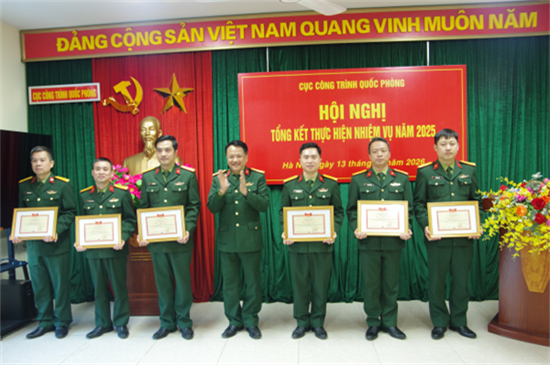 |
| Leader of the Department awards outstanding individuals of 2025 |
In recent years, the tasks of national construction and defence have evolved, placing new demands on defence works construction in terms of scale, quality, technical standards, schedule, safety, and confidentiality. At the same time, the rapid development of science and technology, particularly the advances associated with the Fourth Industrial Revolution, is transforming the methods, tools, and capabilities employed in the management, surveying, design, and construction of defence works. Fully recognising these requirements, the 2025–2030 Congress of the Party Organisation of the Defence Works Department identified a breakthrough priority: “Applying science and technology to defence works tasks and developing a database for the management of defence works.” This is intended to create a driving force for enhancing the Department’s capacity, quality, and operational effectiveness, thereby meeting the requirements of its tasks in the new situation.
To achieve this objective, first and foremost, the Department has strengthened leadership and direction and concretised the policies on developing science and technology, innovation, and digital transformation in a focused and targeted manner, closely aligned with its functions and tasks. Thoroughly grasping and implementing the policies of the Party, the Central Military Commission, and the Ministry of National Defence, particularly Politburo Resolution No. 57-NQ/TW, dated 22 December 2024, and Central Military Commission Resolution No. 3488-NQ/QUTW, dated 29 January 2025, on breakthroughs in developing science and technology, innovation, and digital transformation in the Army, the Department has formulated and promulgated a plan for breakthrough development in these areas within the Defence Works Department. The plan identifies the application of science and technology and digital transformation as key priorities to management and administration; the digitisation, standardisation, and exploitation of data in support of surveying, design, appraisal, and defence works management; research into and application of new materials, technologies, and technical solutions; and the improvement of standards, norms, and professional procedures. These efforts are intended to gradually establish a data-driven approach to management and administration, enhance technological self-reliance, and improve the quality and effectiveness of task performance.
Based on the approved plan, the Department Party Committee and its command have directed agencies and units to translate the plan into specific programmes and tasks suited to each field and section; assign responsibilities in accordance with the “six clear” principle, while strengthening inspection and supervision and using actual progress, quality, and effectiveness as the criteria for assessing the performance of agencies, units, and their leading cadres. At the same time, the Department has organised briefings and educational activities to raise cadres’ and soldiers’ awareness of the position, role, objectives, and requirements of applying science and technology and digital transformation. These efforts have helped establish a shared understanding and unified action, foster a spirit of innovation and creativity, and mobilise the collective strength for task performance. With this approach, the Department has gradually applied science and technology and digital transformation effectively to its assigned tasks. In 2026, it successfully fulfilled its responsibilities in coordinating and advising on the formulation and promulgation of legal normative documents and the system of economic and technical indicators for defence works; and participated in surveying and formulating, supplementing, and adjusting plans for defence works and combat facilities across the Army and nationwide, meeting operational requirements.
Second, the Department has stepped up data digitisation and standardisation and renewed its management and administrative methods. As the leading agency responsible for providing strategic advice and direction on defence works, the Department manages a vast volume of records, documents, and technical data accumulated over different periods and covering multiple fields, with stringent requirements for accuracy, consistency, and confidentiality. Accordingly, it has identified data digitisation, standardisation, and exploitation as a foundational task for accelerating the application of science and technology and digital transformation, gradually shifting from a management approach heavily reliant on dispersed records and documents towards data-driven management. Closely following higher-level guidance and directions while taking into account the practical requirements of its tasks, the Department has focused on standardising data and establishing unified rules for classification, identification, management, storage, updating, and exploitation. It has clearly defined the responsibilities of agencies, sections, and individuals, ensuring strict control throughout the process, from data selection, digitisation, and storage to management and exploitation, and strictly adhering to regulations on the protection of state secrets and relevant regulations of the Army.
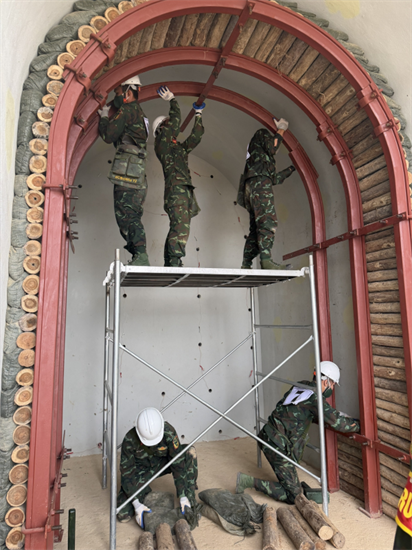 |
| The 2026 military-wide engineering contest |
Alongside these efforts, the Department has gradually developed data in a structured and systematic manner, ensuring that it can be linked, updated, and exploited, thereby addressing the problem of scattered records and information that are difficult to retrieve or require manual compilation. Once digitised, data are classified, organised, and managed according to specific task groups and types of records, serving relevant areas of work. On this basis, the Department is gradually establishing a shared data resource within the permitted scope, providing a foundation for improving the quality, speed, and accuracy of advisory work, management, surveying, design, appraisal, inspection, and task direction. Building on the established data platform, the Department has directed its sections, offices, and individual personnel to renew their working methods and practices, gradually developing the habit of exploiting and using digital data when preparing advisory content, retrieving information, compiling reports, and monitoring work progress. To date, the Department has digitised more than 25,000 documents and records, with over 86 per cent of tasks being conducted in the digital environment, making it one of the Engineer Corps’ leading agencies in digital transformation. This provides an important foundation for the Department to further develop its databases, expand the application of science and technology, and enhance the quality and effectiveness of its work in the new situation.
Third, the Department has stepped up research, application, and mastery of technology in the management and design of defence works. Defence works impose stringent technical and tactical requirements, while many projects are carried out in complex terrain and geological conditions and within confined spaces. Accordingly, the Department has determined that science and technology must be applied throughout the task implementation process, using technology to enhance accuracy, quality, and safety, while using practical experience to test, refine, and master technologies.
Accordingly, the Department has actively researched and selected technologies suited to specific tasks and stages, prioritising solutions that address the limitations of traditional methods, reduce manual labour, shorten implementation time, and improve quality. In surveying and design, emphasis has been placed on the application of positioning technologies, unmanned aerial vehicles (UAVs), specialised software, and digital data-processing tools. In construction supervision and direction, the Department has promoted specialisation and mechanisation and applied modern equipment to technically demanding stages of construction. At the same time, it has strengthened the deployment of cadres at construction sites to promptly address emerging issues and ensure strict compliance with technical procedures, safety requirements, and confidentiality regulations.
At the same time, the Department attaches importance to scientific research and encourages initiatives and technical improvements, focusing on addressing new, complex, and urgent problems arising from practical requirements. Through a systematic and scientific approach, the Department has now mastered the use of Real-Time Kinematic (RTK) positioning technology, unmanned aerial vehicles, and specialised software for surveying and design, as well as the New Austrian Tunnelling Method (NATM), ground anchoring techniques, and SVP steel-section temporary support systems, among others. Notably, the Department is currently working closely with relevant agencies and research organisations to research, design, and manufacture prefabricated arched field fortifications using new materials. The aim is to gradually translate research findings into practice, improving the quality and effectiveness of constructing fortifications and establishing defensive positions for combat-readiness exercises and operations when contingencies arise.
Fourth, the Department has built a workforce of technically competent cadres and employees with scientific thinking, gradually enabling them to master new technologies. The specific nature of the Department’s tasks requires its technical cadres and employees not only to possess strong professional expertise and capabilities in advisory work, project management, bidding, and appraisal, but also to demonstrate innovative thinking and the ability to access, apply, and master advanced technologies. To meet these requirements, alongside focusing on personnel development, planning, placement, and employment, the Department regularly reviews and assesses the capabilities of its workforce as a basis for developing appropriate training and professional development plans. To maximise effectiveness, it closely combines basic training with specialised professional development and foundational knowledge with updates on advances in science and technology through diverse forms of training. It also encourages participation in seminars and scientific exchanges on construction technologies, new materials, and innovative technical solutions. These efforts have gradually built a workforce of cadres and technical employees capable of accessing and mastering technologies and meeting task requirements.
In particular, the Department places strong emphasis on using practical work as an environment for training, developing, and strengthening the scientific and technological capabilities of its cadres. Young cadres are assigned to participate in new tasks and projects involving demanding technical requirements and the application of new technologies, under the guidance and mentoring of experienced cadres. This enables them to develop research capabilities, independent thinking, and the ability to identify and resolve problems, while accumulating practical experience and gradually maturing professionally. As a result, the Department has developed a workforce with specialised expertise, scientific and technological thinking, and systematic working methods, capable of accessing and applying new technologies and gradually mastering them. More than 87 per cent hold master’s degrees or higher, meeting both immediate and long-term task requirements.
Building on the traditions, achievements, and experience accumulated over 70 years of building, fighting, and development, the Defence Works Department will continue to promote its proactive and creative spirit, accelerate the application of science and technology, innovation, and digital transformation, and bring about sustained improvements in its capabilities in management, surveying, design, and construction. These efforts will contribute to consolidating and strengthening the country’s defence potential, defence posture, and defensive strength, thereby meeting the requirements of the mission of safeguarding the Fatherland in the new era.
Senior Colonel NGUYEN DUC TAI, Director of the Defence Works Department