Ensuring the adjudicative operations of Military courts during a national defence emergency
The adjudicative operations of Military courts during a national defence emergency encompass the acceptance, examination and resolution of criminal cases, together with judicial and military administrative activities conducted under the Criminal Procedure Code, the Law on the Organisation of People’s Courts, the Law on National Defence, the Law on States of Emergency and other relevant legislations. Research into measures to ensure that adjudication complies with the law and is appropriate to a national defence emergency is therefore of great importance.
The adjudication of criminal cases by Military courts follows the procedures prescribed by the Criminal Procedure Code for cases falling within their jurisdiction, including first-instance trials, appeals, cassation and reopening proceedings.
However, during a national defence emergency, these adjudicative activities are also governed by legislation on military and national defence affairs and other relevant laws. Emergency legislation concerning military and defence matters is comprehensive, drawing upon various legal instruments and regulating multiple spheres of social life and relationships. Its purpose is to mobilise the resources of the country and society to safeguard independence, sovereignty and territorial integrity and ensure national security.
In recent years, under the Party’s leadership, Vietnam has developed sustainably, maintained political and social stability, and ensured national defence, security, public order and safety, without facing an imminent national defence emergency. Nevertheless, the global and regional situation is expected to remain complex and unpredictable. Ethnic and religious conflicts, separatism, riots, political instability, intervention, attempts to overthrow governments, terrorism, localised wars, and disputes over territory and resources continue in several regions. National construction and defence have entered a new stage with more demanding requirements and, despite favourable conditions, numerous difficulties and challenges. These realities demonstrate the need for early and proactive preparation by agencies and units for a national defence emergency, including the adjudicative operations of Military courts.
Under Clause 2, Article 272 of the Criminal Procedure Code and Clause 8, Article 21 of the Law on National Defence, Military courts have jurisdiction over all offences committed in areas subject to martial law. This is among the most distinctive features of military criminal adjudication during a national defence emergency. Assigning this jurisdiction to military courts is appropriate because state administration in areas under martial law is entrusted to Military units.
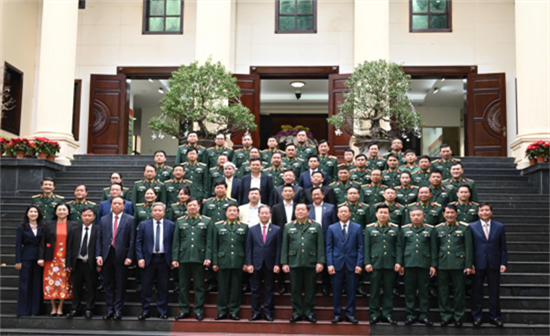 |
| Leaders of the People's Supreme Court and the General Department of Politics visit and work with the Central Military Court |
However, a review of current legislation shows that, beyond the general provisions of the Criminal Procedure Code, the Law on National Defence and the Law on States of Emergency, there is no specific legal framework or detailed regulation governing the operations of judicial, inspection and legal affairs agencies in general, or Military courts in particular, during a national defence emergency; nor have competent authorities issued detailed guidance. One major difficulty is ensuring sufficient personnel for military courts to handle a large caseload. Under current staffing rules, each Military court at military-region or regional level may have no more than six judges. During a national defence emergency, the number of cases is expected to rise considerably, especially in areas under martial law. Military courts would hear all criminal cases normally within the jurisdiction of people’s courts, requiring additional judges and court clerks.
Clause 3, Article 6 of the Law on States of Emergency assigns the Procurator General of the Supreme People’s Procuracy, the Chief Justice of the Supreme People’s Court, the Ministers of National Defence and Public Security, and heads of relevant ministries and sectors responsibility for issuing detailed rules and guidance on procedural decisions during a state of emergency. Such guidance has not yet been issued. Moreover, certain matters specific to emergency conditions require more detailed regulation, including priority use of expedited procedures, trials in the absence of certain participants, courtroom rules, models for criminal courtrooms during emergencies, and permission to use various terrains, locations and halls for hearings.
In our view, the following measures are necessary to ensure that Military courts can conduct adjudication effectively during a national defence emergency:
Firstly, to strengthen Party leadership over the adjudicative operations of Military courts. During a national defence emergency, Military court operations form part of judicial work and of political, defence and security duties under exceptional circumstances. The Party exercises leadership while respecting the principle that judicial power is independent and subject only to the law; it must not interfere in proceedings concerning individual cases in ways that undermine judicial fairness.
Accordingly, in addition to strictly observing the principle of “serving the public, upholding the law, and acting with absolute fairness and impartiality”, and the principle that courts adjudicate independently and obey only the law, military courts must rigorously comply with criminal procedure legislation during national defence emergencies. This will ensure consistency in legal application and coherence and feasibility under exceptional conditions. At the same time, sustained Party leadership is needed in the transfer, secondment and reinforcement of Military courts with personnel from people’s courts to hear criminal cases during martial law, giving priority to national sovereignty and the interests of the country and nation, and contributing to the protection of the Fatherland, the Party, the State, the Army and the People.
Secondly, to continue improving legislation governing Military court operations during a national defence emergency. With regard to criminal procedure, amendments to the Criminal Procedure Code should be studied and proposed to prioritise expedited procedures and permit trials in the absence of certain procedural participants during a national defence emergency. Provisions should also be added to allow the Chief Justice of a Military court to apply certain procedural arrangements differing from those ordinarily prescribed by the Criminal Procedure Code, where necessary to ensure adjudication under exceptional conditions without violating the principles of criminal procedure or the Law on States of Emergency. In addition, the Chief Justice of the Supreme People’s Court should be authorised to issue courtroom rules and emergency courtroom arrangements allowing hearings to be held in suitable terrain, locations and halls.
As for the Law on the Organisation of People’s Courts, amendments should allow Military courts, when the President declares martial law, to requisition judges, court clerks, premises and facilities of people’s courts in the affected areas for participation in military criminal proceedings.
On that basis, the National Assembly Standing Committee should issue a resolution establishing a coordination mechanism among the Ministry of National Defence, Ministry of Public Security, Ministry of Justice, Supreme People’s Procuracy, Supreme People’s Court and other relevant judicial bodies for criminal proceedings during a national defence emergency. Under this mechanism, the Ministry of National Defence and military judicial agencies would serve as the core and lead bodies conducting and administering proceedings, with other agencies coordinating their implementation.
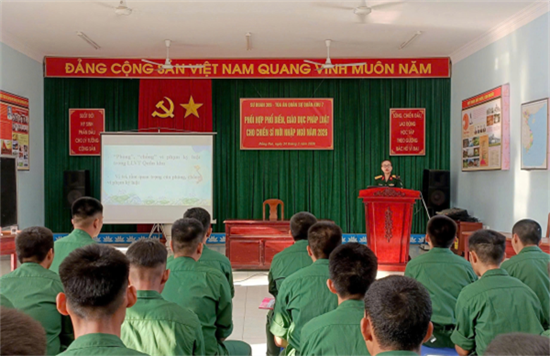 |
| Military Court of Military Region 7 conducts legal dissemination for troops of Division 309 |
Finally, to develop and improve coordination mechanisms among Military judicial, inspection and legal affairs agencies to ensure the quality of criminal adjudication. During a national defence emergency, Military units assume state administration in areas under martial law. Therefore, in addition to Military courts hearing all relevant cases, Military agencies would lead activities relating to crime prevention and control, handling violations, inspection and legal affairs. Because adjudication is the final stage in resolving a case, close and effective coordination among relevant agencies is essential. Specifically, inspection, investigation and procuracy agencies should coordinate in verifying reports and allegations of violations and crimes, transferring files showing signs of criminal offences for initiation of proceedings, investigation and prosecution, or returning them for administrative or disciplinary action as required by law. Investigation, procuracy and court agencies should coordinate in exchanging views and agreeing on reports to competent Party committees regarding approaches to handling disputed or otherwise relevant cases in accordance with Party regulations. Judicial agencies within and outside the Army, especially military and people’s courts, must cooperate closely in trying criminal cases under martial law. The potentially large number of cases and the transfer of case files, documents, suspects and defendants amid political and social instability, together with prisoner transfers and the application, replacement or cancellation of preventive measures, require coordination to avoid legal violations and other serious consequences.
Agencies should also coordinate closely in enforcing criminal and civil judgments, particularly in cases normally under the jurisdiction of people’s courts but heard by Military courts during martial law. In particular, judicial, inspection and legal affairs agencies must cooperate effectively in researching and advising the Central Military Commission, leaders of the Ministry of National Defence, Party committees and commanders of agencies and units, and local Party committees and authorities on issuing and implementing military and defence directives, legal dissemination and education, and the handling of violations and disciplinary matters.
In recent years, Vietnam has not had to declare a national defence emergency; consequently, there is no practical experience of Military courts trying criminal cases under such conditions. Furthermore, Vietnamese law has not yet established specific regulations or guidance for Military courts and the related judicial agencies in these circumstances. The issues discussed above are therefore drawn primarily from research, situational forecasts and reasoned extrapolation from Military court operations under normal conditions.
Further research is therefore necessary to develop the theoretical, legal and practical foundations needed to ensure that Military courts can adjudicate criminal cases promptly and lawfully in a national defence emergency, contributing to the protection of the Fatherland, the Party, the State, the Military and the People.
Lieutenant General, Dr. DUONG VAN THANG, Deputy Chief Justice of the People’s Supreme Court; Chief Justice of the Central Military Court
Colonel, MA. LE THANH BINH, Head of the General Research Division, Central Military Court