“Culture must light the way for the nation” - an overarching value and driving force for national development in the new era
On 24 November 1946, at the first National Cultural Conference, President Ho Chi Minh affirmed: “Culture must light the way for the nation”. Over the past eighty years, his thought has helped orient the cause of building Vietnamese culture and nurturing the nation’s spiritual strength in the struggle for liberation and in building and defending the Fatherland. In the new era, leveraging the value of that thought requires embedding culture deeply into social life, linking cultural development with building people, and strongly awakening endogenous resources and the aspiration to develop a prosperous and happy country.
From the ideological foundation to a new step in the Party’s awareness of culture
The Party’s guideline on culture was formed and developed through each stage of the revolution and has always been closely bound up with political tasks and the requirements of national development. The 1943 Outline on Vietnamese Culture established the principle of “National, scientific and mass-based”, laying the foundation for building a new culture. During the period of resistance and nation-building, culture contributed to awakening patriotism, consolidating the will for independence and mobilising the spiritual strength of the entire nation.
Through the renovation process, the Party’s awareness of culture has become increasingly comprehensive and profound. The Resolution of the 5th Central Committee (8th tenure) identified culture as the spiritual foundation of society, both a goal and a driving force promoting socio-economic development. Resolution No. 33-NQ/TW, dated 9 June 2014, of the Party Central Committee (11th tenure) and Conclusion No. 76-KL/TW, dated 4 June 2020, of the Politburo (12th tenure) continued to emphasise the requirement to build and develop Vietnamese culture and people to meet the requirements of the country’s sustainable development. The Documents of the 13th National Congress and the Party’s subsequent policies affirmed the central role of the human being, while setting out the requirement to leverage the strength of culture in association with the aspiration for national development.
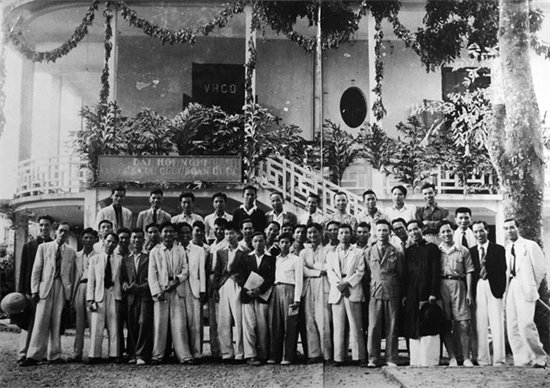 |
| Delegates attending the first National Cultural Conference in 1946 (Photo: tapchilichsudang.vn) |
The speech of General Secretary Nguyen Phu Trong at the National Cultural Conference (November 2021) also profoundly reaffirmed: “Culture is the soul of the nation, expressing the identity of a nation; if culture endures, the nation endures; if culture is lost, the nation is lost”. In other words, culture plays the role of regulating the development of society, helping human beings orient themselves towards the values of truth - goodness - beauty.
In particular, entering a new stage with Resolution No. 80-NQ/TW, dated 7 January 2026, of the Politburo (13th tenure) “On the development of Vietnamese culture”, the Party affirmed: “The development of culture and people is an important foundation and endogenous resource, a great driving force, a pillar and a regulating system for the country’s rapid and sustainable development”. The 14th National Congress of the Party continued to uphold this viewpoint: “...to leverage the strength of culture and people to become an endogenous resource and a powerful driving force for development”.
Thus, from the 1943 Outline on Culture to the present, the Party has made a profound shift in its thinking on culture, from regarding culture as a sharp weapon for national liberation (1943) to regarding culture as an endogenous resource for building and developing the country sustainably (2026). In that process, the Party has continuously inherited the “National, scientific and mass-based” character, while adding modern tools such as cultural industries and digital transformation in order to fully harness the potential and advantages of the nation’s culture for the country’s rapid and sustainable development.
Leveraging cultural values, consolidating confidence and the strength of great national unity
Culture is the very bond that links people with the community, fosters civic responsibility and nurtures the spiritual foundation for social consensus. Amid the multi-dimensional flow of information and the rapid expansion of cyberspace, cultural and moral values, together with the capacity to receive information, act as a compass that helps maintain confidence, filter out fake news and build a healthy social environment. For culture to truly leverage its value of “lighting the way”, comprehensive solutions need to closely combine “building” with “combating”, taking education and positive values as the focus; and to resolutely combat deviant behaviour.
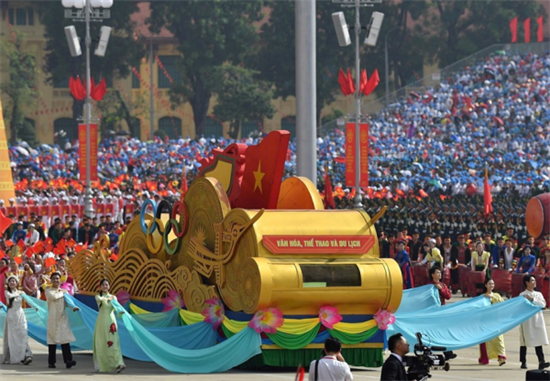 |
| Bloc of the Culture, Sports and Tourism Sector at the National Day Parade (Photo: qdnd.vn) |
First of all, it is necessary to persistently cultivate a healthy cultural environment within families, schools, communities, workplaces, organisations, and in cyberspace. The values of patriotism, compassion, honesty, responsibility, loyalty, and respect for the law must be transformed into concrete behavioural norms suitable for each living environment. Literary, artistic, journalistic, publishing and communication activities need to continue to leverage their role in orienting aesthetic taste, spreading good things, encouraging new factors and truthfully reflecting social life. Along with that, social trust must be fostered by the effectiveness of the political system, the quality of service to the people, public-service ethics and the responsibility to set an example. Every cadre and Party member, especially heads of organisations, needs to strictly implement the Party’s regulations and the State’s laws; stay close to the people, respect the people, listen to the people and take responsibility to the people. Building a culture of integrity, discipline and dedicated service is a practical requirement to consolidate the close-knit relationship between the Party, the State and the people.
In particular, the subject role of the people in creating, preserving and enjoying culture must be leveraged. The people are not merely the beneficiaries of service, but also the very subject that generates the vitality of culture. Favourable conditions must be created for communities, artisans, artists, intellectuals, enterprises, and youth to participate in heritage conservation, create new cultural products, develop cultural spaces, and spread positive values across digital platforms. When the right to access and enjoy culture is ensured equally among regions and social groups, culture will contribute to strengthening consensus, consolidating the bloc of great national unity and creating a solid social foundation for development.
Perfecting institutions, creating substantive changes in cultural development
In recent years, the Party and State have issued many important guidelines and policies aimed at creating changes in cultural development. Resolution No. 162/2024/QH15, dated 27 November 2024, of the 15th National Assembly, approving the investment policy for the National Target Programme on Cultural Development for 2025 - 2035, created a basis for concentrating resources and overcoming limitations in cultural institutions, human resources, heritage preservation and enhancing the people's access to culture. Resolution No. 80-NQ/TW of the Politburo (13th tenure) and Resolution No. 28/2026/QH16, dated 24 April 2026, of the 16th National Assembly “On the development of Vietnamese culture” continued to supplement important political and legal bases for the development of Vietnamese culture in the new stage.
The rollout of the National Target Programme must be executed synchronously and strategically, with focus and key priorities, aligning investment goals directly with efficiency and accessibility of the public. The tasks of developing people, perfecting cultural institutions, preserving and promoting heritage, developing human resources, arts education, digital transformation and cultural industries need to be concretised into implementation plans, clearly defining progress, responsibilities and output results. The implementation process must ensure openness and transparency, avoid scattered investment, and attach importance to operational effectiveness and sustainability after investment.
Alongside State resources, appropriate mechanisms need to be built to mobilise social resources and encourage enterprises, organisations and individuals to participate in providing cultural products and services. Socialisation must go hand in hand with ensuring the orientation of development, preserving heritage values, safeguarding the people’s right to access culture and the responsibility to protect public interests. The State plays an enabling role, perfects institutions, invests in essential fields and creates a favourable environment so that cultural subjects can leverage their creative capacity.
Renovating cultural governance is also an urgent requirement. The completion of the National Set of Criteria for Cultural Development and the deployment of the National Culture Index (V-Culture Index) mark a breakthrough shift in the governance method: from administrative management to “results-based governance”. In particular, the establishment of an independent group of indicators on Cultural and Creative Industries has affirmed progress in management thinking, namely the harmonious combination of heritage preservation with leveraging economic value, increasing employment and making a positive contribution to GDP.
The Index is expected to become a supporting tool in renovating governance, accelerating digital transformation and reflecting more clearly the role of culture in socio-economic development in the spirit of Resolution No. 80-NQ/TW, helping to transparently assess investment effectiveness, the growth momentum of the creative economy and the level of cultural enjoyment among the people.
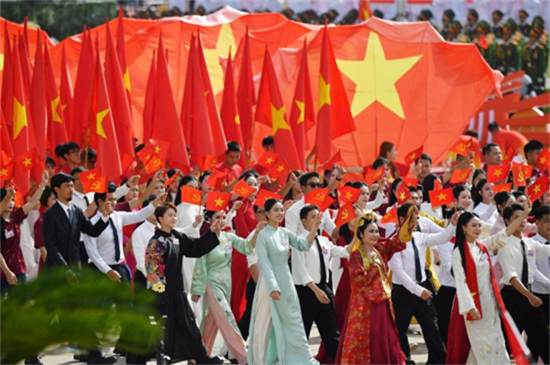 |
| Artists parade at the 80th Anniversary of the National Day (Photo: qdnd.vn) |
Key tasks in the new period
First, unify awareness and enhance responsibility for cultural development and human building. Continue to thoroughly grasp and concretise the Party’s policies and guideline on culture in the development programmes and plans of each sector, locality, agency and unit. Uphold the responsibility of Party committees, authorities and heads; link the task of cultural development with socio-economic, defence, security, and foreign affairs objectives. Overcome the perception that views cultural activities merely as short-term campaigns or temporary supporting tasks; attach importance to the long-term and persistent nature of human development and the cultivation of social values.
Second, build comprehensively developed Vietnamese people and create positive changes in the cultural environment. Link the education of revolutionary ideals, ethics, and lifestyles with the enhancement of knowledge, physical fitness, aesthetic sense and life skills. Leverage the roles of families, schools and communities; pay close attention to education in culture, the arts, history and heritage for the younger generation. Bring cultural values into public service, production, business and social conduct; promote exemplary roles, and encourage self-discipline, responsibility, and the consciousness of law compliance. Ensure opportunities for participation, creativity, and cultural enjoyment for the people, especially ethnic minorities and compatriots in remote areas, border regions, islands, and disadvantaged localities. Caring for cultural life must be linked with actual needs and community characteristics, while promoting the people’s role as the central subject.
Third, perfect institutions, mobilise and effectively utilise resources for cultural development. Continue to review and refine policies and laws, ensuring synchronism and suitability to the specific characteristics of cultural and artistic activities. Promptly resolve difficulties in heritage preservation, institutional development, human resource training, as well as the creation and dissemination of works; and improve the effectiveness of law enforcement on copyright and related rights.
Effectively implement the National Target Programme on Cultural Development for 2025 - 2035 and the promulgated mechanisms and policies. Clearly define objectives, timelines, responsibilities and output results; ensure openness and transparency; prevent losses and waste. Leverage the investment role of the State, while creating conditions to mobilise social resources in accordance with the law, ensuring community interests and the people’s ability to access culture.
Fourth, preserve and leverage heritage values in association with developing cultural industries and digital transformation. Place the community at the centre of heritage preservation and promotion; respect the historical value, authenticity and cultural space of heritage. Pay close attention to protecting forms at risk of fading away and support artisans in transmitting knowledge and skills; combine preservation with education, tourism and the creation of sustainable livelihoods. Develop cultural industries on the basis of responsible exploitation of cultural resources, promoting creativity and improving product quality and competitiveness. Strengthen connections among creators, training institutions, enterprises and the market; build brands and expand the distribution of Vietnamese cultural products and services.
Step up the digitisation, connection and sharing of cultural data; apply appropriate technologies in preservation, research, education and promotion. The application of artificial intelligence and new technologies must be linked with ensuring information security, protecting copyright and related rights, and maintaining the authenticity of heritage.
Fifth, develop human resources, make full use of talents and improve the quality of creativity. Renovate the training and refresher training of the contingent engaged in management, research, creation and the organisation of cultural activities. Attach importance to practical capacity, innovative thinking, digital skills and integration capability; strengthen the linkage between training and the demand for human resources.
Perfect the mechanisms for detecting, nurturing, utilising and rewarding talents in accordance with the specific nature of culture and the arts. Create conditions for writers, artists and intellectuals to create and contribute to the community; pay attention to the contingent working in traditional art forms and in fields that have difficulty attracting human resources. Encourage high-quality works with enduring vitality that reflect the historical and cultural depth as well as the reality of the country’s renovation.
Sixth, leverage the culture strength in international integration and defending the Fatherland. Proactively expand cooperation, selectively absorb the quintessence of humanity’s culture, and enhance the capacity to promote the image of Vietnam and its people. Link cultural activities in foreign affairs with tourism development, people-to-people exchange and national branding; promote the role of the Vietnamese community abroad in preserving and spreading the nation’s cultural identity.
Strengthen coordination between the Culture, Sports and Tourism sector and agencies and units in traditional education, building cultural life and caring for the spiritual needs of the people, cadres and soldiers. Leverage the value of revolutionary historical relics, museums, as well as literary and artistic works on the theme of the armed forces and the revolutionary wars. Consequently, nurture patriotism, consolidate confidence, strengthen military-civilian solidarity, and elevate a sense of responsibility for the cause of building and defending the Fatherland.
Eighty years after the historic teaching of President Ho Chi Minh, the thought “Culture must light the way for the nation” further affirms its vitality and timeless value. That thought needs to be vividly manifested in the quality of policies and the effectiveness of State management over culture, in order to awaken society’s creative resources and raise the substantive level of people’s spiritual enjoyment.
Under the leadership of the Party, the management of the State and the active participation of the entire people, the Culture, Sports and Tourism sector is responsible for continuing to bring strategic policies into practice and comprehensively leveraging the values of Vietnamese people. When these values permeate deeply into every aspect of life and become the foundation for action and development choices, the endogenous strength of the nation will be multiplied, contributing to building a prosperous, civilised and happy nation and firmly defending the socialist Vietnamese Fatherland.
Dr TRINH THI THUY, Deputy Minister of Culture, Sports and Tourism