Building a “smart, modern” Army Academy to meet its mission requirements in the new situation
With a deep understanding of its functions and assigned missions, the Army Academy continues to promote its heroic tradition and focus on building a “smart, modern” institution, worthy of being a leading centre for military education, training, and scientific research in the Vietnam People’s Army (VPA).
On 7 July 1946, following the directive of the Party Central Committee and President Ho Chi Minh, the Central Military Commission decided to open a Military Supplementary Training Course, marking the establishment of the Army Academy.
Over 80 years of construction, combat, and development, in spite of many changes in its name and stationed area as well as countless difficulties and challenges, generations of officers, lecturers, cadets, employees, and soldiers of the Academy have always upheld self-reliance, self-strengthening, solidarity, and creativity, striving for “good teaching, good learning, good scientific research, good service”, forging the tradition of “remaining steadfast, united, and creative, overcoming difficulties, fulfilling tasks”.
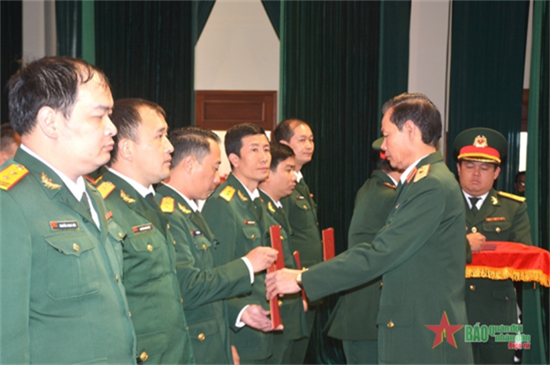 |
| Presenting certificates of graduation to cadets of a master’s degree course (photo: qdnd.vn) |
To date, the Academy has organised nearly 600 training courses for more than 58,000 command and staff officers at regimental and divisional levels from the infantry and other specialised branches of the VPA, together with thousands of officers for the armed forces of Laos and Cambodia. It has also trained thousands of doctors and masters of military science, holding 22 courses on advanced political theory for more than 4,000 officers. Graduates from the Academy across different periods have always promoted their role effectively and truly become the core force in combined-arms command and staff work at tactical and operational levels. Many of them have become generals, Heroes of the People’s Armed Forces, and top scientists and experts, holding important positions in the Party, State, and VPA.
Alongside cadre training and development, the Academy has placed special emphasis on scientific research, with hundreds of research projects at Ministry of National Defence and sectoral levels being successfully accepted and rated excellent; thousands of military textbooks and materials developed by the Academy have been applied for research, teaching, and training across the VPA. These efforts have significantly contributed to the development of Vietnam’s military science theory and art and the VPA’s training, combat readiness, and development process.
At present, the rapid development of the 4th Industrial Revolution creates opportunities while posing challenges in education and training for military schools in general, for the Academy in particular. In order to fulfil its heavy yet glorious mission, meet the requirements of educational reform and national development, and well perform the task of building a “revolutionary, regular, elite, modern” VPA in the new era, the Academy has been adopting various synchronised solutions aimed at comprehensively developing its potential and promoting innovation and improvement in education, training, and scientific research. To that end, it focuses on building a “smart, modern” institution as the basis for successfully completing both immediate and long-term tasks.
First, strengthening the leadership and direction of all-level party committees and commands over the building of a “smart, modern” Academy. The Academy continues to grasp and strictly implement resolutions and directives on education and training, particularly the 13th Politburo’s Resolution 71-NQ/TW, dated 22 August 2025, on breakthrough development in education and training, Resolution 290-NQ/QUTW, dated 7 January 2026, by the Central Military Commission on breakthrough development in education and training within the VPA, and the Action Plan of the military school system in response to the impacts of the 4th Industrial Revolution in the period of 2018 - 2020 and beyond. Doing so will enable all staff members across the Academy to fully grasp the necessity of renewing education and training and building a “smart, modern” institution, while leadership and direction by the Academy’s Party Committee and Board of Directors and all-level party committees and commands over this important task will be strengthened.
Given the very high requirements and initial results achieved, the Academy continues to develop action plans and programmes with clear, scientific, and highly feasible road map and solutions closely aligned with its functions and assigned tasks. It focuses on renewing leadership methods and action-orientated mindset, tightening discipline in task execution under the principle of “clear people, clear tasks, clear timelines, clear responsibilities, clear authority, clear outcomes”, promptly identifying and correcting shortcomings and weaknesses. While commending and replicating innovative, effective models and approaches in applying scientific and technological advances in task performance, it combats conservative thinking and reluctance to innovation. These efforts will help the Academy promote its overall strength and create breakthrough momentum for building a “smart, modern” institution and raising the quality of education, training, and scientific research.
Second, developing a contingent of cadres and lecturers in line with the criteria of a “smart, modern” Academy. Cadres and lecturers are the direct, core force in realising the goal of building a “smart, modern” Academy. Therefore, alongside developing these staff members’ political qualities, ethics, lifestyle, professional expertise, pedagogical skills, and command of foreign languages, the Academy places emphasis on improving their information technology competence and skills in using smart classrooms, interactive boards, simulation software, AI-assisted teaching tools, and learning management systems, and exploiting big data, as the basis for them to access and apply the achievements of the 4th Industrial Revolution in their teaching and work.
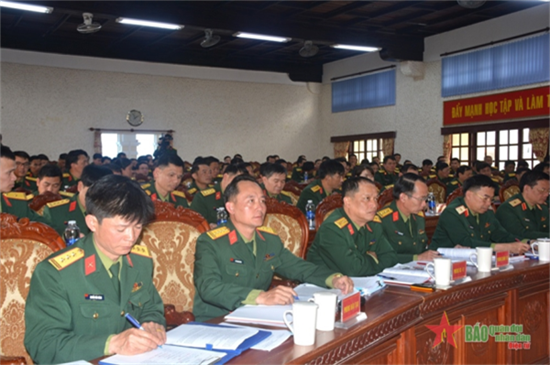 |
| A workshop on “building smart, modern Army Academy to 2030, with a vision towards 2045” (photo: qdnd.vn) |
In the coming period, the Academy will continue resolutely, persistently realising its training and development plans, closely combining planning, professional development, and training within itself with job rotation and practical assignment in units, properly selecting lecturers according to the criteria of a “smart, modern” institution, raising the quality of excellent lecturer contests at all levels. By the end of the term, over 95% of its lecturers and education managers shall meet the prescribed standards; 80% of them shall experience commanding and managing positions in units as required; 90% of its lecturers shall hold postgraduate qualifications (including over 30% with doctorates); 70% of its cadres and lecturers shall be equipped with advanced knowledge of digital transformation and IT skills. Each year, at least three lecturers or education managers shall be recognised as associate professors. Achieving these goals will allow the Academy to raise the quality of education and training and maintain its reputation as a “red address for cultivating the virtues and talent” of operational- and strategic-level officers.
Third, developing synchronous, smart, modern digital infrastructure. Building a “smart, modern” Academy requires significant investments in facilities and equipment, especially information technology systems. Therefore, the Academy continues to mobilise resources to upgrade and modernise its infrastructure and equipment, as the foundation for realising the building of a smart, modern institution. Priority is given to developing smart classrooms, simulation training centre, and national-standard data centre and upgrading military data transmission infrastructure and secure wireless transmission systems to meet the requirements of digital transformation in leadership, command, management, and administration. Surveillance systems for lecture halls, offices, and key areas is being completed; access control for people and vehicles is integrated with automatic attendance systems. A two-tier command, operation, and management centre continues to be developed in a synchronised, advanced manner to comprehensively facilitate management and command and meet the requirements of education, training, scientific research, and troop command.
In addition, to better meet the learning and research needs of its cadres, lecturers, and cadets, the Academy is completing a digital learning resource Centre, with a focus on developing a digital resource repository and digitalising textbooks and reference materials. Software systems are being developed to manage the learning resource Centre, enable remote resource discovery and transfer, and provide centralised management and search of materials. Modern technologies are gradually being applied and linked with authentication databases of users across the Academy, thereby allowing convenient access to IT applications and utilities.
Fourth, developing digital platforms, digital applications, and digital data. Digital platforms, applications, and data enable data integration, connection, and sharing between information systems on the military computer network, effectively serving the Academy’s activities. Therefore, the Academy directs its specialised agencies to adopt the web portal platform developed by Command 86 and customise it to the Academy’s needs on both the military computer network and the Internet. To improve its management, command, and operation efficiency, the Academy develops applications such as: system for synthesising and analysing data, and displaying specialised information, system for analysing data and displaying cybersecurity and network operation, command and operation information system, as well as document and workflow management software for electronic document exchange between the Academy’s affiliates and relevant agencies and units. This ensures timely leadership and command, facilitating communication, management, and report, scientifically managing tasks and schedules, tightly controlling work progress and quality.
To assist its lecturers in classifying cadets according to ability, designing proper teaching methods and content, assessing the quality of teaching, conducting online information exchange with cadets, and inspecting cadets’ learning results as well as to help cadets self-study, self-assess, obtain automated learning forecasts and warnings, and receive guidance on subject selection and learning pathways, the Academy directs its specialised agencies to research and propose smart and scientific educational software systems.
In order to implement the principle of “teaching, learning, and assessing results with substance”, the Academy promotes research and development of assessment and testing software integrated with automatic attendance systems and classroom surveillance cameras; it also develops software for managing question banks, exams, and grades, automatically analysing data and assessing training quality, evaluating input and output quality, and assessing question bank quality, thereby making appropriate adjustments. It aims to complete and effectively implement these systems by 2030. Besides, it regularly adopts and customises online teaching and learning platforms developed by Command 86 to suit the Academy’s needs, such as online teaching systems on the military network infrastructure through lecture hall and dormitory equipment and learning management systems facilitating full-cycle training management from enrolment to course completion. These approaches enable the Academy to monitor its cadets’ learning progress, create virtual teaching and learning environments, and foster interaction between lecturers and cadets in the process of assignment and support, while allowing cadets to track their learning progress and participate in online learning.
With the intellect and enthusiasm of all cadres, lecturers, and cadets, the Army Academy strives to achieve the criteria of a “smart, modern” school by 2030, contributing to building a “revolutionary, regular, elite, modern” VPA capable of firmly defending the Fatherland in the new situation.
Lt. Gen. DO MINH XUONG, PhD
Director of the Academy